


Lake Titicaca was another memorable once in a lifetime experience. We spent three days exploring its iconic sights and learning about its vital role in Inca culture. According to legend, the sun god’s offspring allegedly emerged from Titicaca’s depths to found the Inca Empire. These days it better known for its unique indigenous communities, such as the Uros people and their floating reed islands or the textile weaving Taquileños on the tranquil island of Taquile.
The reed islands were mind boggling. According to our guide, more than a thousand people live on these artificial islands floating in the lake’s thick totora reed marshes. The image below (that I’ve pulled from the web) gives you a good feel for this remarkable archipelago containing upwards of 60 islands. Our tour group visited one of these extraordinary structures on the way to Taquile.

As we glided into the reeds, I was surprised to see how close we were to Puno. As you can see below, the city’s hillside suburbs were always visible in the distance. I hadn’t expected these remarkable floating islands to be within sight of a major urban centre. It's incredible to think that the Uros have maintained their unique lifestyle for hundreds of years less than 5km from the hustle and bustle of modern life.


After weaving through reedy channels, we eventually "docked" at an island the Uros had converted into a tourism venture. Here we met some of the locals and experienced their aquatic culture first-hand. This included lessons on building and maintaining a floating island.
The islanders continually harvest and dry reeds to sustain their remarkable islands. As the bottom layer of reeds rots, they replenish the island’s surface with a fresh layer once or twice a month. Over time, these layers descend until they eventually become the island’s new base layer.
The Uros harvest reeds from the bed of the lake using a long underwater scythe-like tool. The reeds are then stacked and left to dry for a month or so. As a result, every island is dotted with conical stacks of drying vegetation. We saw them everywhere we went.


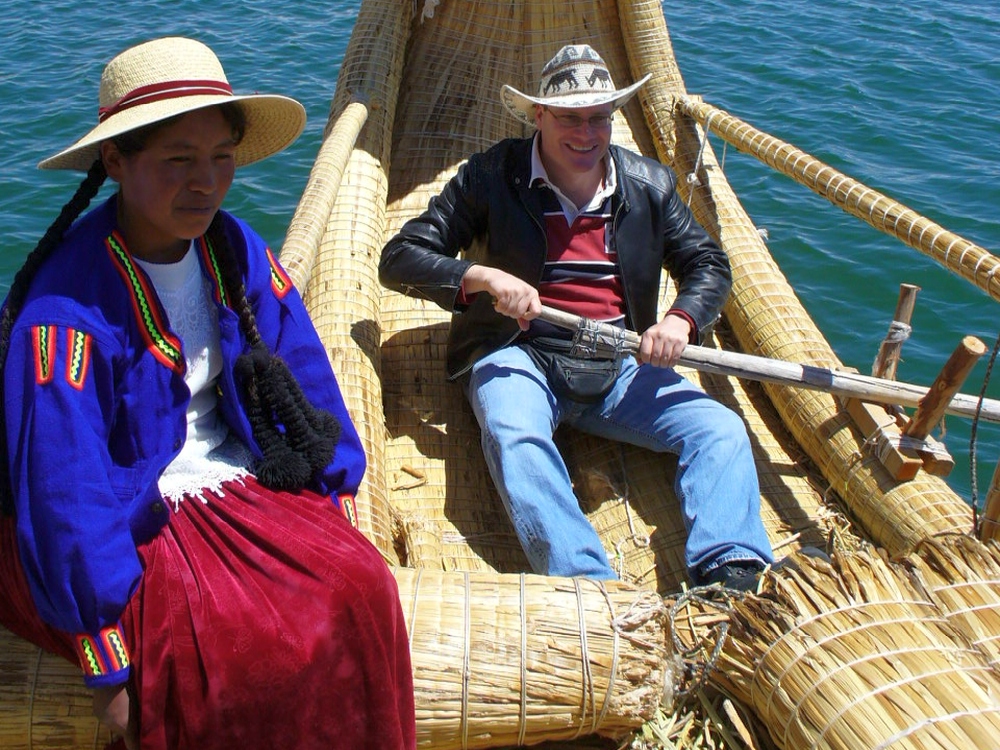
We also took a short ride in a traditional reed boat. They’re surprisingly sturdy, built from tightly bound “logs” of dried reeds. At one point, Garry and I were each handed an oar and invited to propel our boat silently across the lake. Yes, it was classic tourist gimmick.

Garry also bought a couple of cushion covers from the locals. You can see him scrutinising a final selection in the image above. We eventually bought two of the grey designs you can see. These now take pride of place, along with cushion covers from South Africa, on our leather sofas at home.


However, while the Uros island visit was fascinating, it did feel a little engineered at times. This made the island of Taquile, our next port of call, all the more special. From childhood every member of the Taquile community – famed for the quality of its textiles – learns how to create traditional handcrafts; the women and girls weave, the men and boys knit.
We found them to be reserved, but friendly folk. To their credit, they've preserved much of their traditional culture and customs despite daily visits of up to 800 tourists, and have done so without morphing into some formulaic tourist version of reality. It was with doubt one of the most authentic encounters we enjoyed during our entire time in Peru.


We climbed to the summit of the island on our first night and watched the sun go down. At 4000 metres, you think you're above the fray. However, as the sun sinks, it drops behind Andean mountain peaks lying beyond the horizon. At this moment, spectacular black shadows streak across the sky. We saw this phenomenon repeated one evening while in the Amazon, almost 4000 feet closer to sea level. Our group then spent the night with a local family in a simple, but functional, home stay annex located on an elevated ridge overlooking the lake.


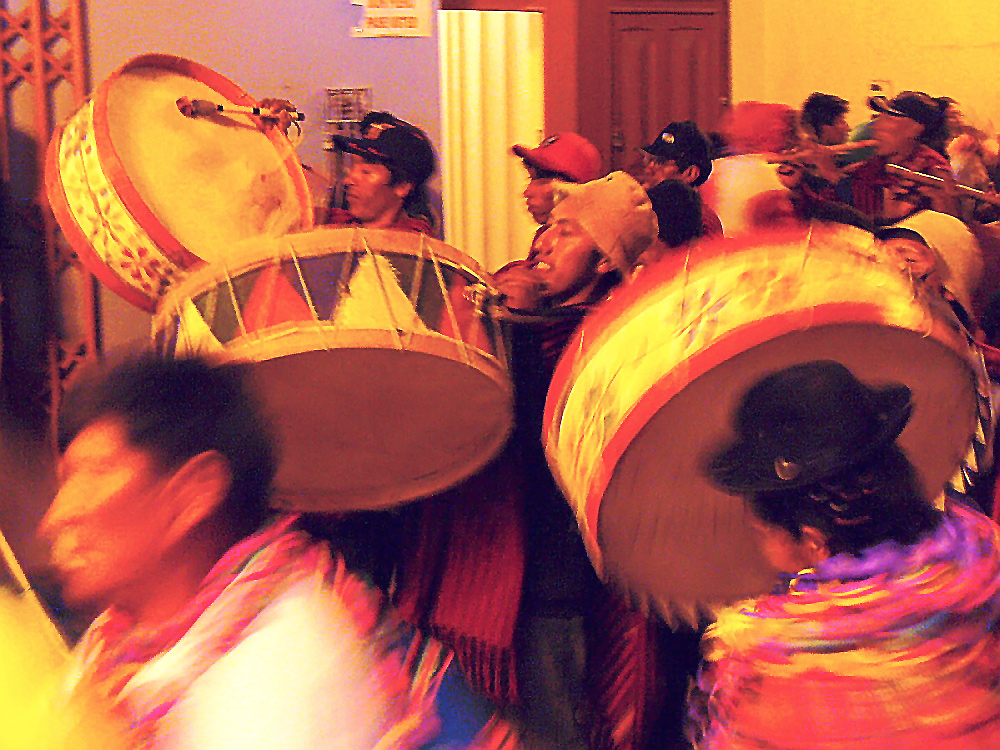

This festive crowd snaked through town for several hours, slowly passing down one narrow central city street after another. By chance, the parade route included a laneway outside the restaurant we'd chosen for dinner. As we dined, our group rose from the table, again and again, to stop and watch the incredible spectacle glide by outside.
The costumes were bright, loud, hand-sewn garments. Everyone, young and old, male and female, rotated and swirled through the cobblestone streets singing and dancing in time to flamboyant, local music blaring from trucks and houses. The entire evening was a stand out highlight during our time in Peru.

Join us on our next stop as we visit the heart of Inca territory.
No comments:
Post a Comment