Skoura is something special. This historic fertile oasis is home to more than 24,000 people. It’s filled with immense palm groves nestled among the confluence of several rivers and streams descending from the central High Atlas mountains. These ultimately converge into the nearby Dadès River. During our visit, most of its gravel stream beds were dry and dusty.
We stayed the night in a boutique hotel, where we enjoyed a spectacular sunset from its rooftop balcony. The following morning, we were met by a local guide who took us on a rambling 3km walk through the oasis as far as Amridil Kasbah, a local icon. We began our walk before sunrise while the locals were at their most active. The sun rose as we walked, bringing warmth and character to the barren landscape.
Our guide was excellent, pointing out quirky facets of daily life in the desert. For example, he explained how the land is divided into family plots; each one gets access to water diverted down irrigation channels once every two weeks. He talked about his own family plot where they grow barley. Others grow corn, beans and alfalfa (feed for the animals). Almost everyone grows and harvests dates.
Amridil Kasbah, a beautifully restored, fortified castle, was another highlight. It’s considered one of the most impressive kasbahs of its kind in Morocco and once featured on the Moroccan 50 dirham note. It’s still owned by a local family who live in part of the complex. We even met one of the family's sons on our way out. Our guide took us through the public areas, which we had almost completely to ourselves for almost an hour.
Incredibly, the entire structure is built from rammed earth or mud brick, with ceilings supported by locally sourced cedar timber, and a roof thatched using bamboo and palm. During our tour, we were shown the wooden forms used to construct its massive walls and geometric towers. The view from every doorway and around every corner was simply breathtaking. I’ll let my photos tell the story.
From Skoura we made our way back to the city of Ouarzazate. Here we briefly stopped to admire the exterior of Kasbah Taourirt, used as an embassy in the movie “Rules of Engagement” and for some scenes in Star Wars. Unfortunately, it’s currently closed for renovations following the 2023 earthquake. However, its external facade is an impressive sight.
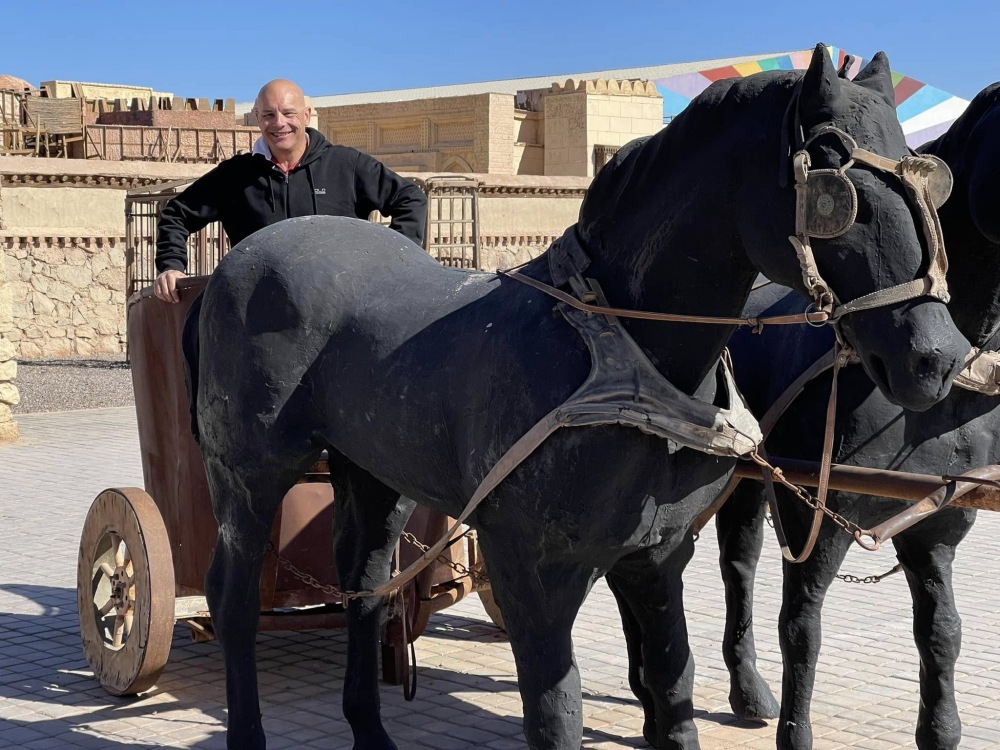
Ouarzazate is home to the Moroccan film industry. Two massive film studios sit on its outskirts. We took a guided tour through several sound stages at Atlas Studios. This includes village scenes that have appeared in movies such as Black Hawk Down, Star Wars and more. We also saw a set used to film the final season of Prison Break and sound stages used to simulate Egyptian, Chinese and Mongolian locations. It’s surreal to pass through a door and encounter Cleopatra’s temple, then turn a corner and discover a forest of scaffolding holding it all in place.
We then spent three hours driving back through the Atlas Mountains to Marrakesh. To celebrate our final night in Morocco, we shouted ourselves to a slap-up dinner at
Nomad, a top-rated North African fusion restaurant in the heart of the medina. We decided to try the mocktail float with our meal, a series of five colourful juice drinks, in place of alcohol that's traditionally restricted in this Muslim nation. Garry and I agreed the Orange, Carrot, Ginger and Turmeric shot was best, followed closely by the Avocado, Orange, Dates, Mint and Verbena shot.




No comments:
Post a Comment