Saturday, May 28, 2011

Sydney's version of winter

Winter officially starts five days from now.  Until this last week you'd have never known it.  Only a week ago I spend most of Sunday afternoon at the Sydney Cricket Ground (SCG) watching a football game and soaking up the sunshine in a short-sleeved shirt. However, the weather took a turn for the worse on Wednesday as a cold front brought rain, wind and rather cool temperatures.  Daytime temperatures dropped as low as 14°C and fell to 10°C overnight (much like an English Spring).  I even turned on the central heating  in the evening for several hours; the first I've felt such a need to since returning to Australia.

Today, after three days of inclement weather, we've woken to blue skies and dazzling sunshine.  The view from our balcony is simply sublime (see above). It's been made all the more inspiring thanks to Garry's hard work.  He took it upon himself to sand and re-stain the weathered teak bench on our balcony while I was in New York.  He's done a brilliant job, returning the grey lifeless wood to its former glory. We now have another cosy spot to sit, enjoy the view and contemplate life.

Sadly, the sunshine is forecast to disappear as another week of rain is on its way. I'm not sure whether to laugh or cry.  After two unusually cold winters in London we've returned to Sydney just in time to enjoy the city's wettest Autumn for more than 20 years. March was particularly damp. On March 19 alone, Sydney recorded its heaviest 24-hour period of rain for more than 27 years when 99mm fell. April then proved no better. The city received 206.2 mm of rain during the month, well above the historical average of 125.8 mm, making it the wettest April since 1999.

UPDATE: May 30
I read today that weather watchers are pedicting that May 2011 will be declared Sydney's coldest May for more than 40 years thanks to overnight temperatures falling well below their seasonal average.

Sunday, May 22, 2011

Seven flights; 38,000 kilometres; 12 time zones

I've just returned from three weeks on the road for business.  My travels have taken me to San Francisco, New York and Hong Kong; with a few quirky side-trips along the way.  In the days ahead I'll share four posts on the following topics; check back regularly for new links as they're activated:
For this trip I took advantage of the OneWorld Alliance's Circle Pacific fare.  As a result, I found myself flying Qantas to the USA, American Airlines to New York and then on to Hong Kong courtesy of Japan Airlines and Cathy Pacific. I can safely say that Japan Airlines has the best premium economy cabin, second only to that offered by Virgin Atlantic.  However, it was Qantas that pleasantly surprised me on both legs I flew with the airline.


First, en route to San Francisco, I found myself assigned a flat-bed seat despite travelling on a premium economy ticket.  Earlier this year the airline stopped providing a First Class cabin on this route.  However, the original seats remain in place.  As a result, some business class passengers find themselves notionally upgraded to these seats, which means that some Premium Economy passengers are assigned business class seats.  Hooray! 

Furthermore, the inflight entertainment system went on the fritz during the flight.  I wasn't too annoyed as I had a couple of magazines I wanted to read and was keen for a good night's sleep across the Pacific.  However, upon arriving home I discovered a $350 travel voucher from Qantas sitting in my mail pile apologising for the inconvenience.  That'll be a weekend away for Garry and I courtesy of Qantas.

Finally, was able to cash in some points for a business class upgrade out of Hong Kong and thus secured another flat-bed seat back home.  Even after accounting for these points I've still earned more this trip than I ultimately cashed in. Perhaps there is an upside to flying more than 38,00o kilometres in less than 20 days.

Friday, May 20, 2011

Ground Zero Redux


In few short months from now Americans will pause to remember the tragic events of September 11, 2001. As the tenth anniversary this year’s remembrance will carries greater significance than usual. With the date rapidly approaching, construction workers are laboring to complete a new national memorial at Ground Zero in New York. An accompanying museum will open next year on the 11th anniversary.

The memorial consists of two square waterfalls set within the footprint of twin towers. The waterfalls will cascade into the reflecting pools before finally disappearing into a gaping central void. Surrounding the waterfalls is a cobblestone plaza filled with more than 300 oak trees. The trees were selected from a 500-mile radius of Ground Zero in acknowledgment of the area directly impacted by 9/11.


When I visited Lower Manhattan last week I was surprised to see how much progress had already been made. The oak trees are already in place and the framework for bronze panels surrounding the memorial falls is rapidly taking shape. Elsewhere on the site construction is well underway for two high-rise towers, the first of eight new buildings and a new soaring transportation hub terminal.

By far the tallest of these is 1 WTC, formerly known as Freedom Tower. It will ultimately rise to 105 stories and stand 1776 feet high, taller than the North Tower of the original twin towers. Construction is well advanced. The framework has reached 68 stories, while the glass facade installation had reached the 40th floor. Nearby the memorial museum’s external façade is nearing completion. The foreboding, empty hole that once dominated Lower Manhattan is rapidly disappearing.


With the tenth anniversary approaching the recent news of Osama bin Laden’s death was all the more symbolic. As the architect of the most deadly foreign attack on American soil since the War of Independence his death had been long sought. He was ultimately killed on May 1 by a team of elite Navy Seals as I flew over the Pacific en route to San Francisco. This meant that I found myself in America as the media reacted to this cathartic milestone in the nation's history. For the next week every available news channel was inundated with mind-numbing analysis of Osama's life, his clinical death and the men ultimately responsible for his demise.

The saturation coverage bought back some stark memories. I still recall where I was when CNN first crossed live to New York shortly after the first plane struck the North Tower on the morning of September 11. I was sitting in Hong Kong hotel room at the time after returning from dinner with a work colleague.  I'd literally switched on the television moments earlier and was settling in for the evening. I distinctly recall watching the second plane fly into the South Tower live on air. Moments before impact I’d noticed its proximity to the tower, its presence seemingly unnoticed by CNN commentators. Within seconds the tower exploded and the rest is history.

A few days later I found myself flying home to Australia on what was to become Ansett Australia’s last flight from Hong Kong. As we flew through the night the airline went bankrupt. As a result, when the aircraft doors were opened in Sydney, the crew was greeted by news that their jobs had disappeared. It wasn’t until I arrived home that it dawned on me how close I’d come to being stranded in Hong Kong with worthless airline ticket. I consider myself privileged to be able to witness so many historic events in such a personal manner. I guess my job, despite its stress, has some unusual perks.

Wednesday, May 18, 2011

The Grand Bridge Encounter


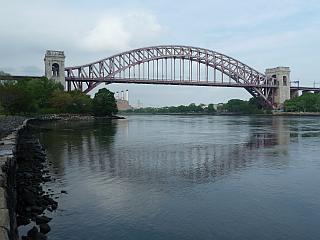
Some time ago I was told of a New York bridge which inspired the design of Sydney's iconic Harbour Bridge’s. For years I looked for the bridge each time I was in New York. It took several visits before, by chance, a taxi driver took me across the Triborough Bridge (recently renamed the Robert F Kennedy bridge) linking the boroughs of Bronx and Queens with Manhattan island. The Triborough bridge is a network of three distinct bridges and elevated highways that cross over Ward’s Island. The island that sits in the middle of the East River is nothing particularly noteworthy.  However, as you cross the island a perfectly formed, miniature version of the Sydney Harbour bridge comes into view.

This is the Hell Gate rail bridge which opened in September 1916 to carry a rail link from New York’s Central Station into the nearby New England states. Its stunning steel arch structure spans the East River for 310 metres, approached from both directions by a series of imposing elevated trusses. It was built to carry four rail tracks, two for passenger rail and two for freight.  Only three of these tracks remain in use today. Pedestrian use is no available anywhere on the bridge or its approaches.


The bridge’s design and construction were the brainchild of Gustav Lindenthal. Originally from the Czech Republic, he immigrated to the United States in 1874. His career as a civil engineer was soon boosted by demand for bridges able to handle the growing weight of American locomotives and their loads. John Bradfield, the man responsible for the Sydney Harbour Bridge, faced a similar challenge. By chance he came across the Hell Gate Bridge during a visit to New York in 1921.

Bradfield’s final design for Sydney, including its accompanying truss approaches, is almost identical to that of the Hell Gate Bridge. However Sydney’s iconic landmark spans 503 metres, carrying two footpaths, two rail tracks and eight road lanes across open water. When I finally saw Hell Gate Bridge up close last weekend the inspiration for Sydney’s bridge was all too clear. I almost felt at home.


Getting up close to Hell Gate Bridge provided more challenging than I’d anticipated. Pedestrian access to Ward’s Island is normally provided by a footbridge crossing from Manhattan Island, located at the eastern end of 103rd Street. However, I discovered that the bridge was closed for refurbishment, despite checking several websites the night before to ensure it was open and in use. As a result, I had to return to the subway and take the train north to 125th Street to use a footbridge on Triborough Bridge.

This unforeseen detour added at least another two kilometres to my planned walking route. In the end walked from Manhatten, around the base of Ward’s Island to the foot of Hell Gate Bridge before rejoining the footpath on the Triborough Bridge crossing into Queens. My final route covered more than eight kilometres, but offered some stunning views of upper Manhattan and the picturesque East River. The immediate area is home to at least half a dozen bridges, inspiring me to call my outing New York’s Grand Bridge encounter.


Over several hours I walked across two of the three bridges that make up the Triborough Bridge, viewed the Ward's Island footbridge from both sides of the river, photographed the Queensboro Bridge futher downstream and stood at the foot of Hell Gate Bridge.  Along the way I also used a pedestrian bridge that crossed a tidal swamp between Randall's Island and Ward's Island; and caught sight of at least two additional bridges that cross from Randall's Island into the Bronx. Those who know me well know I'm an avid fan of civil engineering works.  Therefore, as you can imagine, with so many bridges to explore I was as happy as pig in poo all afternoon!

Saturday, May 14, 2011

America's greatest sporting rivalry


One of the greatest rivalries in American baseball is that between the New York Yankees and the Boston Red Sox. Its origins lie in the sale of the Red Sox' star player to the Yankees in December 1919; a man who went on to become one of baseball’s record breaking legends. That man was Babe Ruth. He played just six seasons with the Red Sox before joining the Yankees. At the time of his transfer he’d just broken the single-season home run record, hitting 29 home runs, while Red Six had won baseball's World Series the previous year.

Babe Ruth's departure hit the Red Sox hard.  For the next two decades the team struggled to break away from a soul-destroying losing streak. In fact, it wasn’t until 2004, and again in 2007, that the team successfully won a World Series. Contrast this result with that of the Yankees. The team has won 27 World Series, most recently in 2009, making it the most successful team in American baseball history.


Last night I was lucky enough to see both teams in action at Yankee Stadium. I couldn’t have picked a better date to see my first live baseball game. The weather was relatively warm and still. My host had bought tickets that looked out over home base and the entire stadium. In fact, from the moment we caught the subway from Manhattan to the Bronx-based stadium, the entire experience was straight out of Hollywood.


The atmosphere in the stadium was electric. More than 48,000 people had poured into the recently rebuilt Yankee Stadium to watch the Red Sox defeat the Yankees by one run. Overhead a classic advertising blimp circled the field. This was once the Goodyear blimp. However these days it’s sponsored by Direct TV, a satellite cable network. Just like in the movies, vendors wandered around the grounds offering peanuts, beer and hotdogs. Naturally I ordered a couple of beers and a dog. Delicous.

Perhaps the most memorable aspect of the evening were the numerous rituals that make up American baseball. These include the crowd rushing to catch and keep each home run ball, a mid-field dance by ground staff grooming the dirt diamond between innings and an ever present giant scoreboard touting head spinning graphics and endless baseball statistics. I now know that the Red Sox’ fastest pitcher can throw a ball at more than 100 miles per hour.  Who knew!

Wednesday, May 11, 2011

Three hours in Canada


The mighty Niagara Falls straddles the border between Canada and the United States. The Falls consist of three separate water courses; the Horseshoe Falls, the American Falls and the Bridal veil Falls. During late-Spring more than 2,800 m3 of water per second plunges into the Niagara Gorge; with almost 90% of this volume passing over the Horseshoe Falls alone. As a result, the Horseshoe Falls are by far the largest and highest of the three falls. Here the Niagara River plunges more than 53 metres; spread along a 760 metre crescent-shaped span; the centre of which marks the international border.

I first visited the falls in October 1983. I still vividly recall the awesome sight of the Horseshoe Falls seen from the Canadian shoreline. Incredibly, an observation deck sits barely a metre from falls dramatic edge. Here you can clearly see the aqua green water flowing by, almost within touching distance. I was thrilled to discover last weekend that the same spot was still accessible to visitors. I can report that the humbling sense of awe you experience hasn’t dimmed in 28 years.


Equally enthralling is the dramatic cruise to the spray-drenched base of the Horseshoe Falls on the deck of a Maid of Mist boat. A 20-minute boat ride up the Niagara Gorge takes you past the boulder-strewn foot of the American Falls and on into the spray clouds that envelope the might Horseshoe Falls. It’s almost impossible to describe the sensation of looking up through the mist as an encircling crest of white water, high above your head, plunges into the abyss. Equally memorable is the moment of confusion you experience as rain suddenly seems to fall from the clear blue sky above. This is the moment the boat crosses into the shadow of the mist cloud rising perpetually above the Falls. Awesome!


On Sunday we started our tour of Falls from the American side; starting with a Maid of the Mist tour which departs from the base of the American Falls. We then crossed the 290-metre wide Rainbow Bridge into Canada to view the same Falls from the gorge’s opposite side. The international boundary can be identified by Canadian and American flags flying from the centre of the bridge. While in Canada, we stopped for a buffet lunch in the Sheraton Hotel. The restaurant was located a stunning 13 floors above the surrounding area. As you’d image, the view is simply spectacular.


After lunch I walked more than a kilometre along the gorge’s crest to the edge of the Horseshoe Falls before it was time to cross back to the United States. Both crossings of the border were faster than normal. Our tour guide attributed the light traffic to people staying home to celebrate Mother’s Day. The speed of our crossing gave us time to take a detour down the gorge to observe the Whirlpool. Here the Niagara River flows into a natural caldera whose curve sends the river swirling in a large arc that eventually crosses its original path. The result is a series of spectacular whirlpools and vortexes. Above the swirling waters a lone red cable car crosses the chasm. Our guide explained that passengers avoid crossing the border by taking the ride in both directions and thus never disembark.


Our day tour finished with a visit to Goat Island which separates the American Falls from the Horseshoe Falls. This was a real highlight for me. I never saw the falls from this vantage point in 1983. Here you can stand on the edge of the American Falls and watch an impossibly large volume of water pour into the gorge below. It’s almost as stunning as the Canadian Horseshoe Falls observation deck. I stood there for almost ten minutes trying to comprehend why anyone would intentionally want to take the plunge. To date, at least 15 people have done so. The first was Annie Edson Taylor, a 63-year-old Michigan school teacher. She went over the falls in barrel.

Tuesday, May 10, 2011

Niagara Falls

Wow! I've just had the most amazing day. Almost 28 years after my last visit I've returned to Niagara Falls. I booked a day trip from New York. The ticket included an airport pick-up from my mid-town hotel, flights to and from upstate New York, a six hour mini-bus tour around the American and Canadian falls and a buffet lunch at the Sheraton hotel located 13 floors above the Falls.

I couldn't have chosen a better day to go. Today is Mother's Day in the USA. As a result the crowds were relatively light, there were no queues at airport security, our flight landed ahead of schedule and the Canadian border crossing was swift in both directions. Even better, the weather was warm and sunny with picture-perfect blue skies all day.


In fact things were so slow today I even secured a helicopter flight over the falls for a 40% discount (It cost US$50 instead of the regular US$85 for a flight lasting roughly 15 minutes). Our guide also noted that our group of 15 was smaller than usual. Most weekends he takes up to 50 people on the tour.

With such a small group in tow our guide was able to schedule more activities today than usual. Our tour ultimately included a Maid of the Mist boat tour through Niagara Gorge to the base of the falls; a walk along the Canadian cliff tops to view the Canadian Horseshoe Falls (less than a meter from the edge); a drive along the gorge to the famous whirlpool gully and a leisurely walk on Goat Island where the American falls can be seen plunging over the cliff right at your feet. When I came here in 1983 as an exchange student we didn't have enough time to visit Goat Island so today's trip included at least one new memory.

Here's a few quick photos to wet your appetite until I'm able to download everything from my camera. Enjoy.

Friday, April 29, 2011

Royal wedding fever

Garry and I have been taking a trip down memory lane this evening as the wedding of Prince William and Kate Middleton is broadcast live around the world. The pair exchanged their vows before 1900 guests in Westminster Abbey - and a global television audience of two billion people - while another million people waited patiently on the streets of central London. Four out of five free-to-air channels in Australia broadcast the ceremony live; with at least four cable channel also providing live coverage.

So much of what we're seeing brings back personal memories. Where do I start?  For example, we recall the spectacle of the Royal Guard marching down The Mall during the Trooping of the Colour; and waving at the Queen as she rode by in an open carriage.  I also recall the colourful Union Jack bunting hung down the Mall every Spring and the sound of Westminster Abbey's stunning acoustics as the choir practised for an evening service.

However, perhaps our strongest memories are those from one sunny Sunday afternoon last September.  Literally days before Garry's appendix suddenly burst we toured the spectacular State Rooms inside Buckingham Palace. It's hard to believe those same grand rooms are now hosting a lavish wedding reception. While television cameras aren't permitted inside, so vivid are the memories of our tour, I can honestly picture the scene that's probably unfolding as I type this post. London really was our home for the last five years.


UPDATE: May 2, 2011
This fascinating royal wedding factiod was published by the BBC today:

The National Grid said its figures showed a huge surge in demand for power after the service - equivalent to one million kettles being boiled - when the royal couple returned to Buckingham Palace. Over the course of the day power use rose and fell during key moments - with the biggest drop in demand when the couple made their balcony appearance and people stopped what they were doing and turned back to their televisions.

I bet a similar surge in domestic water usage also occured after the wedding as well. We're clearly creatures of habit. 

Friday, April 22, 2011

Where did our savings go?


It’s been another remarkable week for the Australian dollar. Yesterday it rose to a new record high against the US dollar, for the third time in as many days. One Australian dollar now buys you US$1.075. Analysts are tipping that the dollar will hit US$1.10 before the year is out. The last time it traded at this level was 1982 before the currency was floated. It’s hard to believe that despite relocating back to Sydney I still live in a country whose currency is worth noticeably more than the US dollar.

While living in London we got rather use to the concept of earning money worth more than the US dollar. However, the Sterling was always a rare breed. In all of our travels the only other currencies trading at similar levels were in the Middle East, reflecting no doubt the power of an oil economy. For example, the Omani Rial is currently buying US$2.60 and the Jordanian Dinar is buying $US1.40. In ten days I fly San Francisco for work so the strong Australian dollar has made some impromptu shopping incredibly tempting.

Of course a strong Australian dollar spells more bad news for the savings we’ve left in the UK. Yesterday one British pound was buying A$1.52 for several hours before closing one cent higher. Incredibly the rate's been worse in recent months. While we were stranded in Antarctica the pound hit a record low of A$1.51 on New Year’s Eve. Regular readers will recall my lament over the plunging value of the pound. When we first arrived in the UK the pound was buying almost a dollar more than today. As a result Garry and I have simply decided to view our UK savings as a long-term currency investment as we wait for the Bank of England to start raising its base rate.

UPDATE: April 29
The Australian dollar climbed to yet another yesterday. It's now buying US$1.095. Most analysts expect it to reach US$1.10 before the end of next week.  Some analysts are now predicting the dollar will peak at US$1.15 before the year over.  It's hard to believe our dollar is worth 10% more than the US dollar.

UPDATE: May 2
Incredibly, the Australian dollar passed the US$1.10 mark this morning.  In less than a month the dollar has appreciated almost ten percent against its American rival.

Wednesday, April 20, 2011

La Nina is just the beginning

Autumn is finally upon us. As we head into a five-day Easter weekend (we have an extra day this year comes courtesy of ANZAC day which falls immediately after the regular public holiday) the forecast is for cooler weather and a chance of daily showers most days. Meteorologists say the regular bouts of rain we’ve had in recent months are a direct consequence of the latest La Nina phenomenon spreading across the Pacific. The same weather pattern has been fingered for the severe floods and cyclones Australia's endured this Summer.

I’ve also seen reports that claim Australia’s climate alternates between wet and dry phases every 20 to 30 years. Apparently we’re entering a new extended wet phase. I dread the thought that since migrating to Australia more than two decades ago I’ve enjoyed an unusually dry period that’s come to a screeching halt. Worse still, I could be all but dead by the time the weather starts to warm again.

Meanwhile in London the weather over Easter is forecast to be mainly sunny, with daytime temperatures equal to those in Sydney. In fact, its only the overnight temperatures that seem to be noticably lower. Maybe the weather wasn't so bad in London after all? I've already bought myself an IKEA throw rug to keep warm this winter.  Garry and I went to IKEA last weekend to return some surplus bookshelves we'd bought. As so often happens at IKEA, a trip to secure a $30 refund resulted in us walking out $200 poorer.  

Sunday, April 17, 2011

London life has its moments

We’ve just experienced the wettest April day in Sydney for more than a decade. It’s a timely reminder that life in Australia wasn’t as perfect as I’d often imagined while living in London. Since our return home people have been asking me if I miss the UK. While it’s true that I don’t miss the grey skies and drab sunlight of London, I do miss a few things.  Here's a list of things London really does better:
  • The extent and variety of reliable online shopping. Australian retailers are well behind the rest of the world.
  • The underground. Sydney trains are slow to load, always late and still use inflexible paper tickets. I miss my Oyster card.  I read today that Sydney's own Oyster card based system won't be in place until 2014.
  • Low-fat pesto. I never thought I’d miss Sainsbury’s home brand pesto. Sydney supermarkets only offer full fat varieties. However, on the flip side I'm please to have low-fat feta cheese back on the shelf.
  • Cheap European cars. While we were away Australia’s luxury car tax rose to 35% making an average European vehicle up to 50% more expensive.
  • More entertainment options.  Nothing bets the variety on offer in the West End any night of the week.  Sydney definitely has fewer cultural options on the go.