Garry's parents, Murray and Rhonda, have arrived safely in London this morning after more than 22 hours in the air. They report that Virgin Atlantic's new Premium Economy is genuinely as good as it sounds on paper. Rhonda's lower back also seems to have coped after some initial discomfort on the flight to Hong Kong. She's in good spirits.
Plans are already underway for a walking tour of London's more famous sights next week. I've quickly mapped out a route that covers Big Ben, Westminster Abbey, Buckingham Palace and Trafalger Square. We've also shown them how to get to Primrose Hill from our house. We thought this simple ten-minute walk might help to ward of the worst affects of jet-lag later today.
Friday, March 30, 2007


Wednesday, March 28, 2007
Counting down the days

The newspapers proudly announced today that Heathrow's new Terminal 5 opens for business in exactly one year. I've noticed that pseudo-public service updates like these are a popular news tradition in the UK. In November papers were heralding the final year countdown for the start of services on the Channel Tunnel high-speed rail link into Kings Cross/St Pancras. When you consider the reputed British passion for queuing such announcements almost make sense. Why not promote a lengthy wait and satisfy the nation's passion.
Those who know me well are familiar with my love for public works, especially large infrastructure projects. Sad as it may seem, I'm quite excited by the thought of being in London when the new High Speed rail link opens for business, or completion of Heathrow Terminal 5.
The new rail link will dramatically reduce travel time to Paris on Eurostar. Once the new terminal opens at Kings Cross, the journey will take no more than 2 hours, 15 minutes. Our house is less than ten minutes by tube from the new terminus, effectively putting Paris within three hours of our doorstep (including time for passport control and check-in). Earlier this month a Eurostar train ran into St Pancras for the first time. Regular services will start on November 14.
Having the Eurostar on our doorstep will make an incredible difference. It currently takes me about 1:45 hours to get home from the moment my plane lands at Heathrow. This means that door-to-door the train is the fastest form of transport for many European destinations including Brussels, Paris and much of France. Later this year a new high-speed rail link will open between Brussels and Amsterdam making it possible to reach the Netherlands in only 3.5 hours. A similar link in early-2008 will put Cologne in the same travel time range.
Terminal 5 is a massive undertaking. From March 30 next year this single building will process 30 million passengers a year, or about 40% of all people currently passing through Heathrow. I can't wait. The current facilities at Heathrow are among the worst in Europe. Air travel in this pass of the world is a definite step down from the new and spacious facilities I once used in Asia.
Plans are now in the making for the construction of a second terminal at Heathrow that will replace three other aging buildings. This second structure will support more than 30 million passengers annually when it opens shortly before the Olympic Games in 2012.
Those who know me well are familiar with my love for public works, especially large infrastructure projects. Sad as it may seem, I'm quite excited by the thought of being in London when the new High Speed rail link opens for business, or completion of Heathrow Terminal 5.
The new rail link will dramatically reduce travel time to Paris on Eurostar. Once the new terminal opens at Kings Cross, the journey will take no more than 2 hours, 15 minutes. Our house is less than ten minutes by tube from the new terminus, effectively putting Paris within three hours of our doorstep (including time for passport control and check-in). Earlier this month a Eurostar train ran into St Pancras for the first time. Regular services will start on November 14.
Having the Eurostar on our doorstep will make an incredible difference. It currently takes me about 1:45 hours to get home from the moment my plane lands at Heathrow. This means that door-to-door the train is the fastest form of transport for many European destinations including Brussels, Paris and much of France. Later this year a new high-speed rail link will open between Brussels and Amsterdam making it possible to reach the Netherlands in only 3.5 hours. A similar link in early-2008 will put Cologne in the same travel time range.
Terminal 5 is a massive undertaking. From March 30 next year this single building will process 30 million passengers a year, or about 40% of all people currently passing through Heathrow. I can't wait. The current facilities at Heathrow are among the worst in Europe. Air travel in this pass of the world is a definite step down from the new and spacious facilities I once used in Asia.
Plans are now in the making for the construction of a second terminal at Heathrow that will replace three other aging buildings. This second structure will support more than 30 million passengers annually when it opens shortly before the Olympic Games in 2012.
Monday, March 26, 2007
The Hilton is open for business
 Our guests will get their first taste of the tube on Friday
 Final preparations have been made for the arrival of Garry’s parents from Sydney. They arrive for six weeks on Friday. We’ve emptied drawers and cupboards in the spare room and Garry has spent time tidying the front yard. The spare room looks grand.
Earlier today we made a dash to IKEA to secure some new curtains for the spare room. Until now it's only had translucent blinds. However, the shift to Summer Time this weekend will make the room too bright for sleeping.
The crowds were crazy at IKEA. People were swarming every where and the roads were filled with slow moving traffic. Perhaps everyone has guests on their way? We eventually secured our curtains, along with a host of kitchen knickknacks from the marketplace hall.
Our Antipodean guests can expect showers on Friday with a high of 11C and an overnight low of 5C. Temperatures should rise again to 15C by Sunday, accompanied by sunny blue skies.
Sunday, March 25, 2007
The British Museum

In 1798, Napoleon's army landed on the African coach at Alexandria and proceeded to march towards Cairo. His army soon overcame the Ottomans, giving the French unfettered control of Egypt. The army set about building fortifications, including construction near the port city of Rosetta. It was here on July 15, 1799 that French Army captain, Pierre-Francois Bouchard discovered the Rosetta Stone.
The stone is scribed with a decree from Ptolemy V repealing taxes and ordering new statues to be erected in local temples. The inscription in two Egyptian languages and classical Greek enabled scholars to previously untranslatable hieroglyphics. Today, the Rosetta Stone sits in the British Museum in London. It arrived in England in 1802 shortly after the British Army successfully routed Egypt’s French invaders.
This afternoon Garry and I finally got to see the Stone for ourselves. We’d previously seen a replica in Cairo, donated by the British Museum in 2005. The Rosetta stone sits just into the main Egyptian hall of the British Museum. It’s easy to spot. Just follow the crowd.
The stone is scribed with a decree from Ptolemy V repealing taxes and ordering new statues to be erected in local temples. The inscription in two Egyptian languages and classical Greek enabled scholars to previously untranslatable hieroglyphics. Today, the Rosetta Stone sits in the British Museum in London. It arrived in England in 1802 shortly after the British Army successfully routed Egypt’s French invaders.
This afternoon Garry and I finally got to see the Stone for ourselves. We’d previously seen a replica in Cairo, donated by the British Museum in 2005. The Rosetta stone sits just into the main Egyptian hall of the British Museum. It’s easy to spot. Just follow the crowd.

The building’s newest addition is a stunning covered atrium known as the Great Court. It was opened in 2000. Effectively, an enormous glass dome covers the Museum’s former courtyard transforming it into Europe’s largest covered square. The sensation of space and light is stunning. A truly spectacular public space.

The British Museum boasts the largest and most comprehensive collection of ancient Egyptian artifacts outside of Cairo. It also has an impressive collection of Greek items, including an extensive selection of marble sculptures from the Parthenon. These stunning relief sculptures of horsemen and warriors are also known as the Elgin Marbles. They were named after the 7th Earl of Elgin who controversially shipped them out Greece in 1806. The Greek government has been trying to have them return ever since. At times the British Museum feels more like a dodgy collection of stolen goods.
Today’s trivial fact de jour? The Parthenon’s current state of ruin isn’t a result of ancient decay. It was destroyed in 1687 when a gunpowder store inside was set alight by an enemy bombardment. It’s hard to imagine an ancient monument was used as a munitions dump. Who says history is dull?

Saturday, March 24, 2007
You're not who you say you are

I have a confession. I was born in New Zealand. I first left the country at the age of 17 and lived for a year in the USA as an exchange student. I returned home to study at University, then moved to Australia where I spent the next 16 years in Sydney.
I’ve effectively spent my adult life living outside of New Zealand. As a result I consider myself an Australian who was born in New Zealand. Such a distinction is understood and commonly accepted in Sydney. Even Russell Crowe is one of us. I travel on an Australian passport, speak with an Australian accent and own Australian property.
However, since arriving in London I’ve found myself described as a Kiwi time and time again. Beyond Australia’s borders the concept of an Australian born in New Zealand doesn’t exist. From a British perspective your place of birth defines you, not your place of last residence or personal identification.
Somehow I’ve become a stranger in my own body. I feel like an Australian and consider myself an Australian. Yet for the first time in my adult life everyone wants to make me be somebody else - a person that isn’t me. I'm expected to know when the Kiwis are playing cricket and care about the fate of the All Blacks. I don't. Friends and work colleagues can’t understand the problem. “You were born in New Zealand, you must be a Kiwi.”
I don't dislike New Zealand. I'm not ashamed of my birthplace. However, its not a place that feels a part of me. To have my identity reassigned without my consent or consultation has been a most surprising and unexpected consequence of relocating to London. I feel as if some part of me has been stolen.
More than 460,000 Kiwis currently live in Australia, almost one in ten New Zealand citizens alive today. Another 200,000 live in Britain. I wonder how many of them have also lost their identity?
I’ve effectively spent my adult life living outside of New Zealand. As a result I consider myself an Australian who was born in New Zealand. Such a distinction is understood and commonly accepted in Sydney. Even Russell Crowe is one of us. I travel on an Australian passport, speak with an Australian accent and own Australian property.
However, since arriving in London I’ve found myself described as a Kiwi time and time again. Beyond Australia’s borders the concept of an Australian born in New Zealand doesn’t exist. From a British perspective your place of birth defines you, not your place of last residence or personal identification.
Somehow I’ve become a stranger in my own body. I feel like an Australian and consider myself an Australian. Yet for the first time in my adult life everyone wants to make me be somebody else - a person that isn’t me. I'm expected to know when the Kiwis are playing cricket and care about the fate of the All Blacks. I don't. Friends and work colleagues can’t understand the problem. “You were born in New Zealand, you must be a Kiwi.”
I don't dislike New Zealand. I'm not ashamed of my birthplace. However, its not a place that feels a part of me. To have my identity reassigned without my consent or consultation has been a most surprising and unexpected consequence of relocating to London. I feel as if some part of me has been stolen.
More than 460,000 Kiwis currently live in Australia, almost one in ten New Zealand citizens alive today. Another 200,000 live in Britain. I wonder how many of them have also lost their identity?
Snow! What about Spring?
 Blossom smothers a neighbourhood tree
 We've been experiencing a cold snap for a week now. Last weekend I went walking a friend along the Thames Path toward Greenwich. Our 20 minute walk started in warm sunny weather and finished in the midst of bitterly cold wind with snow flurries. Since then we've had several light flurries during the week with temperatures plunging as low as 2C. So much for Spring!
The warmer weather returns next week with temperatures climbing as high as 18C. I'm sure the squirrels are confused. Winter this week, Summer the next.
Thursday, March 22, 2007
More kulture coming
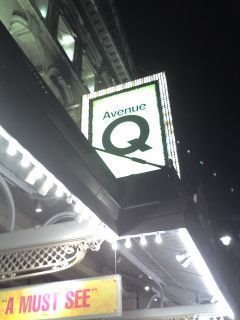
With our many family visitors almost upon us, we've been booking tickets for plenty of live theatre. London is full of theatre. It's staggering how much is on offer. The West End alone has more than 50 productions live every day, competing against an equal number of active fringe theatres.
Over the next few months we're off to see:
- Boeing, Boeing- a classic comedy that's been revived on the West End. I recall first hearing of this play while at school in Morrinsville, New Zealand. The local amateur theatre group staged a production in its aging Little Theatre. I never saw it but a story involving commercial airlines captured my imagination and has remained with me ever since.
- King of Hearts - another comedy that explores a world in which the future King of England wants to marry a Muslim bride. I'm sure it'll have its moments of controversy. It's on at our local theatre literally five minutes walk from home.
- Dame Edna Everage - we've scored tickets to watch the taping of Dame Edna's new television show on ITV1. This should be a unique experience watching the show come together, sharing outakes and witnessing moments that never translate well on to the small screen. I've not seen a television show taping for ages. I recall taking my parents to see a live Australian lunch time talk show go to air many years ago. Bananarama were guests at the time.
It looks like we got plenty of laughs ahead of us. I've also booked my parents tickets to see The Mousetrap. The show must go on.
Hit me! 3000 times!
 London Eye at night from our bedroom window
 Swiss Cottage hit another milestone today. The blog clocked up its 3000th hit. Amazing! The first 1000 hits took seven months, the second thousand only four months and the last thousands barely three months. Who are these people? At the current rate the site will receive close to 6000 visitors in 2007.
The original purpose of this blog was to capture the adventure we're having in Europe, while describing what it's like to live in Europe. I worry that as time passes I'll lose my foreign observer's eye. It's only natural that daily differences will eventually become the norm. I'd hate for this to become just a blog about life as usual. The world's got to be more interesting than that.
I've decided to expand the scope of the blog in future to include memories from past travel adventures. I've been traveling internationally since leaving home at the age of 17. At the time I was an exchange student in Syracuse, a city in Upstate New York. My teenage adventure kicked off a history of wanderlust that continues to this day. Come August we'll visit Mexico and I'll clock up my 50th country. It's time to capture some of these travel memories and liberate thousands of photos stored in shoe boxes around the house.
Look for stories about my trip to Easter Island, climbing the Rock of Gibraltar, sliding down the Great Wall of China, stalking leopards in Africa and cruising the islands of Tahiti. I've been lucky to have seen so much of the world in the last 25 years. It helps that my job enables me to revisit much of it every year. Hopefully these new posts will inspire a few mystery web friends to explore more of the world as well.
Monday, March 19, 2007
75 years old? It's a baby

The Sydney Harbour Bridge was closed today for a public walk-over. The event celebrated the 75th anniversary of the bridge's opening. Australia's festivities made me wonder which was London's oldest surviving bridge.
The oldest bridge across the Thames River in London is Westminster Bridge. This wrought iron bridge was opened in 1862, replacing an even older structure that opened in 1750. The bridge sits along side the House of Commons in the Palace of Westminster. The first bridge on this site was the second Thames crossing built in London. It's remarkable that there was only one bridge crossing the river until the mid-1700s.
Previously the oldest bridge had been London Bridge, built in 1831. A bridge has been situated in this area for almost 2000 years. The current bridge was opened in 1973. Its predecessor was famously sold to an American millionaire, disassembled and shipped to Arizona. The resurrected bridge is now the centrepiece of a planned community called Lake Havasu City.
Congratulations Sydney Harbour Bridge. You'll be old once you reach 145 years of age.
Saturday, March 17, 2007
The glory of the empire
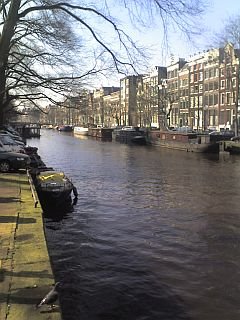
I was back in Amsterdam this week. I love visiting. I defy anyone to despise Amsterdam's picturesque canals lined with 17th Century merchant houses. The glory of an old sea-faring empire is still very much alive. I stayed a night in the Renaissance Hotel which sits in a quiet cobbled stone laneway, literally metres from Singel, one of Amsterdam's famous canals. The hotel has one of the city's more unusual conference centres, built in the shell of a 17th century, brick domed church.
While in town I attended a meeting inside one of the city's grand merchant homes. We met over lunch in a high-ceiling drawing room, complete with crystal chandelier and beautifully restored painted walls depicting rural landscapes from the 1600s. It was one of those moments when I'm reminded how special my job can be.
I was in town mainly as a keynote speaker for an industry event in Amersfoort, about 40 kilometres from Amsterdam. My presentation on the rise of online social networks and the immersive internet was warmly received by more than 110 industry peers. My host was Hans Appel, a delightful man, with a generous, playful spirit. With more than 30 years in the IT industry he's something of a local icon.
Tuesday, March 13, 2007
The proud Australians

Headlines this weekend were dominated by the much delayed completion of the new Wembley stadium. Late on Friday, Australian developer Multiplex officially handed over the stadium’s keys to the Football Association. If all goes well this year’s FA Cup final will return to Wembley in May after an absence of five years.
The stadium’s completion had originally been scheduled for January last year. In 1995 when planning first began, it had been hoped the stadium would open in the Summer of 2005. However, a series of delays and cost overruns have plagued the site since work began. The final price has been equally high for Multiplex. As the new stadium's cost increased from £352 million to a mind-numbing £757 million, Multiplex lost a reported £75m on the project. It also issued four profit warnings in 2005, had its executive chairman resign in disgrace and watched its share price subsequently plunge.
We arrived in London in December 2005 as delay headlines were dominating the news. The big question at the time, "Would the stadium be ready for the FA Cup Final in 2006?" All this is now history following Friday's announcement. The new stadium seats an impressive 90,000 spectators and contains 2,618 toilets – supposedly more than any other building in the world. The stadium's dramatic signature arch, 133 metres high, can be seen from many parts of the city (including the top of the London Eye).
The stadium’s completion had originally been scheduled for January last year. In 1995 when planning first began, it had been hoped the stadium would open in the Summer of 2005. However, a series of delays and cost overruns have plagued the site since work began. The final price has been equally high for Multiplex. As the new stadium's cost increased from £352 million to a mind-numbing £757 million, Multiplex lost a reported £75m on the project. It also issued four profit warnings in 2005, had its executive chairman resign in disgrace and watched its share price subsequently plunge.
We arrived in London in December 2005 as delay headlines were dominating the news. The big question at the time, "Would the stadium be ready for the FA Cup Final in 2006?" All this is now history following Friday's announcement. The new stadium seats an impressive 90,000 spectators and contains 2,618 toilets – supposedly more than any other building in the world. The stadium's dramatic signature arch, 133 metres high, can be seen from many parts of the city (including the top of the London Eye).

We’ve also seen the stadium precinct up close several times since arriving in London. It’s a quick 15 minutes North by tube from our local station. Close by the stadium is retail park, consisting largely of large furniture, home electrical and furnishing stores. This was our weekend haunt for many months when we moved into Swiss Cottage.
Wembley isn’t the only major construction project being undertaken by Mulitplex in London. Most working days my tube train takes me past White City where a truly gigantic office and retail complex is rapidly taking shape. This 40 acre site is being built for another proud Australia, Westfield.
The scale of the project is mind-boggling. The site includes new motorway access ramps, a new tube station, multi-story car parking, leisure centre, cinema and retail mall. When completed it will rival some of the largest malls scattered across Australia. While common Down Under, such retail destinations remain relatively rare in London. It’s also uncommon to see such an enormous construction site so close to the heart of London.
Fingers crossed. All appears to be on schedule at this Multiplex site.
Saturday, March 10, 2007
Spring has sprung
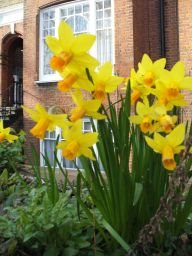
Spring has arrived. Temperatures are slowly on the rise. The Met Office is predicting a steady period of daytime temperatures hitting 12-14C for the next ten days. Likewise, the overnight temperature is expected to hover around 7-9C. A month ago, daytime temperatures were closer to those now being forecast overnight.
I continue to be amazed how distinctive each season is in the UK. Daffodils are starting to bloom in the garden and neighbouring trees are smothered in blossom. The Royal Horticultural Society has confirmed that most spring flowers are in bloom, at least a month earlier than usual. Garry and I have decided to schedule a trip to the London Zoo and see the new born animals this year. The Zoo is located on the edge of The Regents Park, less than 15 minutes walk from home.
Last week the Met Office reported that the winter just ended was the UK’s second mildest on record. For London, it's been the mildest ever recorded. In fact the last 12 months (March 2006 to February 2007) have been the warmest period for 348 years. The rest of Europe is reporting similar records. MeteoSwiss says that Switzerland has experienced the warmest winter since records began 140 years ago. The German Weather Service also declared winter the warmest on record across Central Europe.
Friday, March 09, 2007
Don't park there!
The Saab has a puncture. Well, there's a nail in the tyre. While its been holding pressure since we discovered it last month, I'm sure it'll eventually deflate if left unattended. As a result, I took the car into the local tyre shop today. What an experience!
I thought I'd stepped on to the sound stage of a television sitcom. First, as I drove into the repair bay and parked the car I was greeted by a stern rap on the window. "I'm sorry mate, you can't park your car there without authorisation. Please move it outside and report to reception." I duly reverse the car and double park behind another customer. A filthy look is offered from the passenger seat. I shrug.
Upon entering reception, the same gentleman that greeted me in the repair bay, now greets me from behind the reception desk. I describe the errant nail. "I see. Please can you drive your car into the repair bay Sir." "The one I was just parked in?" "Yes Sir." He's serious. I move the car back to its original parking spot. Is this Candid Camera?
The tyre is repaired. Now, a new slap stick routinue unfolds in reception as two rotund, grease-covered men in overalls attempt to print a receipt. Several paper jams later, accompanied by endless opening and closing of printer doors, removal of printing cartridges and paper trays, I'm presented with a well finger-printed invoice. The successful printer technician hands it over with a wide greasy, grin - complete with missing tooth.
I drive off and barely travel 100 metres before discovering that the boot is open and the lid is flapping widely. I attempt to pull over as a stream of impatient traffic nips at my heels. This is London. The street is narrow. The terrace houses lack driveways and parked cars line the street as far as the eye can see. In desperation I pull into the first driveway I can find. Disaster strikes. It's a daycare centre and the car behind me wants to drive in. Now I'm stuck in a driveway. Glaring parents are starting to pile up behind in their SUVs. Move over Mr Bean!
After much frantic arm waving in the rear vision mirror I'm finally able to reverse out of the driveway, close the boot and make my way home. The biggest joke of all? We're £146.50 poorer. Tyres aren't cheap in London.
I thought I'd stepped on to the sound stage of a television sitcom. First, as I drove into the repair bay and parked the car I was greeted by a stern rap on the window. "I'm sorry mate, you can't park your car there without authorisation. Please move it outside and report to reception." I duly reverse the car and double park behind another customer. A filthy look is offered from the passenger seat. I shrug.
Upon entering reception, the same gentleman that greeted me in the repair bay, now greets me from behind the reception desk. I describe the errant nail. "I see. Please can you drive your car into the repair bay Sir." "The one I was just parked in?" "Yes Sir." He's serious. I move the car back to its original parking spot. Is this Candid Camera?
The tyre is repaired. Now, a new slap stick routinue unfolds in reception as two rotund, grease-covered men in overalls attempt to print a receipt. Several paper jams later, accompanied by endless opening and closing of printer doors, removal of printing cartridges and paper trays, I'm presented with a well finger-printed invoice. The successful printer technician hands it over with a wide greasy, grin - complete with missing tooth.
I drive off and barely travel 100 metres before discovering that the boot is open and the lid is flapping widely. I attempt to pull over as a stream of impatient traffic nips at my heels. This is London. The street is narrow. The terrace houses lack driveways and parked cars line the street as far as the eye can see. In desperation I pull into the first driveway I can find. Disaster strikes. It's a daycare centre and the car behind me wants to drive in. Now I'm stuck in a driveway. Glaring parents are starting to pile up behind in their SUVs. Move over Mr Bean!
After much frantic arm waving in the rear vision mirror I'm finally able to reverse out of the driveway, close the boot and make my way home. The biggest joke of all? We're £146.50 poorer. Tyres aren't cheap in London.
Wednesday, March 07, 2007
Time for a change

On March 25 we'll be moving our clocks forward one hour to British Summer Time (BST). The UK has been doing this every year since 1916. BST was also in force permanently during the Second World War from February 1940 until October 1945, with double summer time used between 1941-1947 (1946 was an exception).
In 1996 all clocks in Europe changed to summer time on the same date for the first time. In 2002, the UK also agreed to permanently link its clock changing dates with Europe. However, in more recent times, regular calls have been made for the UK to remain permanently on BST rather than turn its clocks back every October. Such a move would put the UK on the same time zone used by the rest of Western Europe (with the exception of Portugal).
I can see plenty of logic for doing this. Paris, which is roughly due south of London, is always an hour ahead of the UK. It seems crazy to have cities at a similar longitude on different time zones. It's amazing what a difference that hour can make in winter. I recall the shock I received last winter when I opened my Parisian hotel curtains about 8am only to discover it was still pitch black outside.
As was the case last year, a private member's bill has been tabled in Parliament seeking a permanent time zone change. However, as in previous years, this bill is unlikely to succeed. The UK did trial a time zone change to Central Europe Time from February 1968 until October 1971. However, politicians lost their nerve and ended the trial once newspapers began printing headlines about Scotish children killed while walking to school in the morning darkness.
While young deaths were a tragedy, researchers found during the trial period that evening road accidents fell by a far greater rate than morning accidents rose. Currently, at least 450 people are left dead or injured on Britain's roads as a result of early darkness returning in the winter months. Surely, the perfect reason for enduring signal failures on the tube every evening.
In 1996 all clocks in Europe changed to summer time on the same date for the first time. In 2002, the UK also agreed to permanently link its clock changing dates with Europe. However, in more recent times, regular calls have been made for the UK to remain permanently on BST rather than turn its clocks back every October. Such a move would put the UK on the same time zone used by the rest of Western Europe (with the exception of Portugal).
I can see plenty of logic for doing this. Paris, which is roughly due south of London, is always an hour ahead of the UK. It seems crazy to have cities at a similar longitude on different time zones. It's amazing what a difference that hour can make in winter. I recall the shock I received last winter when I opened my Parisian hotel curtains about 8am only to discover it was still pitch black outside.
As was the case last year, a private member's bill has been tabled in Parliament seeking a permanent time zone change. However, as in previous years, this bill is unlikely to succeed. The UK did trial a time zone change to Central Europe Time from February 1968 until October 1971. However, politicians lost their nerve and ended the trial once newspapers began printing headlines about Scotish children killed while walking to school in the morning darkness.
While young deaths were a tragedy, researchers found during the trial period that evening road accidents fell by a far greater rate than morning accidents rose. Currently, at least 450 people are left dead or injured on Britain's roads as a result of early darkness returning in the winter months. Surely, the perfect reason for enduring signal failures on the tube every evening.
Sunday, March 04, 2007
The moon stops traffic

The first total lunar eclipse for more than three years occured last night. Garry and I were out with a group of friends in Soho. As we came out of the pub around 10:30 we found people everywhere standing in the street looking skyward. Traffic in the area had almost come to a halt.
Our timing was perfect. The earth's shadow had just begun spreading across the moon. The sight was incredible. As we watched the moon was progressively swallowed by darkness, its surface being lit by an ever decreasing crescent of light. The last total eclipse visible from the UK was in May 2004. However, it was obscured by clouds. Last night the sky was clear and the air was still.
The last time I recall seeing a lunar eclipse so clearly was in 1984. I recall this event so well because I was at Toronto Zoo at the time and the moon had been making one of its ghostly white daytime appearances. We'll see another lunar eclipse from the UK on 21 February next year.
Saturday, March 03, 2007
Torres Colón
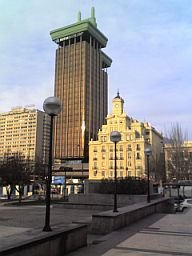
I've just completed a whirlwind two-day business visit to Madrid. The weather was wonderful and my hotel was centrally located in Plaza Colón. The plaza has two prominent landmarks. The first is a tall, slender obelisk capped by a statue of Christopher Columbus, the man reputed to have discovered America. Cristóbal Colón is the Spanish name for this famous local hero. The plaza also includes a giant flagpole with a truly enormous Spanish flag. Strong winds on Thursday kept it flowing all afternoon.
The second landmark is Torres Colón, a copper-coloured twin tower block crowned by a green roof and twin green masts. For the last two days I've woken to a view of this stunning building from my hotel window. The building is known locally as the 'Enchufe' (plug-in) thanks to its roof design. Torres Colón was one of Madrid's first skyscrapers when completed in 1976. Each tower is 116 metres tall, sitting high above other buildings in the area. As a result, it offers a stunning, uninterrupted panoramic view of Madrid. Despite its age, Torres Colón remains a wonderful monument to modern architecture.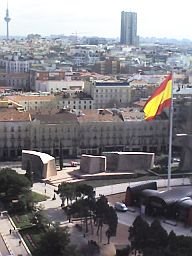
Earlier this week, I had a lunch meeting close to Liverpool Street railway station in London. Coming back from lunch I was enthralled by the unexpected sight of another wonderful high-rise icon. 30 St Mary Axe, more fondly known as the 'Gherkin', stood out against the local skyline. At 180 metres, this bold Sir Norman Foster designed building is currently London's second tallest building. It really did look spectacular against a drab foreground of dusty Victorian buildings.

Tuesday, February 27, 2007
On the road again
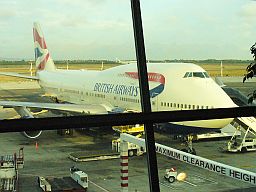
I have more business travel over the next few weeks. I'm off to Madrid for 48-hours on Wednesday evening, then off to Amsterdam two weeks later for another 48-hour dash across the channel. Then its away for Easter in early April to a secret location (I can't tell you or I'll spoil the surprise for Garry's parents), then I'm off to Paris for a week on business and finally finishing April with a 36-hour stint in Milan.
May already has a holiday booked in Turkey so the travel doesn't stop for a while yet. June also has a weekend away with my parents planned and then July has at least another two trips; one to Austria and then off to Australia via the USA.
Phew! I'll have every inflight magazine read from cover to cover for the next six months.
Monday, February 26, 2007
A victim of global warming
My return from South Africa has brought with it a dose of late-Winter flu. Since Tuesday I've had an alternating series of stomach pains, headaches and a phlegm-filled cough. The hotel air-conditioning in Johannesburg set off my sinuses last week so I wasn't surprised when it developed into something more by the time I flew home.
I read today that a mild winter actually increases the likelihood of illness in the Spring. A harsh winter typically kills off more microbes, bacteria and parasites that cause disease. Conversely the lack of a prolonged cold spell results in more aliments. How ironic. I'm ill thanks to global warming.
Of course everyone is telling me I've picked up a bug on the plane. I have my doubts about this urban myth. A well-ventilated aircraft has cleaner air than the average home or office. For example, we definitely don't have industrial-strength HEPA filters screening out patheogens at Swiss Cottage. Whatever is floating around the house sits there for quite some time.
Recent research indicates that the transmission of tuberculosis in-flight required people to sit within two rows of a contagious passenger for at least 8 hours. On Monday's red-eye flight I had a baby in front of me , a bulkhead behind me and a very healthy, tanned and athletic Italian sitting next to me. As a result, I'm pointing the finger at the Hilton's air-conditioning rather than British Airways.
Spring is coming!
Garry and I went for a walk in the neighbourhood yesterday. An increasing number of trees have burst into blossom. Winter is rapidly drawing to a close. With the start of March only days away, this should be no surprise. Spring is almost here.
I read today that a mild winter actually increases the likelihood of illness in the Spring. A harsh winter typically kills off more microbes, bacteria and parasites that cause disease. Conversely the lack of a prolonged cold spell results in more aliments. How ironic. I'm ill thanks to global warming.
Of course everyone is telling me I've picked up a bug on the plane. I have my doubts about this urban myth. A well-ventilated aircraft has cleaner air than the average home or office. For example, we definitely don't have industrial-strength HEPA filters screening out patheogens at Swiss Cottage. Whatever is floating around the house sits there for quite some time.
Recent research indicates that the transmission of tuberculosis in-flight required people to sit within two rows of a contagious passenger for at least 8 hours. On Monday's red-eye flight I had a baby in front of me , a bulkhead behind me and a very healthy, tanned and athletic Italian sitting next to me. As a result, I'm pointing the finger at the Hilton's air-conditioning rather than British Airways.
Spring is coming!
Garry and I went for a walk in the neighbourhood yesterday. An increasing number of trees have burst into blossom. Winter is rapidly drawing to a close. With the start of March only days away, this should be no surprise. Spring is almost here.
Saturday, February 24, 2007
Bombers and burqas

Much like global warming, extreme fundamental Islam is a prominent news topic in London. The debate provokes intense emotion from both sides. In fact, I’ve vacillated for months about whether to write a post on this topic. I worry that an extremist could take offense to my observations and subsequently harm Garry and me. It’s a tragedy that fear plays such a large part in the current multicultural debate.
This fear is fueled by some very sobering news stories. We all remember the July 7 suicide bombings in which 56 commuters were killed by extremist Islamic youths. The unsuccessful tube bombings of July 21, 2005, have also been back in the news this month as the accused are brought to trial. Since January 15, Woolwich Crown Court has been hearing evidence that six men conspired to murder by exploding homemade suicide bombs.
Coverage of the trial has been intense. We’ve seen footage from inside the tube carriages moments after one of the alleged bombers triggered his detonator. We also heard detailed eyewitness accounts of this incident. Last night’s news bulletins were screening video footage showing two of the accused being arrested by armed police. It’s both compelling and disturbing television.
The Islamic religion has a far higher profile in London than anything I’ve experienced before. For example, every day on the way to work I pass many women wearing headscarves and some in full-length, black shapeless burqas. The sight of these women with nothing more than a narrow eye slit showing is very unnerving. Part of my discomfort is simply a lack of familiarity. I’m sure if I lived in Saudi Arabia I’d find their presence perfectly normal. However, until now, I've never seen women in full-veil burqas outside of the Middle East and North Africa.
I realize that my discomfort stems in part from my own cultural heritage. Covering the face is a symbol of deception in Western culture. For example, outlaws wore scarves, not law-abiding citizens. Conversely, surgeons wear masks, but their white or light green colour is associated with cleanliness, unlike the black burqa veil. My culture also associates Islamic dress with the subjugation of women.
However, I appreciate that this dress code has an opposite connotation for many followers of Islam. For some, it's considered an act of humility or modesty. For others, it's a symbol of respect for their faith. Finally, it's often considered a practice that protects women against harm. An immoral man is less tempted when his eyes have little to feast upon. It's clear that cultural norms distort the debate.
The fact that educated and well-traveled people like me are uncomfortable whenever women in burqas walk by also helps explain why the multicultural debate provokes such intense emotion. Of course, the debate isn’t helped by CCTV images of one July 21 bomb suspect fleeing London dressed in a burqa. Such drama only fuels mistrust for women dressed in Islamic clothing and increases suspicion on both sides. The July 21 bombing trial is not just a news story about justice, it's also a story about fear – on both sides of the current debate.

A typical shopping day in Egypt
Friday, February 23, 2007
In memory of the polar ice caps

No blog on life in London can ignore the threat of global warming for long. The topic consistently commands headlines here and across Europe. It dominates political debate, social commentary, and stories on business ethics. I don't recall global warning ever commanding such attention in Australia - other than occasional commentary on the Kyoto Accord. I guess Australians are used to hot, sunny weather and endless droughts.
By contrast, Europe appears obsessed with the impact of global warming. I must admit that I was skeptical about the hype when we first arrived in London. However, in recent times I've encountered compelling evidence about the reality of global warming. Evidence that carries added weight simply because it appears in the oddest of places.
Take, for example, the discovery I made at Cape Point last weekend. In this wind-swept corner of the globe lies a global atmosphere watch (GAW) station. It's part of a network of 20 stations worldwide, managed by the World Meteorological Organisation. The network includes stations at the South Pole and mainland Europe.
The Cape Point station has a small public display summarising its day-to-day work. I learned that the site monitors trace gases like ozone, methane and carbon dioxide, as well as solar radiation and various meteorological measures. Having visited the Cape Peninsular twice now I can safely say that the air is incredibly clear and persistent winds blowing in from Antartica keep the area free of pollutants.

As a result, it's an ideal location to measure atmospheric changes. I'd believe any measurement taken here. This has to be one of the world's cleanest locations. You can't imagine samples being corrupted by contaminants from Cape Town, Los Angeles or the urban world in general. In other words, trends measured at Cape Point must represent baseline numbers for the planet as a whole.
At regular intervals throughout the day the station samples the atmosphere at two points; one 30 metres above the ground, another at five metres. The captured sample is analysed and the results are transmitted automatically to a series of global databases. I was staggered to learn that the station has been reporting a steady increase in CO2 atmospheric gas levels for more than a decade.
The reality of global warming hits home when you see an uncontaminated site track with such clear and irrefutable evidence. CO2 levels really are rising in our planet's atmosphere. For the first time since arriving in Europe, I actually believe what I'm reading. I trust Al Gore's popular slide show. I can see that the media hype is based on fact. A very sobering thought indeed.

The graph on display at Cape Point. The trend is hard to ignore.
Thursday, February 22, 2007
Cecil Rhodes, Dassies and Baboons
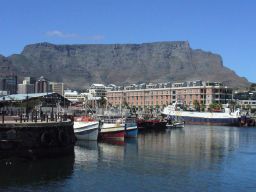
As I mentioned yesterday, I enjoyed several new highlights during my second Cape Town visit last weekend. Three immediately come to mind.
The first is the Rhodes Memorial. It sits in the foothills of Table Mountain, offering spectacular views across the western suburbs of Cape Town and False Bay. Surprisingly, I never noticed this granite, colonnaded monument during my last visit. It's hard to miss. The monument's architecture is in stark contrast to its surroundings. Its neo-classical style has absolutely no link to traditional art and design on the African continent. I can't recall any object looking so utterly colonial and so totally out of place in all of Africa.

It immortalises the memory of South African politician and businessman Cecil John Rhodes. This English-born man shaped much of modern South Africa up until his death in 1901. Among his many claims to fame is the founding of DeBeers, the world's largest diamond producer. The now-defunct nation of Rhodesia was also named after him. This nation was largely crafted by the colonising activity of his British South Africa Company in the later half of the 19th Century.
Access to the site is by way of a winding, paved road. On approach, a sculpture of a rearing horse draws your eye. One of the most prominent landmarks visible from here is the cooling towers of the nearby Athlone power station. This coal-fired utility sits in the middle of Cape Town's suburbs. It's a most unexpected sight from this location, and no less surprisingly during the drive into town from the nearby airport.

Last weekend's second highlight was an unexpected encounter with a group of Cape Hyrax. These fat little animals have more than a passing resemblance to giant guinea pigs. In South Africa, they're commonly called "dassies" or "rock rabbits". I ran into several of them while walking out to an observation point at the Cape of Good Hope. At first, I thought I'd spotted someone small dog on the loose. I spent several delightful minutes watching these lively herbivores frolic around me.

The final highlight of my weekend was also at Cape Point. Here I encountered the local baboons. Last July I'd only seen these animals briefly while driving out to the Point. However, on this trip, they were out in force everywhere harassing tourists without a hint of remorse. As I drove up to the parking zone, I came across two rather cheeky primates sitting on the roof of a parked car. My mind immediately ran through the clauses in my rental contract as I envisaged an insurance claim for baboon damage. As I drove on, more cars came into view littered with cheeky baboons. Definitely, a road hazard I've never seen in Sydney.


Last weekend's second highlight was an unexpected encounter with a group of Cape Hyrax. These fat little animals have more than a passing resemblance to giant guinea pigs. In South Africa, they're commonly called "dassies" or "rock rabbits". I ran into several of them while walking out to an observation point at the Cape of Good Hope. At first, I thought I'd spotted someone small dog on the loose. I spent several delightful minutes watching these lively herbivores frolic around me.

The final highlight of my weekend was also at Cape Point. Here I encountered the local baboons. Last July I'd only seen these animals briefly while driving out to the Point. However, on this trip, they were out in force everywhere harassing tourists without a hint of remorse. As I drove up to the parking zone, I came across two rather cheeky primates sitting on the roof of a parked car. My mind immediately ran through the clauses in my rental contract as I envisaged an insurance claim for baboon damage. As I drove on, more cars came into view littered with cheeky baboons. Definitely, a road hazard I've never seen in Sydney.

Table Mountain
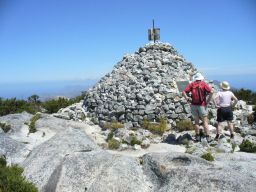
The first recorded ascent of Table Mountain in Cape Town took place in 1503. Today, a 120 rand transaction gets you a ticket on the public cableway. Within minutes you're whisked 1067 metres above sea level to a stunning plateau approximately 3 km in length.
The mountain top is surprisingly flat. Its highest point is a small rock table called Maclear's Beacon. It's 1,086 m above sea level, about 19 m higher than the cable station. Last week I made the 45-minute trek from the cable station to this remote point. The beacon's most prominent landmark is a stone cairn built in 1865 by Sir Thomas Maclear. The surveyor used this location to calculate the exact dimension and shape of the Earth.
The views across False Bay from this location were stunning. I could even see in the distant haze Cape Point itself. Another wonderful Cape Town memory.

Wednesday, February 21, 2007
Ostriches on the beach

I've just returned from an intense week in Johannesburg. While much of my time was taken with business I did make another weekend dash down to Cape Town. It's currently the height of Summer in South Africa, making for a completely different experience to that of my first visit last winter.

I revived several favourite memories while finding time to add a few more. Old memories included another day trip up Table Mountain (this time without a cloud in the sky) and another encounter with ostriches on the beach at the Cape of Good Hope. I was astonished to find these birds in almost the same location as last time.
Watching them forge in the wind-swept bushes, metres from the rolling Atlantic surf, was undoubtedly as magical as last time. A new memory was made when they kindly wandered across the road, halting traffic and bringing faces of joy to every driver. Baywatch was never this riveting.

I also added a couple of lighthouse encounters to my travel diary. The first was the bold white, cast-iron tower at Kommetjie. This structure was erected in 1914 and sits on a narrow ribbon of land between imposing cliffs and a white-capped ocean. There's something undeniably majestic about this lighthouse and its forlorn location, two-thirds of the way down the Cape Peninsular. Getting to the lighthouse is half the fun.
The best route is along Chapman´s Peak Drive from Hout Bay. This narrow, winding road was literally hewn from a near vertical cliff face between 1915 and 1922. In one place the 10km long scenic road is built into a deep groove blasted from solid rock. You can see this sight in the photo below.
Along its length heavy-duty steel nets protect drivers from falling rocks. The threat is real. Since 1987 there have been five deaths from rockfalls on this route. The road was even closed for several years in 1999 after a driver was killed by an unusually large rockfall.

The second lighthouse encounter was Dias Point Lighthouse located at the tip of Cape Point. On Sunday a narrow track out to a nearby observation post was open to the public. Last winter this access had been blocked off. The 15 minute walk was well worth the effort. It's impossible to describe the sensation of standing on this narrow point of land as the wind roars in from the Southern Ocean. This really was the end of the world.

This lighthouse is the second of two at the cape. The tragic loss of the Lusitania in 1911 forced authorities to approve its construction. The original lighthouse, located at the highest point on the cape (246 metres above sea level), was often covered by fog, thus diminishing its effectiveness. I can't recall any other location with a twin set of towers.
My jet lag has finally caught up with me this evening. More Cape Town adventuress tomorrow.
My jet lag has finally caught up with me this evening. More Cape Town adventuress tomorrow.

Sunday, February 18, 2007
Seven Dials
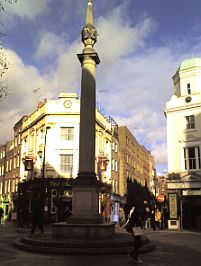
Seven Dials is one my favourite landmarks in the West End of London. At the intersection of seven narrow laneways lies a slender sundial pillar. The area was created in 1690 by Thomas Neale, a man who went on to become the first postmaster general of United States colonies. He planned to capitalise on popularity of the new Covent Garden Piazza area nearby.
The area's early residents were largely individuals from the city's more respectable endeavours; lawyers and skilled tradesmen. However, within a century the area had become one of London's most notorious slums. It remained in decay until the late 1970s before finally being regenerated.
Even the sundial is new. The current pillar was only erected in 1989. Apparently the original was removed in 1773 in an effort to discourage unruly crowds from gathering. Today, during the warmer months, its a popular weekend venue for people watching. Some of my favourite cafes and bars are also in area.
I find it fascinating that such a simple, memorable location has gone full circle over three hundred years. My earliest memory of Seven Dials dates back more than five years. I remember coming across the sundial and marveling at its unexpected presence. At the time I was in town for a Board meeting at the Convent Garden Hotel, situated 100 metres along one of the radial laneways.
I love this hotel. Its one of London's quaintest boutique establishments, serving a wonderful Sunday brunch in the sunny parlour of recently gentrified building. When the bill arrives, you'll have ample proof that Seven Dials isn't slumming it any more. These days Garry and I have brunch down the road at Box, a simple cafe bar reminiscent of those we love in Sydney.
Sunday, February 11, 2007
The Mousetrap
This evening Garry and I went to see The Mousetrap, the world's longest running theatre production. It opened in 1952 and has continued uninterrupted until today. It's clearly as popular as ever. Tonight's performance was a sell out crowd.
The play is staged at St Martins theatre. This is a small space with a beautifully restored interior. The walls are lined with heavy, dark-stained mahogany wood and dark crimson panels. The dress circle is framed by bold wooden banisters while the ceiling is capped by a striking glass panel dome.
The performance itself has stood the test of time surprisingly well. We found ourselves laughing out loud on more than one occasion. Tonight the role of Christopher Wren, a hyperactive young man, was played brilliantly. I found myself believing the authenticity of his character more than any other on stage.
In keeping with the tradition I won't reveal the murderer. However, Garry identified the guilty party during interval and was duly proven right. Sadly, I had no idea.
The play is staged at St Martins theatre. This is a small space with a beautifully restored interior. The walls are lined with heavy, dark-stained mahogany wood and dark crimson panels. The dress circle is framed by bold wooden banisters while the ceiling is capped by a striking glass panel dome.
The performance itself has stood the test of time surprisingly well. We found ourselves laughing out loud on more than one occasion. Tonight the role of Christopher Wren, a hyperactive young man, was played brilliantly. I found myself believing the authenticity of his character more than any other on stage.
In keeping with the tradition I won't reveal the murderer. However, Garry identified the guilty party during interval and was duly proven right. Sadly, I had no idea.
Subscribe to:
Posts (Atom)

 Posts
Posts


