Showing posts with label Brazil. Show all posts

Saturday, November 26, 2005

Where is Jeremy Irons?


Let me tell you more about our time in Brazil. Perhaps the easiest place to start is the two days we spent at Iguazu Falls. The falls were simply spectacular! Beyond words. 

Our first encounter came on the Brazil side where we booked a 15-minute helicopter flight over the Falls. This gave us a terrific overview of the area and prepared us for two days of memorable sights and sounds. Once our flight was done we headed to the panoramic Brazilian falls viewing track.

I will say this, if we ever return to the falls we're definitely staying at Hotel das Cataratas. This hotel sits in the heart of Iguazu National Park. It was clear from the air that your room is literally spitting distance away from the thundering water. Nice!


The walking track followed the river gorge towards the falls. Each turn revealed a new perspective of the falls and the churning river below, each view more spectacular than the last. Then, just when we thought it couldn't get any better we came upon the Salto Santa Maria walkway. This zig-zagging elevated catwalk took us out into the very heart of the Brazilian falls themselves. The spray soaked us within seconds, the sound was deafening and the wall of water surrounding us was beyond description. That's Garry giving us a wave in the photo above. A magic moment indeed.


That same day we also visited a nearby bird park. The first few aviaries of rather average birds made us think this was a tourist-cheap affair. However, we then moved on to a series of giant walk-through enclosures packed with the most stunning birdlife I´ve ever seen. We literally had beautiful Toucans sitting beside us on the pathway, while Macaws flew by in a whirlwind of colour.


The following day we visited the Argentine side of the falls. The perspective here is completely different. So much so that you feel as if you´re visiting a totally different location. Here we took jet boat rides to the base of the fall themselves. We tipped our boat driver so that he'd give us a couple of extra sights and a few extra plunges into the falls themselves. We were totally soaked by the end of the experience. The rest of the day was spent wandering the various walking tracks around the Falls National Park.


At every turn you expected Jeremy Irons to wander past, reliving dramatic moments from the movie, "The Mission". Sadly, no Hollywood stars were sighted, although I did spot a rather large lizard harassing an American couple. A B-grade remake of "Godzilla" perhaps?

One final anecdote about our time at the Falls. As our tour progressed some of us on tour grew tired of the tour guide's uninspiring restaurant choices. In particular, he seemed to have an obsessive predilection for pizza and steak, rather than any local cuisine. 

On our last night in Iguazu Garry and I had finally had enough. After our guide announced that we were off to yet another pizzeria we staged a mutiny. We hadn’t travelled halfway across the globe to spend a week eating pizza. We walked out of his chosen venue and went searching for another. Much to our amusement, several members of the group caught wind of our plans and came with us.  

After wandering the streets for 10-15 minutes we came across a bustling restaurant more than willing to accommodate a large, walk-in group. We ultimately enjoyed a surprisingly tasty meal at a long table in a semi-private alcove at the back of the restaurant.


Sunday, November 20, 2005

San Paulo


Almost ten years ago now, Kinselas, a popular bar in Sydney briefly closed its doors. The bar's new owners gutted the joint, transforming it into a trendy minimalist water hole. Upon reopening, its signature drink became the Caiprioska. What a wonderful beverage. It's the perfect cure for scurvy, and its preparation is the ultimate workout routine for any barman.

In Brazil, Garry and I soon discovered that Kinselas had simply been cashing in on the nation's favourite drink. The Brazilian national drink is the Caipirinha. It's made from a sugar cane alcohol called Cachaca, which is mixed liberally with crushed limes and palm sugar, and then shaken over ice. If you substitute the Cachaca for Vodka, you've created a Caiprioska.

However, unlike Kinselas, the correct method for making this drink in Brazil requires the barman to pour vodka into your glass until someone suggests he stop! It took us a few drinks in San Paulo to learn this ritual. Needless to say, those first few cocktails were potent, to say the least. We both agree it’s the perfect drink-mixing procedure for anyone who’s just completed a Rio cab ride, or a hair-raising drive to San Paulo. But I digress.


Our minivan journey to Sao Paulo involved another driver in training for the Grand Prix. Along the way, our route included a steep and winding mountain pass. Shortly after traversing the summit, we encountered an overturned truck on a downhill hairpin corner. Much to our relief, the gruesome accident encouraged our driver to ease off the pedal as we continued descending. However, his lead foot, and traffic weaving antics, returned in force when we reached the local motorway.

Sao Paulo is huge. We spent our first evening in town at Bar do Terraço, a classy piano bar at the top of the 46-story Edifício Itália office building. Thanks to some savvy tipping by our tour guide, we secured a couple of cosy window seats. We ordered, you guessed it, the national drink and toasted our near death experience. As we drank, we took in a stunning urban skyline that spread as far as the eye could see in every direction.


The following day was spent exploring the city. In the morning we took a walking tour with our guide through several city neighbourhoods. Highlights on our walking tour included a visit to Catedral Metropolitana de Nossa Senhora da Assunção e São Paulo, also known as the See Cathedral. It’s the largest Catholic Church in the city. It’s also relatively new having only been consecrated in 1964.

The stained-glass windows in the cathedral were a fascinating mix of biblical references and pictorial validation of the catholic church’s divine right to rule. For example, one window depicts a bare-chested Francisco de Mello Palheta riding triumphally into town carrying a potted coffee plant bursting with ripe red berries. We were surprised to learn that coffee isn't an indigenous plant. It was actually brought to South America from Africa by Francisco in 1727.


The cathedral sits on the southwestern edge of Praça da Sé, a plaza long considered the centre of San Paulo. The distance for all roads passing through São Paulo is measured from here. In the middle of the plaza is a statue of José de Anchieta (1534–1597). He was a Spanish Jesuit missionary to Brazil in the second half of the 16th century and is credited as one of the founders of São Paulo, in 1554, and Rio de Janeiro, in 1565.


It would be fair to say that San Paulo wasn't a particularly attractive city.  However, it does offer a fascinating juxtaposition of old and new no matter where you turn.  One moment we'd spot an old and decaying colonial building, while around the next corner, we'd encounter a surprisingly stark and modernist structure or a decaying and relatively new building. Perhaps no building captured this essence better than the final stop on our walking tour, MASP, The Art Museum of Sao Paulo. It's an elevated glass cuboid suspended in the air on four vibrant red pillars.


Once our walking tour was done we left the group to do our own thing at the local Zoo. We'd chosen the Zoo in the hope of seeing a range of uniquely South American fauna. However, it proved rather disappointing. Many of the enclosures were small, barren, and not all appealing for either the animals or their human visitors.


After stopping in San Paulo for two nights, our Brazillan road trip continued inland to the post-modern city of Cubitia. After the chaos and decay of San Paulo, this next destination was a real surprise.

A Portuguese paradise


After joining our tour group in Rio we drove to the heritage-listed town of Paraty. This is a perfectly preserved Portuguese colonial town about four hours south of Rio. A truly photogenic town of old white buildings, colourful painted doorways, window sills, and trims, located on bone-jarring cobblestone streets.

Paraty is older than it looks. It was founded in 1597. Over time it developed into a regional centre for Portuguese colonists in the surrounding area. Its impressive array of colonial buildings sprang up after the discovery of the world's richest gold mines in the mountains of Minas Gerais in 1696. Paraty rapidly became a major export port for gold and a supply port for the mines. 

Interestingly, the precious metal was first transferred on coastal ships to Rio de Janeiro and from there on to Portugal. Apparently, the harbour wasn't suitable for larger sea-going vessels. The city briefly boomed again when the coffee trade picked up and again more recently thanks to sugar cane farming. Today tourism is Paraty’s major economic contributor.


On our first day in town our guide took us for a brief walk through the town’s historical waterfront district. Perhaps the most memorable sight is Capela de Santa Rita, the oldest church in Paraty. This all-white structure, trimmed in yellow, was completed in 1722. This was the local church of the freed slaves and freemen, or former slaves. It reminded me of the Chapel of Nossa Senhora da Guia in Macau. Its white bell tower can be seen for miles and is instantly recognizable in promotional tourism images.


The town is set in a harbour full of islands. Our guide suggested we hire a boat and visit a few of them. However, our harbour cruise the following day mainly involved swimming, soaking up the sunshine, and drinking copious amounts of Caipirinha, Brazil’s national drink. It was rapidly becoming apparent that our guide’s idea of a good time was a cliche backpacking experience.

Upon our return to shore we saw the town's unusual street-cleaning ritual in action. The streets in Paraty’s historical district are swept clean by the rising tide twice a day. Although, we later learned that the flooding we’d witnessed only happens a few times a month. It takes a full moon and an accompanying king tide to set things in motion. As the king tide peaks it sends water flowing down the town's colonial streets through special openings in the harbour seawall. These openings are set slightly above the average high tide mark to avoid flooding the town every day.


The waterline image above was taken during our boat trip. I captured it with considerable care.  I wanted to preserve the spirit of our idyllic day sailing around Baia Carioca. I grabbed my digital camera and without any water protection swam ever so carefully into the bay to turn and take the photo you see here.

Sadly, not every memory of Paraty was a positive one. A group of us went for dinner at a Japanese restaurant on our final night. We naively assumed a seafood-based meal in a coastal town was a guaranteed winner. We couldn’t have been more wrong. The fish and the ingredients were anything but fresh. In the end I ate little more than rice and noddles. 


After two nights in Paraty, we headed south to San Paulo. The drive took more than five hours, with the last hour spent crawling along a freeway jammed with traffic on the outskirts of San Paulo. Shortly after leaving Paraty we stopped briefly to admire Cachoeira da Escada. This is a cascading waterfall on the edge of the Rio-Santos highway, about 27 km south of town.  The base of the main fall is protected by a slightly disheveled statue of Oshun. She’s the queen of freshwater, rivers and waterfalls. You’ll find her halfway up the falls in the first image above.

Saturday, November 19, 2005

Brazilian Nut Mix


It's time to fill you in on our first week in Brazil. We arrived in Rio on November 14, after two weeks in Peru. This next part of our RTW ticket proved to be another whirlwind of sights, sounds and smells.

Our less-than-direct flight from Lima to Rio passed without incident. As some of you will know we flew Lan Chile which saw us transit via Santiago. The flight left Lima at 1:15 am and took three hours to reach Santiago. However, Santiago is currently two hours ahead of Peru so we found ourselves awakened for breakfast barely two hours into our flight. Ouch! 

However, the painfully early start delivered a truly breathtaking sunrise over the Andes. As our plane descended towards Santiago we soon found ourselves flying alongside the highest Andean peaks. Their rugged snow-capped outline, lit by dawn’s early light, followed us relentlessly as we descended. The Andes really are an impossibly long and unbroken chain of mountains.

After transferring in Santiago, we flew on to Rio. Our flight included a brief stop in São Paulo, another extraordinary experience. From the air, as our plane traced a broad arc around its fringe, we could see that São Paulo was mind bogglingly big. It extended to the horizon in every direction. It reminded me of Tokyo, the only other city I’ve ever encountered with such an overwhelming urban landscape. An exhausting day of dog-leg routed travel finally ended shortly after 2:00pm with our arrival in Rio.


Rio was incredible! We wished we´d had more than 1.5 days here. I think we´re definitely going back. The city is set in one of the most beautiful locations I´ve ever seen. Sydney Harbour pales by comparison. Our hotel was close to Flamengo Beach, which sits within the main bay of Rio looking directly at Riõ´s famous Sugarloaf Mountain. 

[2023 Note: Sadly I can't find any record of the hotel's name.  I think it may have been the Hotel Argentina. More research is clearly required...!]

After checking in we spent an afternoon strolling along the beach promenade trying our best to soak in the wonderful laid-back culture. By the time we were done, we'd walked almost 8km. Sadly, I didn't think to take my camera. At the time we'd only intended to take a relatively brief stroll along the waterfront.

Instead, our route ultimately took us past Vivo Rio, a post-modern conference centre, and on as far as Catedral Metropolitana de São Sebastião do Rio de Janeiro, the city's famous pyramid-shaped Catholic cathedral. The cathedral is located across the road from the terminus of the restored Santa Teresa tram line. We watched a tram pull in with tourists perched along its outward-facing bench seats. However, I couldn't talk Garry into taking a ride so we retraced our steps slowly back to the hotel. 

Later that night we caught a cab to Marius, a popular seafood restaurant, located on the eastern edge of Copacabana Beach. This local institution is a crazy place. The entrance, shrouded by oversized palm fronds, sits at the base of a nondescript apartment complex. Inside, you find a sprawling and suitably chaotic venue decorated with all manner of eclectic items including suits of armour, crystal chandeliers and marine brass fittings. The images above were pulled from the internet. They give you a good feel for the experience.

The meal itself was an endless rodízio style degustation menu consisting of every fresh seafood dish you can possibly imagine. We literally rolled ourselves out the door after one too many prawns! Garry recently reminded me that we also took a brief stroll along the Copacabana promenade to soak in the evening air.

Marius operates a churrascaria restaurant with the same rodizio format next door. Garry immediately made me promise we’d try this establishment the following night. Those of you who know Garry will also know that there is no more dedicated carnivore than him. We did indeed return the following evening and consumed every conceivable part of a cow known to man, plus a few pigs, chickens and other meats I was too nervous to ask for a translation.


Catching a cab to either Marius restaurant is something everyone should experience once in their life. Rio cab drivers are all in training for the national Grand Prix, revving engines loudly at every red light, taking any corner at breakneck speed and generally doing their best to pass every vehicle on the road. 

Of course, road chaos is nothing new to me after many years in Asia. India and China definitely have mastered random driving as a national sport. However, Rio adds the frightening element of speed to the mix!

Given how little time we had in Rio, we wanted to make the most of it.  To give us a head start, I shouted Garry a private guided tour for his birthday. This involved a whirlwind day exploring many of Rio's most iconic locations. Our guide was excellent. He was incredibly laid back and gave us plenty of time to experience each stop before moving on.


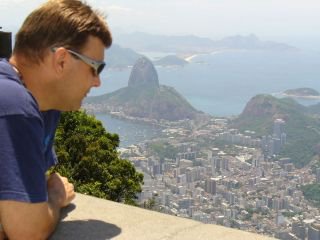
Our tour kicked off with a visit to the famous Corcovado mountain, where a 30-metre statue of Christ watches over the city. As expected, the view was breathtakingly spectacular and gave us our classic postcard photos. We reached the summit via the famous Corcovado cable car. This rack railway operates from a base station in the hillside neighbourhood of Cosme Velho, rising to 670 metres over a distance of 3.8 km. The 20-minute ride, through narrow cobblestone streets and lush tropical vegetation, was an experience all of its own.


We then drove through the old neighbourhood of Santa Teresa where even the cable car drivers think they’re Grand Prix champions. I´ve never seen a cable car sway quite the way they did in this particular neighbourhood! The dust we saw being thrown into the air on every curve was unnerving, to say the least. You can see a hint of this in the image above.

Perhaps Garry was being prescient when he refused to ride one the previous day. We’d watched it gliding into the terminus station during our waterfront walk. He was exhausted thanks to the limited sleep we’d had on our overnight flight. Although, in hindsight, a hair-raising cable car ride might have woken us up!


Of course, Rio wouldn't be Rio without Carnivale. Our guide took us to the famous street where it all happens. Television can be so deceiving. You'd think the parade was snaking its way through miles of city suburbs when in reality, it's all happening on a purpose-built 800 metres long roadway, bordered by concrete stadium seating. While there we toured a local museum housing some of Carnivale's colourful costumes. On a whim, I boldly rented one for a photo shoot and had my own little Mardi Gras.


We then caught a cable car up Sugarloaf Mountain for more spectacular views. This included watching ant-sized climbers making their way up the rock face the hard way. In the opposite direction, Rio's stunning Atlantic coast stretched into the distance. It was a genuine pinch me moment.

From Sugarloaf, our guide took us past an endless stream of beautiful coastal beaches reminiscent of the best in Sydney. This included brief stops to view Ipanema Beach and a glimpse of luxurious lakeside villas lining the tranquil shores of Lagos de Jacarepagua in the Barra da Tijuca district. These are gated communities so our guide had us peer through a steel-grilled fence bordering the lake.

These high-walled, gated villas stood in stark contrast to Rio de Janeiro’s slum districts, known locally as favelas. Their densely packed, makeshift dwellings cascade down the surrounding hills everywhere you go. This includes Rocinha, the city’s largest and most infamous favela. It dominates a hillside above the coastal highway between Barra da Tijuca and Ipanema Beach. It’s somewhat ironic that some of the city’s poorest residents enjoy some of its most spectacular views. The photo above shows a small favela visible from the Corcovado tram.


We finished our private tour with a leisurely cocktail at an outdoor bar overlooking Pepino Beach. As we sat there soaking in the coastal view several tandem hang gliders came into land. Our guide offered to take us up to the launching point for a flight. However, visions of a broken limb curtailing our forthcoming Egyptian adventures saw us politely decline his offer. Although if truth be told a part of me secretly regrets not taking him up on it.

Later that evening we joined our next overland tour group. Then, early the following morning our small group departed for the heritage-listed town of Paraty. Imagine a dozen of us crammed into one large minivan driven by another complete and utter manic.

Our Brazilian adventure continues here.