Showing posts with label Arizona. Show all posts

Saturday, April 06, 2024

The Grand Canyon


Over the years I’ve been fortunate enough to visit the Grand Canyon twice. Both visits were day tours from Las Vegas. I’ve also passed over it at 30,000 feet while flying trans-continental across the USA. My first overflight took place while travelling to Syracuse, New York, as an exchange student in 1983. No matter what your vantage point, the Grand Canyon never fails to impress. 

My first ground visit occurred in July 2000. At the time, I was on my way to Text 100's San Francisco office for a two-week General Manager’s secondment. I flew into LA on Friday 28 July, passed through immigration and transferred mid-morning onto a flight to Las Vegas. 


I spent three days exploring Sin City, including a spectacular helicopter flight that took me into the Grand Canyon at Grand Canyon West. The day trip involved two separate activities. The first was a breathtaking flight from Henderson Airport over the Hoover Dam, Lake Mead and the Grand Canyon, concluding with a landing 3,200 feet below the rim. 

We landed on a sloping plateau, about 30 metres above the canyon floor, with an uninterrupted view of the Colorado River below. Our group of four, excluding the pilot, spent about 20 minutes on the ground toasting our visit with a glass of bubbles. 


I’ll never forget the moment we flew over the canyon rim. The sensation of the ground suddenly falling away into a vast abyss will stay with me for the rest of my life. An American couple flying with me made the moment all the more memorable. As we passed the rim, the wife let out a classic melodramatic “wow” followed by more gasps and groans in a distinctly American drawl. Her breathless enthusiasm was rather infectious. 

The tour included a video of our flight. When you play it back, this woman's delirious commentary can be heard in the background. Decades later it still makes me chuckle. I've arranged for the VHS tape to be converted to MPEG4.  I'll try to upload a reel soon.  

Perhaps the most astonishing aspect of this video was its creation. The pilot controlled two cameras as we flew, skilfully cutting from one to the other as the scenery unfolded below. Then, when our tour was done, he opened a hatch at the helicopter’s rear revealing a bank of video recorders. The company had set these up to simultaneously record our flight. The pilot ejected a tape from each machine and gave a copy to each of us. It's hard not to be impressed by such an efficient set-up.


From the canyon floor, we flew to Guano Point on the West Rim. Here members of the local Hualapai Indian tribe took us on a walk to view the canyon from ground level. Along the way, our local guide shared stories of the tribe’s history in the area and explained the magnificent geography unfolding before us. Of course, a ubiquitous display of handcrafts was also on offer. 

In the years since the Hualapai have expanded their simple tourism venture to include an impressive glass floor Skywalk platform. This lets you walk out past the rim and experience the same “ground falling away” sensation I enjoyed on my helicopter flight.


My second visit to the Grand Canyon, in 2002, was also by air. However, this time I was en route to Utah’s iconic Monument Valley courtesy of the aptly named Grand Canyon Scenic Airlines. My day trip started with a flight to Grand Canyon National Park Airport in a relatively spacious De Havilland Twin Otter Vistaliner. From here we were taken by minivan to the Grand Canyon South Rim to soak in a classic view of the canyon itself.

Most of the tourism images you see of the Grand Canyon are taken from the south rim. The canyon is 731 meters deep at this point and spans more than 10km to the northern rim. I can confidently confirm that the vista is every bit as awe-inspiring as those postcards and posters promise. Although, like a typical antipodean traveller, I was equally enamoured by the squirrels running rampant around the lookout’s stunning vantage points.


We then returned to the airport and took a second flight to Goulding's-Monument Valley-Oljato Regional Airport. Landing here marked my first visit to Utah as much of Monument Valley’s famous landscape straddles the Arizona state border.  This remote little airport can be seen in the image above.

Monument Valley isn't a valley in the conventional sense, but rather, a flat and desolate landscape surrounded by crumbling rock formations that rise hundreds of metres into the air. They're the last remnants of a sandstone layer that once covered the region, eroded by hot dry winds that howl through the desert.


Once again, the local tribespeople were our guides. Our Navajo hosts took us on a four-wheel drive through the desert, stopping to take in many of the national park’s iconic views. The area’s dramatic rustic red buttes and mesa have long been used as a classic background for Hollywood Westerns, a tradition that began with Stagecoach, starring John Wayne, in 1939. 

It also provided the backdrop for one of Forrest Gump’s more memorable scenes. Do you recall the scene where Forrest Gump runs across the country? After gaining a large group of followers he decides it is time to stop. This pivotal moment in the movie was shot on Highway 163 in Monument Valley. The Forest Gump viewpoint has become so renowned that Google Maps now marks its location a few kilometres north of the state border.


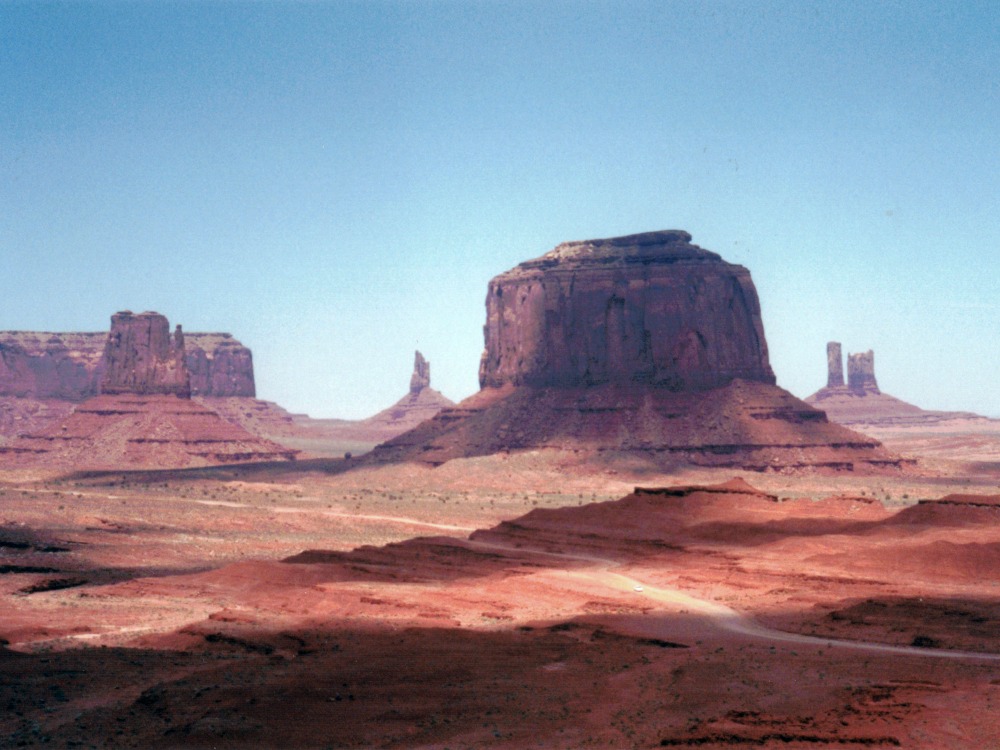
However, my day tour focused on classic vistas south of the border including North Window Overlook and John Ford Point.  The latter location is ironically named after a Hollywood producer. Here you get a stunning view of the Three Sisters, a tripartite collection of soaring rock pillars.

The image of me in a cowboy hat above was taken at a stunning lookout in the Monument Valley Tribal Park Visitor Center. It shows West Mitten Butte and East Mitten Butte, just two of at least a dozen similar formations visible from this elevated location. Just out of view to the right is the equally impressive Merrick Butte. It's best viewed from a lookout called Artist’s Point, as shown in the third image above.


At John Ford Point, a Navajo local kindly rode his horse onto an outcrop overlooking the valley below. As you see above, this allowed us tourists to capture an iconic Lone Ranger moment. Then, for a healthy tip, he let us sit on his horse for another memorable photo opportunity. Naturally, I was inspired to capture my own cliche moment for immortality.  


However, the breathtaking views of the two Mittens ultimately captivated me. These photogenic buttes, each with an opposing rock finger, are the iconic formations most often associated with Monument Valley. Driving past these towering burnt ochre outcrops was awe-inspiring and worth every penny of my pricy day trip.


The tour finished with a return flight to Grand Canyon National Park Airport where I transferred onto a tiny Cessna Caravan. This aircraft normally seats nine passengers. However, for reasons unbeknown to me, the pilot flew a weight-restricted flight back to Las Vegas. As a result, there were only four of us on board. I was even weighed before take-off.

I vividly recall buying a souvenir shirt and some sort of knick-knack at the airport, then witnessing an airline staff member's crestfallen face as I returned to the gate with my goodies. Thanks to my shopping spree this staff member was unceremoniously offloaded from the flight.

Then, as we prepared to take off, the pilot kindly warned us that the afternoon flights are often rather bumpy. As he explained, the sun’s unrelenting heat generates increasingly turbulent updrafts as the day progresses. He wasn’t wrong. More than once our tiny aircraft was bounced around in clear air as we passed over the Colorado River’s ancient rifts and gullies.


NOTE: April 2024
The images illustrating this story were scanned from original printed photos. As you can see, I have plenty of spectacular Kodak moments waiting to enter the digital era.

Tuesday, November 01, 2011

Arizona remembered


I've prepared a series of posts on our second week in Arizona in late-September.  Click on the links below to learn more about:
Please check back again soon for additional posts. Highlights yet to come include:

Saturday, October 01, 2011

Gunfight at the OK Corral


Tombstone, Arizona; they call it “the town too tough to die”. It’s also one of the best preserved towns in the midst of what once was the American Wild West. The town’s original 1880’s buildings have been lovingly maintained. The result is a streetscape that wouldn’t be out of place in a classic Western movie. The main street is lined by a shaded boardwalk protecting the entrance to saloons, brothels and stores. However, unlike a Disney stage-prop set, the buildings aren’t quite as spotless and exhibits are often worn and dusty.

Tombstone is also home to the OK Corral, the site of an infamous gunfight long since immortalized in more than one movie. On October 26, 1881, in a six-metre wide lot behind the Corral three cowboys faced down four rival townsmen. In less than a minute, 30 shots were fired, leaving three cowboys dead and two other seriously wounded.


Today, visitors can watch an amusing reenactment of the gunfight twice a day, staged in a simple amphitheatre alongside the original Corral. Alternatively, you can push a button at the actual gunfight site and watch some clumsy animatron robots crudely reenact the fatal scene. It’s probably the only truly chintzy tourist gimmick in town.


We spent 1.5 days exploring the township, learning all there was to know about the gunfight and host of other excentric characters that gave the town its enduring reputation. Highlights included the Bird Cage Theatre where an elevated row of opera boxes along its opposing walls were used by prostitutes to ply their trade rather than well-heeled theatre-goers. In fact, we discovered that many of the well-heeled local were the prostitutes. It seems that the wives of many prominent locals, including the sheriff, were prostitutes at one time or another.

Several horse-driven stagecoach tours also operate around the town. They’re undoubtedly a bit of a gimmick as a horse cannot travel far in 15 minutes at a leisurely pace. However, this does give the drive plenty of time to share all manner of amusing anecdotes about the town and its history. The odd stray bullet hole was also pointed out along the way.


I was fascinated to learn that that much of Tombstone’s colourful history took place over a surprisingly brief period. The town was founded in 1879; near a recently discovered silver mine. This made it one of the West’s last frontier towns. Within a year the town was the fastest growing city between St Louis and San Francisco. In fact, its population grew from less than 100 people to more than 14,000 in less than seven years.

The mines struck water in the 1880s and were kept open by a pump operating 24-hours a day. In 1886 the main pump house caught fire, seriously damaging its pump. The mines flooded and the cost of repair was deemed excessive. Mining in the area rapidly declined and the town began to falter. By 1990, less than 700 people remained. However, savvy locals turned to tourism in a bid to save the town. Today, Tombstone attracts almost half a million visitors annually.

Wednesday, September 28, 2011

Where do planes go to die?


If you’re a US military aircraft there’s only one place you’ll end up at the end of your flying days; the 309th Aerospace Maintenance and Regeneration Center (AMARG) at Davis-Monthan Air Force Base in Tucson, Arizona. This site, also known affectionately as the “boneyard” is the official storage depot for all surplus, retired or decommissioned aircraft. 

It’s currently home to 4,400 aircraft and 13 aerospace vehicles from the Air Force, Navy-Marine Corps, Army, Coast Guard, and several federal agencies including NASA. As you can imagine, with so many aircraft in storage the site covers a huge area. Unsurprisingly, its presence makes Tucson a high-priority military target for nuclear-armed ballistic missiles.

Garry and I we lucky enough to join a guided bus tour of the boneyard, arranged by the nearby Pima Air and Space Museum. It’s an amazing sight! The might and power of the US military becomes all too apparent as the bus tour unfolds. The array of equipment is truly mind-boggling. There are acres devoted to storing jet engines, wing tip extensions and all manner of accessories. You then come across hundreds of neatly parked jet fighters, helicopters and giant high-speed B1-B bombers, all stretching as far as the eye can see.


The entire scene is made even more surreal thanks to the preservation method used on site. Despite the areas’s protective dry desert environment, every aircraft is carefully preserved by wrapping it in a special white plastic cling film. The result is row after row of ghostly white objects of all shapes and sizes. The weather also played along by adding it own dramatic flair which included a sudden burst of torrential rain, lightening and thunder.


Pima Air and Space Museum was an equally impressive attraction. The site covers a huge area upon which is stored an incredible variety of aircraft. Highlights include several lovingly restored Super Constellation aircraft. These were the workhorse of the long-haul commercial aviation industry prior to the start of the modern jet age. I’ve always wanted to see one for myself. I was thrilled to discover that the Museum has one painted in classic TWA colours. It was like an old grainy photo from the 50s come to life.


Inside the museum’s numerous hangers we saw the world’s smallest plane and the smallest jet plane (which was only slightly larger); both of which looked like large toys. However, the Guinness Book of Records has verified that they really did take to the air. Elsewhere we came across a World War II plane flown by Lt. Louis E. Curdes, the only pilot to be awarded a Distinguished Flying Cross medal for shooting down a friendly plane.

Apparently, the wayward American aircraft was preparing to land on a runway that had been recaptured by enemy forces. The quick thinking pilot tried to warn off the pilot to no avail. In the end he carefully shot the plane’s engines forcing it to ditch miles short of the airport. The plane landed close to another friendly aircraft pilot who was also preparing to be rescued.


All in all we spent half a day wandering among literally hundreds of planes, many of which were one-off test craft, others which held a unique place in aviation history. For example, we saw a plane that was used by President Kennedy and President Johnson as the last propeller-driven Air Force One. Was this the aircraft that carried Kennedy's body back from Dallas?  

Nearby was NASA’s aptly named Super Guppy cargo plane. It looks much like a giant tadpole with wings. It was used to transport segments of the Saturn V moon rocket and more recently segments of the International Space Station. I was also thrilled to see my first Sikorsky S-64 sky crane helicopter. There are incredibly powerful, heavy-lift helicopters that look much like a praying mantis.

Finally, being the true space geek that I am I was thrilled to see the B-52 bomber that had been specially modified to carry the X-15 rocket plane aloft. The X-15 was the first such craft to fly to the edges of space and return to earth as a regular plane. This twin vehicle concept has since been adapted by Virgin Galactic as it prepared to launch its first commercial sub-orbital spaceflights. Needless to say I went back to our hotel a happy lad, while Garry was probably relieved to be doing something different!

Tuesday, September 27, 2011

Biosphere 2


I can honestly say that only two venues on our entire Southwest road tour failed to live up to expectations. One of these was Biosphere 2. It’s a 3.14-acre (12,700 m2)[1] series of airtight structures built to test the concept of creating and maintaining a self-contained ecological system. Five buildings housed a series of artificially recreated environments ranging from a coral sea to desert terrain and jungle foliage.

The structure was notable for its innovative solution for coping with atmospheric expansion. During the day, heat from the sun caused the interior’s air to expand, while cooler night time temperatures caused it to contract. Building a sealed structure able to cope with these daily forces would have been prohibitively expensive. To solve the problem, large inflatable diaphragms in domes were used to store expanding gases that passed along two large passages between the domes and the main structure.


Over the course of three years, two teams entered the complex where they were sealed off from the external environment. Each team set out to demonstrate that it was possible to create enough oxygen and food within an artificial environment to sustain life indefinitely. The first mission lasted two years; from September 26, 1991 to September 26, 1993. Eight crew members participated.

A second mission followed on March 6, 1994, with an announced run of ten months but was terminated early after a series of nasty disputes, including a protest by participants from the first mission that climaxed in an act of vandalism. Since then the site has been used for experiments on a range of ecological questions including climate change and the natural water cycle.


The first mission generated mixed results. The agricultural system produced 83% of the mission’s total diet. This included a wide variety of crops such as bananas, papayas, sweet potatoes, beets, peanuts, lablab and cowpea beans, rice, and wheat. No toxic chemicals were used since they would quickly impact health. During the first year inside the eight inhabitants reported constant hunger. During the second year, applying lessons they’d learnt the crew produced an additional ton of food. Their average caloric intake increased and they regained some of the weight lost during the first year.


Of course, each experiment included moments of drama and many fascinating insights into the complexity of our planet’s ecosystems. Unfortunately, few of these insights were shared during one of the guided tours you take through the complex. Even more disappointing, the interior is currently in the midst of a drought experiment which has made much of its vegetation increasingly scrappy. Furthermore, many of the plants are now two decades old and thus showing their age.

The overall impression was rather shabby and our tour guide seemed far too keen to justify the complex’s current reason for being. Our tour’s only highlight was the discovery that fish in the artificial ocean are descendents of the site’s original population. They’ve never been fed or cared for and thus represents compelling proof that it is possible to create a sustainable, artificial ecosystem.