Showing posts with label Peru. Show all posts

Sunday, November 13, 2005

A most Amazon adventure


It's time to tell you more about our grand tour of South America. Perhaps one of the more exotic places we visited was the Amazon Basin. We flew into steamy Puerto Maldonado from Cusco on November 10, ready to enjoy three nights in the jungle. This was a side trip we'd tacked onto our original itinerary.

The contrast between the Andes and the Amazon was obvious from the moment we touched down. The jungle is humid. I mean, really, really steamy. Within minutes of exiting our plane, we had sweat flowing from every pore, a situation that didn’t change the entire time we were in the Amazon. I’ve never felt so perpetually damp in my entire life.

The Amazon's unrelenting humidity was manifested the moment the aircraft door opened. Almost instantly, cool air from the cabin’s overhead vents began condensing into misty streams along the aisle. It was an odd sensation walking through the plane as a dramatic dry-ice-like vapour curtain led the way.


Our group was transferred from Puerto Maldonado to the banks of the Rio Tambopata, an Amazon tributary on the edge of town. Here we boarded a slender open-sided boat - no fancy wharf, just a muddy track down to the water’s edge. For the next two hours, we travelled upstream to our jungle lodge, Refugio Amazonas

The lodge was located about 35 km upstream as the crow flies. However, thanks to the river’s winding switchback channel, we eventually travelled closer to 50 km.  Unlike rivers in Australia, New Zealand and Europe, the Amazon's tributaries twist and turn dramatically, often doubling back, for hundreds of kilometres. The closing photo in this post gives you a sense of what I mean. I took this picture north of Puerto Maldonado, on our flight back to Lima.

The leisurely pace of our journey gave us plenty of time to watch the locals going about their daily lives. The river is a communal place. We saw women washing clothes, children swimming, and village people gathering along the shore, watching as the world passed by. Simple huts were everywhere, some thatched, some protected by corrugated iron.


There was an endless stream of traffic on the river. With few roads in the area, the river acts as a regional highway. Many of the boats we passed were traditional wooden dugout canoes - with one modern twist. They were always propelled by an outboard motor with the propeller attached to the end of a long, manoeuvrable shaft. All were loaded with cargo, people, or both. 

Everything you can imagine is transported in these slim, elongated canoes. We saw timber beams, sacks of food and entire families crammed into their narrow hulls. Many were so heavily weighted that they barely sat above the waterline. It’s hard to imagine living entirely without land transport. Yet here these people were deftly manoeuvring their boats up and down the river, sitting in the open, exposed to the elements year-round.


The lodge was far more luxurious than expected. It had 32 rooms, each simply but comfortably appointed despite its remote location. This is a real jungle, located within 200 privately-owned hectares in the buffer zone of the Tambopata National Reserve. The final image above was ripped from the lodge's website. Sadly, the photos I took of our room, while showing the same scene, were rather dark and blurry thanks to low light. The jungle is a heavily shaded world, and our room was without electricity during daylight hours.

As you can see, we slept safely behind a curtain of mosquito netting that fully enclosed our bed. We’d slide between the sheets each night, carefully ensuring we left no gaps for anything to crawl inside the netting. During the day, the housekeeping team would gather up the netting and stow it on an overhead canopy. 

The threat of yellow fever and malaria is ever-present. One afternoon, much to our surprise, one of our guides matter-of-factly recounted his own experience with a debilitating bout of malaria a few years earlier (that's him in the image below). He seemed fully recovered, but the recounting of his illness certainly put the fear of god into our entire group.


Our room included a wall of unglazed windows permanently open to the surrounding jungle. However, the complex itself was separated from the dense vegetation by a grassy buffer zone about three metres wide. From the comfort of a hammock, we soaked in the endless sights and sounds of animals going about their daily lives. 

I never realised how noisy the jungle is. It's never silent. Crickets and cicadas chirp, monkeys screech, and birds call out. We also witnessed a cavalcade of reptiles of all shapes and sizes constantly rustling and foraging through scattered leaf litter along the jungle’s edge (and there's lots of leaf litter).

Incredibly, on our second day, an agouti wandered out of the dense foliage and brazenly searched the grass in front of us. The agouti is a short-tailed rodent, about the size of a large cat, but with a distinctive, flat snout. Garry and I couldn’t believe our eyes. In unison, we turned to one another, confirming we’d just witnessed the same thing.


On our first full day in the Amazon, we rose early and went fishing for Piranha in Lake Condenado, an oxbow lake that was once part of the nearby river bed. The trek through the jungle was magic. As we walked, our guide pointed out giant soaring balsa trees, massive strangler vines the size of trees and an array of deadly plants and fungi. He also explained how the trails we used were rarely man-made. Instead, they've been created and maintained by animals traversing the jungle, day after day, night after night, and year after year.

The lake itself was a murky body of water surrounded by impenetrable, lush, verdant jungle. In the early morning light, its surface was serenely calm and glassy. You’d have never guessed that schools of deadly Piranha lurked below. As we fished, I was secretly grateful that our pontoon boat had waist-high side rails to stop us from toppling in.

Sadly, we tourists never caught a thing. However, we could feel the fish nibbling and tearing at the bait. Eventually, our guide took pity on us. He dropped a line, wiggled it skilfully, and within minutes successfully hooked a Piranha for us to examine. Rows of deadly razor-sharp teeth were clearly visible. It's hard to believe such a tiny fish can be so deadly.


After lunch, we ventured out again to climb a 35-metre canopy tower. It offered a spectacular bird 's-eye view of the surrounding jungle and the river beyond. In every direction, wilderness stretched out into the distance as far as the eye could see. It was a magical experience looking over centuries-old Brazil Nut trees, Acacias, Ceibas, and Ironwoods soaring above the canopy. 

Before we'd set out, our guide revealed that the tower is the only place in the jungle where you could pick up a weak cell phone signal emanating from base stations near Puerto Maldonado (about 30km away). We took a phone with us to test his claim. Sure enough, a solitary coverage bar appeared on the screen atop the tower. On a whim, we called Garry's mother and exchanged best wishes for his birthday the following day. 


The following morning (Garry's birthday), we rose at the crack of dawn to watch parrots and colourful macaws gather by the dozen at a local clay lick. This was an incredible sight that I’ll never forget. The black-framed image above was taken with the binoculars our guide brought along. As you can see, we literally enjoyed a bird's-eye view of these magnificent creatures from a nearby sheltered hide. 

When we first arrived, the muddy clay ridge was barren. Our guide urged us to be patient and remain silent. For a while, we stood in his ramshackle wooden hide staring at nothing. However, our patience was eventually rewarded as the cautious birds, initially just one brave soul, slowly increased in number. 

[Note: A few years later, in 1994, the lick was featured on the cover of National Geographic magazine.]

Later that evening, our friendly lodge staff sang Happy Birthday to Garry, then presented him with a delicious cake they'd baked earlier in the day. This surprise treat was all the more impressive considering the camp was powered by a generator for just a few hours a day. Otherwise, we went about the day without electricity, and hot water was the last thing you wanted to shower in.

Our final morning saw us rise at dawn to catch a boat back into town and then on to the airport for a flight to Lima. We'd done Peru! The trip was shaping up to truly be an experience of a lifetime. After five weeks on the road, Garry and I were still in good humour and enjoying each other's company. Next stop: Brazil.


Friday, November 11, 2005

Citadel in the sky


From Cusco, we caught the train to Machu Picchu. This was another stunning journey. We weaved our way through narrow valleys where towering mountain walls seemed to almost touch. Highlights included ubiquitous craft sellers offering their handmade goods through the carriage window at every station, plus a brief stop at Kilometre 104 where the Inca Trail’s most popular day trip begins. We saw several ambitious hikers get off the train here.


The 104 Kilometre access point is approximately 12 km from Machu Picchu. They say that, if you're fit enough, you can walk this section in a single day. Apparently, some people get off the train here, hike to the ruins, and spend two hours exploring before catching a train back to Cusco that evening.  The more hardy trekkers start the classic trail at 82 Kilometres after disembarking in Ollantay Tambo. It then takes four days to walk to Machu Picchu.


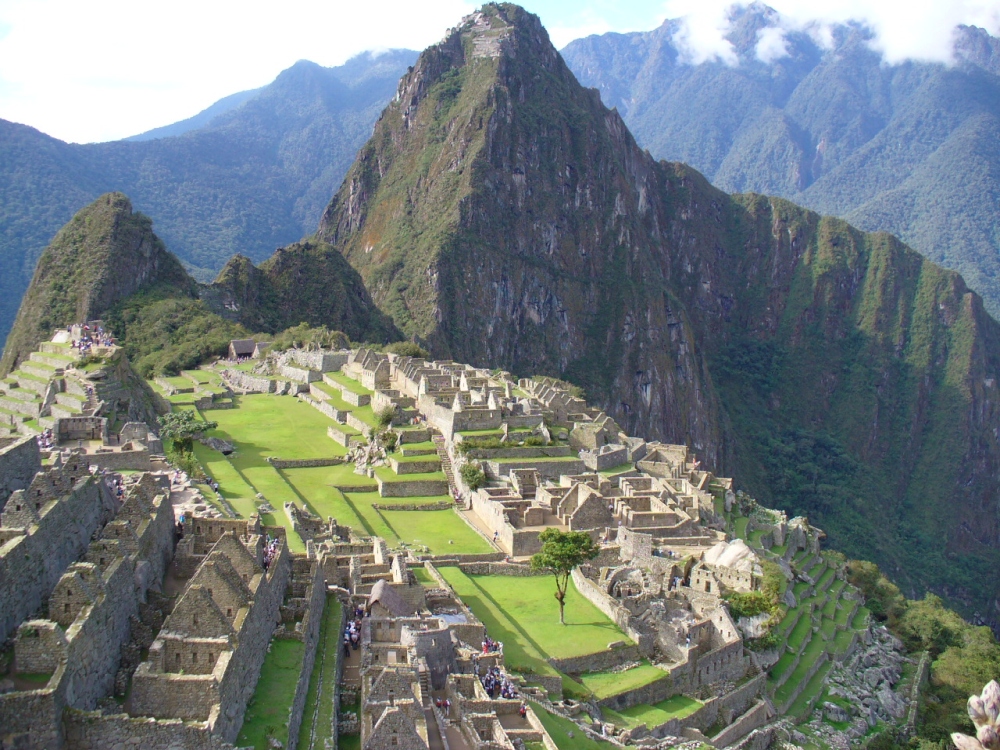
As for Machu Picchu, these Inca ruins were exactly as depicted in postcards and books. This is one tourist site that not only lived up to expectations but exceeded them. We enjoyed a picnic lunch overlooking the ruins on our first day, interrupted by a brief mist of rain, before walking the final section of the Inca trail. 

A three kilometre uphill hike took us up to Inti Punku, the Sun Gate, which overlooks the entire valley. I loved the view. However, some of the narrower terraced sections were a little too nerve-wracking for Garry. The day had been largely overcast until we reached the gate. True to its name, the sun broke through, and in the distance, Machu Picchu glowed a wonderful vivid green.

If you look closely at the image below, you'll notice the winding Hiram Bingham Highway. It takes tourists up to Machu Picchu. We stayed overnight in the village of Aguas Calientes. This small tourist town sits in the valley below, about 6kms from Machu Picchu itself. The road to Machu Picchu takes you, via a series of 14 nerve-wracking hairpin turns, from an elevation of 2,040 metres up to the ruins at 2,430 metres. Thankfully, the narrow gravel road is restricted to authorised traffic, and trust me, it's no highway!


The following morning we visited again at dawn. Clouds were swirling around the site as we arrived giving everything a completely different mood. I then bravely climbed the nearby peak of Huayna Picchu. The ascending trail was damp and near vertical in places. However, the view from the top was well worth the huffing and puffing to get there. The trail back down was a whole different story.


What the guidebooks don't tell you is that shortly after reaching the summit you return by descending two flights of ancient Inca stairs. Each is at least 100 metres in length, with a sheer drop of literally hundreds of metres to the valley floor. Of course, there are no handrails and some of the rock steps are less than 40 cm wide and 20cm deep. I literally clung to the side of the mountain and watched my life pass me by!


The first of these terrifying stairways can be seen in the photo above. This view, taken from the top of stairs doesn’t do it justice. The vertigo you experience is hard to describe and angle of descent is difficult to grasp.

For example, the little white dot that you can see at the bottom of the stairs is a large 40-litre rubbish bucket. Beyond the edge of each step is the valley floor, almost 800 metres below. The photo below, pulled from the web, shows the same stairway from another angle.


However, it was the next set of stairs that truly did my head in. To reach them visitors pass through an abandoned, roofless stone hut. It’s visible at the base of the stairs in the image above. The hut’s level ground and sturdy walls create a false sense of security, a sense that the worst of the descent is behind you. 

Nothing could be further from the truth. As you exit the far end of the hut you’re confronted by a near vertical stairway, steeper and more terrifying than the last. Visitors must descend this to reach the main hiking trail below. Here’s a series of images that tell the story better than I can.


The first image above gives you a sense of the vertical drop, while the second reveals how narrow the stairs were in the most treacherous section (take a closer look at the right side of this image!). I've also included a third image taken from below to give you a better sense of the shear vertical drop involved. It really is that steep!


Finally, in case you don’t believe me, above is a photo ripped from the web, that shows that final descent from another angle. Unlike the group in this image I didn’t have the comfort of others to inspire me. Instead, it was just me and a young woman I met part way down encouraging each other to keep going. Truth be told, she was just as mortified as I was by the narrow stone steps. We both swore, “Never again!”


Of course it would be remiss of m not to acknowledge that the views on offer were equally jaw-dropping. The image above shows the superb aerial view of Machu Picchu I enjoyed while descending this final stairway. The misty cloud cover also conveniently hid the deadly drop more than once.


Earlier in the day Garry had sensibly refused to even consider climbing with me. He spent a comfortable afternoon drinking beer at a local restaurant with others from our tour group. A wise man. Although I did notice an interesting flash flood escape route sign on the wall outside - perhaps he wasn't so risk-averse after all?

I'll finish this post with a few images that capture Machu Picchu's cultural highlights. This includes its intricate stonework, irrigation and drainage channels and the only surviving fully intact Intihuatana, a mysterious Incan device used for astronomical observations and ritual ceremonies. 


The Intihuatana stands in the middle of the Sacred Plaza, the highest elevation in Machu Picchu's central complex. It follows a tiered, pyramid-like setup, topped with a small rock needle carved from a single slab of rock. Through its high elevation, it is thought to connect the different levels of the Inca mythology (Hana pacha, Kay pacha, Ukhu pacha; Spiritual World, Now, Underworld) in one focal point.

This stone dais looks a bit like a sundial, which is actually not far from the truth. During the two equinoxes (21 March and 21 September) the sun stands directly above the Intihuatana – creating no shadow whatsoever. Its precise placement hints at the incredibly rich astronomical knowledge of the Inca.


After two days of exploring these iconic ruins, we caught a late afternoon train back to Cusco. We then spent a final relaxing day wandering the city with others from our tour group. From here, a smaller group flew onward to the Amazon.


One final comment. Words cannot describe the sheer beauty of Machu Picchu. We took literally hundreds of photographs during our two-day visit. It's been a challenge to select just a handful to illustrate this post. On reflection, we were incredibly lucky to visit in such good weather, enhanced by interludes of drifting rain and dramatic mist. I hope that the images I’ve chosen bring the majesty of this special place to life.