Showing posts with label Morocco. Show all posts

Saturday, August 23, 2025

Meknes for a day


Here's another retrospective post about my first time in Morocco. I visited this ancient North African city in October 1990, while backpacking in Europe with a friend called Dean. Our Moroccan adventure kicked off on 7 October when we crossed the Strait of Gibraltar by ferry, then made our way to Fez, travelling with two English couples, Cathy and Tony and Linda and Craig, whom we'd met on board the boat. You read about our adventures in Fez here.

After 2.5 days in Fez, Dean and I were keen to head for a new destination. We had UK Working Holiday Visas that had to be endorsed within six months of being issued. As a result, we had to arrive in the UK by 25 October. We’d arrived in Morocco on 7 October and thus had two weeks remaining. Before time ran out, we wanted to see more of Morocco, visit Paris and explore the Netherlands.

However, we soon discovered our English friends were operating on a different timetable. They weren’t in a hurry to go anywhere. We decided to leave them at a campground in Fez and travel by train to Meknes, one of Morocco's four Imperial cities, before returning to Spain.


We reached Meknes mid-morning on Wednesday, 10 October, and spent the day exploring its popular tourist sites, including el-Hedim Square, a vast plaza at the southern end of the old city, and Bab Mansur al-'Alj, an ornate ceremonial grand entrance to the Kasbah of Moulay Isma'il. You can see this gate in the image above, along with a couple of entrepreneurial locals dressed as Guerrabine, or traditional Berber water sellers.

Water sellers once provided fresh water for local residents before the advent of modern plumbing. You’d find them in public squares and markets loaded with goatskin water bags and brass containers, dishing out a measure of water using brass cups. The brass implements, accompanied by bells, were often hung in a fashion that caused them to jangle as they walked, thus announcing their presence. These days, they’re simply a tourist attraction.


The Kasbah is a vast palace complex built in the medina by the Moroccan sultan Moulay Isma'il ibn Sharif between 1672 and 1727. It's said to be the world's largest palace. We explored the complex for much of the day, including the ruins of Dar el-Kebira, the oldest of several palaces inside. Dar el-Kebira was abandoned after Moulay Isma'il's death and replaced by another, even grander series of buildings. These were replaced in turn by successive sultans.

The three images above were pulled from the web. They give you an excellent sense of the size and scale of the old city walls surrounding the medina, and the spectacular Mausoleum of Moulay Isma’il within the palace complex. To be honest,  I can't recall much about our time in Meknes beyond a general consensus that we were glad we'd made the effort to stop here on our way back to the Mediterranean coast.  It offered an interesting contrast to the chaos, crowds and clutter we'd encountered in Fez.

Our final night in Morocco was spent sleeping (sort of) on an overnight train to Tangiers. The train was crowded, and the seats (if you could get one) were little more than rows of timber benches. Most of us sat on our luggage or on the floor, resting against the carriage walls. In many respects, this noisy and chaotic carriage was the closest we ever got to experiencing real daily life in Morocco.


The following morning, 11 October, we caught the ferry back to Spain.  Yes, that's my actual ferry ticket above. As we backpacked through Europe, instead of buying bulky and impractical souvenirs, I kept some of the tickets and receipts we collected along the way. While researching this post, I discovered that the ferry no longer docks in Tangier. These days, its final destination is a massive new international port built approximately 40km along the coast.

Upon arrival in Algeciras, we successfully retrieved our confiscated backpacks after paying a modest fine for failing to collect them before our locker time expired. You can learn about our cheeky storage solution in my retrospective post about Fez. From here, we made our way north by train to Seville, our final stop in Spain. More about this next adventure in another post.

Upon reflection, I’m astounded by how bold we were travelling in North Africa. Even more so, given the stories we’d heard of backpackers mugged by ruthless youths. Likewise, seemingly harmless encounters sometimes morphed into situations that often made us feel decidedly unsafe.

For example, we’d jokingly decided early on that the first English words every Moroccan child learns are “Hello, my friend”. However, we soon discovered that their language skills morphed dramatically when we refused to buy their trinkets. Smiles were rapidly replaced by anger and a string of graphic profanities in English and Moroccan, which quickly drew a crowd. This often included older boys who'd harass and intimidate us as we walked along the street. It was another valuable lesson about the situational lack of power experienced by cultural minorities.


Cultural encounters


It’s retrospective post time again. In October 1990, I spent five days in Morocco while backpacking in Europe. At the time, I was travelling with Dean, a sheep farmer from Victoria. Visiting Morocco was a genuinely transformational experience. It was my first immersive contact with a Muslim culture, my first exposure to life as a racial minority, and my first encounter with true poverty.

Our Northern Africa excursion was an eleventh-hour itinerary change. Months earlier, I'd worked out that we could get to Morocco by leveraging discounts associated with our Eurail Youth Pass.  However, we'd have to manage our timeline carefully to ensure we crossed the UK Border before our working holiday visas expired in early November. We decided to play it by ear and see how our schedule unfolded in Southern Spain.

After spending time exploring Andalusia, we decided to give Morocco a go. On Saturday, 6 October, we reached the Mediterranean coast, arriving by train in Algeciras. We arrived mid-morning and transferred onto a local bus for La Linea de la Concepcion, a town on the border with Gibraltar. Here we crossed the border and spent time exploring the Rock. You read more about our time in Gibraltar in a separate post.

After staying overnight in Gibraltar, we crossed back into Spain the following morning and made our way to the port in Algeciras. On the advice of fellow backpackers, we repacked a couple of day packs with enough clothing and essentials to last a week, before storing our primary backpacks in coin lockers at the ferry terminal. I must confess that we blithely ignored signs warning that the lockers would be emptied after 48 hours if their contents weren’t collected.

It seems we weren’t the first itinerant travellers seeking to store luggage for extended periods at the port. However, other backpackers reassured Dean and me that the port authorities would simply move uncollected luggage to a nearby storage room. Although I must admit that some experiences shared by returning travellers were less reassuring.

For example, we met an English backpacker coming off the ferry who told us he’d been robbed in Morocco, driven to the port, given money for a ferry ticket and told never to return. As I recall, he’d met a group of young men one evening who’d offered him hashish and a good time. However, a good time soon morphed into a robbery and pseudo-kidnapping. Dean and I decided hashish wouldn’t be added to our bucket list of travel experiences.


The ferry to Tangier took less than two hours to cross the Strait. However, during that time, we also crossed an unanticipated cultural divide. I distinctly recall feeling uneasy on board. At first, I couldn’t work out why until the realisation struck home. Dean and I were an ethnic minority. Except for two English couples we ran into, we were the only Caucasians on board, and among the only English-speaking passengers. Everyone else was a dark-haired, tanned Arab, or appeared to be of that origin.

Until that moment, at the age of 25, I’d never found myself in a situation where I was an ethnic minority. For the first time in my life, I suddenly understood, in some small way, what it felt like to be part of a minority group. I’ll never forget the sense of vulnerability and the perceived loss of situational power I felt on that boat. It was one of those life-defining moments that only travel can deliver.


Dean and I understandably gravitated towards the English couples on board. We ended up drinking beer and swapping travel stories with Craig and Linda (on the left in the image above), and their friends Tony and Cath (on the right above). The two couples were friends from England travelling together in a campervan they’d driven through France and Spain. They were now headed to North Africa. They invited us to travel with them to Fez, their first destination. Free transport through Morocco was an opportunity simply too good to pass up.

Upon disembarking in Tangier, we drove south through the dry and dusty Moroccan landscape with our newfound English friends. It took us more than five hours to reach the ancient city of Fez, nestled in the northern foothills of the Atlas Mountains. We knew nothing of the city before our arrival. Our dog-eared travel guide didn’t have any chapters on North Africa. We were literally travelling “off the page” in the pre-Internet era.


Fez is a truly remarkable place. It’s been called the "Mecca of the West" and the "Athens of Africa". It is also considered the spiritual and cultural capital of Morocco. It has the world’s largest intact medieval city, with a pedestrian-only medina (old city) covering 2.2 square km. 

For the next three nights, our group based itself at a campground on the edge of the modern city. One couple slept in the van, the other in a tent, while Dean and I slept in the open air under the stars. Much to our surprise, the entire campground was shaded by Australian Eucalyptus trees. Never in a million years could we have anticipated camping in Africa under the shade of Australian native trees.

The next two days were a blur of cultural and sensory overload. We’d all heard horror stories of tourists getting lost in the medina’s sprawling labyrinth of laneways and enclosed cul-de-sacs. To avoid the same fate, we all chipped in and hired a local guide to take us through the best of Fes. Our first day was spent exploring the modern city and Fes el-Jdid, its “new medina”. New, of course, is a relative term. Fes el-Jdid was founded in 1276. Our second day was spent in Fes el-Bali, the oldest and original ancient city, founded between 789 and 808.
 

We begged our guide not to take us to a selection of cliché tourist traps. We also made it clear that we didn’t want to spend our time visiting an endless stream of handicraft workshops. By and large, our guide delivered. We got to explore and see the best of Fes and its mind-blowing medina, visiting only one Persian rug showroom during the two days we spent with our guide.

The sights, sounds and smells of Fes are hard to describe. This was also my first encounter with truly non-European culture, making the contrast uniquely memorable. Until then, my travels had been limited to the USA, Canada, Australia and New Zealand, plus recent adventures in Western and Eastern Europe. For example, consider the three children shown in the image above. We encountered them carefully chiselling ceramic tiles into an array of mosaic shapes while touring the Medina. 

Our guide had taken us into the back streets to learn how mosaics on the city’s monumental gates and buildings were made. In a tiny workshop, we were introduced to groups of children tracing mosaic shapes onto glazed ceramic tiles while others chiselled them into the finished shape. Our guide explained that these children worked for a living, helping their families earn enough to survive. The poverty we witnessed was a shock to say the least. 


Perhaps the most mind-blowing sensory experience was the Chouwara Tannery. This ancient open-air complex was extraordinary. You could smell it long before you could see it. Here, animal skins are cured with quicklime, cow urine and pigeon poop by men pounding with their feet, then are dyed in a series of tiered, round vats of vivid yellow, red, green or blue.

In the words of one travel writer, “the process is medieval and will challenge both your olfactory nerves and attitude to voyeuristic tourism.” I couldn’t agree more. For example, in the foreground of the image above is a pungent pile of rotting hides. These were the rejects from earlier batches, casually discarded and simply left to decay. It’s hard to fathom that animal hides have been cured and prepared this manner, in this location, for almost a thousand years.


Other highlights included Bab Boujloud, a monumental gateway leading into the old city. Through its ornate Moorish horseshoe arch, you get your first spectacular glimpse of the medina inside. The locked entrance doors to the Dar al-Makhzen, the King of Morocco’s Royal Palace, in Fes el-Jdid were equally impressive (that’s us above standing in front of them).


One of our travelling couples decided to shop for a rug. As a result, Dean and I were entertained by locals wielding oodles of hot, sickly sweet mint tea while they shopped for the perfect rug. Once selected, your chosen rug was expertly folded and stuffed into a canvas shopping bag ready for dispatch. You could take it with you or have it delivered directly to your home. 

The craftsmanship on display was impressive to say the least. It’d be another decade or so before I’d explore similar showrooms in India and the Middle East. However, nothing will ever compare to this first encounter with a non-European culture. The novelty of this incredibly exotic experience is neatly captured by the image above.

Likewise, Dean and I were fascinated by the local women dressed in their traditional burqas. Most also had their faces fully veiled. We'd never seen anything like it and wanted to capture this cultural experience in a photo. However, it quickly became clear these women didn’t want to be photographed. In the end, we resorted to a rather culturally insensitive solution. We took photos of each other in the medina’s laneways, timing the photo to include a passing woman. This post opens with one of these images.


We also visited the elegantly white-washed Jewish cemetery in the city’s old Jewish quarter. Once again, my naivety was made manifest. Until this moment, I’d never known that something as fundamental as burying the dead could differ between cultures. Likewise, the cemetery tells a troubling story of European persecution. We learned that large Jewish communities developed in Morocco and elsewhere in Northern Africa after the Jews were expelled by royal decree from Spain in 1492 and Portugal in 1497. 

By the mid-16th century, the Jewish quarter in Fes had an estimated population of 4000, and by the end of the 19th century, it had some 15 active synagogues. However, these days the cemetery is little more than a memorial to a community that has long since vanished. By 1997, there were reportedly only 150 Jews living in all of Fez, and no functioning synagogues remained. Travel really does broaden the mind.


A few kilometres further on, by the ruins of the Merenid Tombs, we stopped to enjoy a stunning view of the medina. These picturesque 14th-century mausoleums were built by the Merenid dynasty that once ruled Morocco. Below us, a carpet of goat skins was scattered across the hillside, drying in the sun. In the distance, the chaos of the media unfolded across the valley. 

It was easy to see why tourists were warned not to tackle its sprawling expanse without a local guide. Of course, these days, the magic of GPS and Google Maps has transformed the experience as Garry and I aptly demonstrated while tackling the laneways of Marrakesh earlier this year.

On 10 October, we left Fez and began retracing our steps back towards Spain. We farewelled our new English friends and headed for the nearby city of Meknes. Follow this link to learn more about our brief stop in this equally ancient city.

Weeks later, we caught up for a drink with Tony and Cath in London. They told us that the campground subsequently charged them an additional “tent fee” because Dean and I had strung up a plastic sheet to shade our sleeping bags. At the time, we’d paid for an entry-level “open-air” camping fee and slept under the stars. None of us thought that a sheet draped over a string would be deemed a tent.


Sunday, January 26, 2025

Moroccan scrub down


Our final day in Marrakesh was spent pampering ourselves at a traditional Moroccan Hammam. These spa venues are everywhere. In the West, they’re what we'd typically call Turkish Baths. Garry and I booked a classic hammam session followed by an hour-long massage. 

Two young women managed our hammam experience in a private treatment room clad in dark blue ceramic tiles from floor to ceiling. What followed was a steamy flurry of showers, scrubs, buckets of water, and plenty of giggling. The venue gave us a pair of disposal shorts for the session, which proved invaluable as we were repeatedly whisked from a heated tiled treatment bench (cushioned by a nylon-clad foam pad) to a shower and back.

A typical hammam session starts with a general wash-down in a tiled room, followed by a steam room sauna. The experience continues with a rigorous exfoliation scrub, plus a head-to-toe mineral clay treatment. Finally, everything is rinsed off and you’re given a final argan oil rubdown. The layers of skin we watched flowing down the drain after our exfoliating scrub was alarming, to say the least.

Our massages proved equally therapeutic. While they weren’t exceptionally firm, we both fell asleep during the session. I guess you know you’re relaxed when your own snoring wakes you mid-treatment.


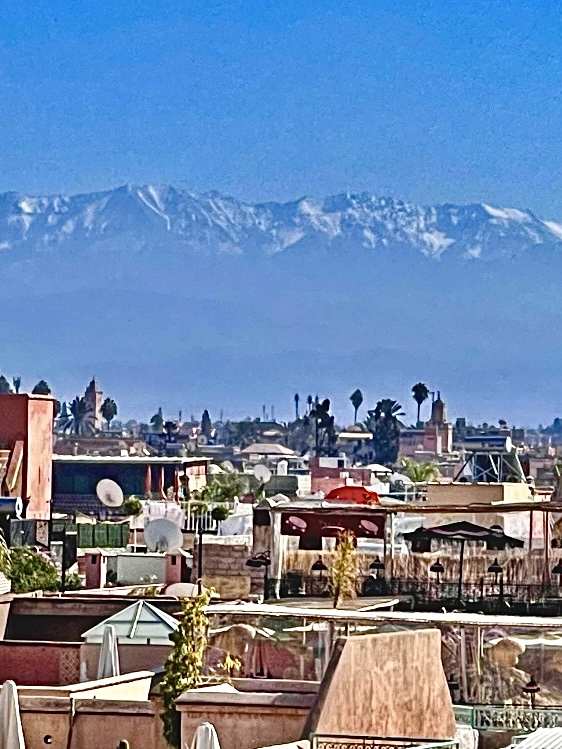
We then returned to our favourite rooftop bar at Shtatto for a late lunch and a final look across the jumbled medina rooftops. The Atlas Mountains gave us a final showing despite the ubiquitous desert haze. It was the perfect way to finish a truly memorable experience. Although I must admit I think I’m finally showing my age. The dirt, chaos and ramshackle sights were a little exhausting at times. The novelty of adventure travel seems to have worn thin after all these years.


Our flight back to London passed without incident. Although we almost caught the wrong train from Gatwick into town. We finally made it into our Paddington-based Airbnb shortly before midnight. Garry found this venue a few months back. It was a recently renovated flat spread over four levels on a triangular footprint less than 500 metres from Paddington Station and a similar distance from Edgware Road in the opposite direction. 

When we opened a curtain the following morning, we discovered it sat directly over the District Line tube tracks. The track briefly passed through an open cut before disappearing under our building and passing under Praed Street. However, triple-glazed windows ensured that a little muted rumbling was all we noticed whenever trains passed below us.


Unfortunately, Garry woke in poor health. He spent the next three days in bed with a fever while I made the daily trek to Olympia for the London Toy Fair. I met with suppliers, walked the halls, and renewed old acquaintances. One supplier, Indigo Jamm, also took me for dinner one evening.

Saturday, January 25, 2025

Skoura


Skoura is something special. This historic fertile oasis is home to more than 24,000 people. It’s filled with immense palm groves nestled among the confluence of several rivers and streams descending from the central High Atlas mountains. These ultimately converge into the nearby Dadès River. During our visit, most of its gravel stream beds were dry and dusty.


We stayed the night in a boutique hotel, where we enjoyed a spectacular sunset from its rooftop balcony. The following morning, we were met by a local guide who took us on a rambling 3km walk through the oasis as far as Amridil Kasbah, a local icon. We began our walk before sunrise while the locals were at their most active. The sun rose as we walked, bringing warmth and character to the barren landscape. 


Our guide was excellent, pointing out quirky facets of daily life in the desert. For example, he explained how the land is divided into family plots; each one gets access to water diverted down irrigation channels once every two weeks. He talked about his own family plot where they grow barley. Others grow corn, beans and alfalfa (feed for the animals). Almost everyone grows and harvests dates.


Amridil Kasbah, a beautifully restored, fortified castle, was another highlight. It’s considered one of the most impressive kasbahs of its kind in Morocco and once featured on the Moroccan 50 dirham note. It’s still owned by a local family who live in part of the complex. We even met one of the family's sons on our way out. Our guide took us through the public areas, which we had almost completely to ourselves for almost an hour. 


Incredibly, the entire structure is built from rammed earth or mud brick, with ceilings supported by locally sourced cedar timber, and a roof thatched using bamboo and palm. During our tour, we were shown the wooden forms used to construct its massive walls and geometric towers. The view from every doorway and around every corner was simply breathtaking. I’ll let my photos tell the story. 


From Skoura we made our way back to the city of Ouarzazate. Here we briefly stopped to admire the exterior of Kasbah Taourirt, used as an embassy in the movie “Rules of Engagement” and for some scenes in Star Wars. Unfortunately, it’s currently closed for renovations following the 2023 earthquake. However, its external facade is an impressive sight.


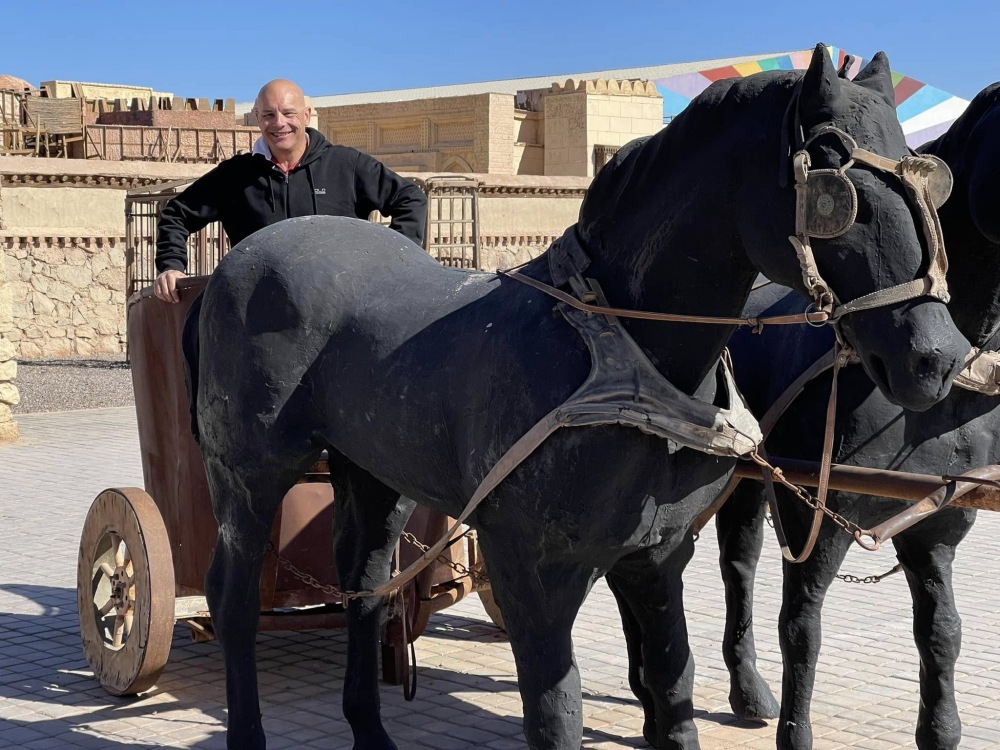
Ouarzazate is home to the Moroccan film industry. Two massive film studios sit on its outskirts. We took a guided tour through several sound stages at Atlas Studios. This includes village scenes that have appeared in movies such as Black Hawk Down, Star Wars and more. We also saw a set used to film the final season of Prison Break and sound stages used to simulate Egyptian, Chinese and Mongolian locations. It’s surreal to pass through a door and encounter Cleopatra’s temple, then turn a corner and discover a forest of scaffolding holding it all in place. 


We then spent three hours driving back through the Atlas Mountains to Marrakesh. To celebrate our final night in Morocco, we shouted ourselves to a slap-up dinner at Nomad, a top-rated North African fusion restaurant in the heart of the medina. We decided to try the mocktail float with our meal, a series of five colourful juice drinks, in place of alcohol that's traditionally restricted in this Muslim nation. Garry and I agreed the Orange, Carrot, Ginger and Turmeric shot was best, followed closely by the Avocado, Orange, Dates, Mint and Verbena shot.