Showing posts with label Kyoto. Show all posts

Friday, August 23, 2024

Nara in the Spring


I flew into Kansai Airport on the evening of 6 April. The airport sits on an artificial island in the middle of Osaka Bay, about an hour by train from the central city. By the time I'd made it through immigration, collected my bag, transferred to the train and finally reached the hotel, it was bedtime. 

The following morning, I caught a train to Nara for the day. The forecast was for mainly overcast conditions with the chance of a late passing shower. I'd decided that exploring temples and shrines was a smarter bet in these conditions rather than the more outdoor-oriented Hakone day trip I'd originally scheduled. 


The gamble certainly paid off. I enjoyed mainly dry conditions until a brief, and rather light, shower passed through while exploring Ukimido Pavilion on the southern boundary of Nara Park. The umbrellas you can see in the opening image above captured this short lived shower. I later found a dry spot under a tree and enjoyed a picnic lunch overlooking the pavilion’s cherry blossom-rimmed pond (complete with a curious deer as you can see above).


Nara is Japan’s ancient capital. Established in 710 A.D., it became the nation’s first permanent capital. Prior to that, the capital moved to a new location as a new emperor ascended to the throne. Most of its sights are concentrated around Nara Park, wooded parklands on the modern city’s eastern fringe. 

I spent half a day exploring the park and its surroundings while dodging hundreds of curious deer roaming freely through the grounds. The deer are fearless. Park visitors can purchase dried food pallets to feed them. As a result, you’re continually harassed by animals frisking you for a treat. I bought one of these small packets, set up my camera, activated its timer, and secured myself a memorable selfie.


The park is home to Tōdai-ji temple. Until recently, the temple's main hall, the Daibutsuden (Big Buddha Hall), held the record as the world's largest wooden building. Interestingly, the present building reconstructed in 1692, is only two-thirds of the original temple hall's size. Inside sits Daibutsu, Tōdai-ji's 15m-high bronze Buddha. It’s an impressive sight.

Off to one side of the hall is a quirky path to enlightenment. One of its massive timber columns has a narrow archway carved through it. Tradition has it that if you can crawl through the gap you’re well on your way to true enlightenment. Sadly, I was far too large to enjoy this niffy shortcut to eternal bliss.


Nearby Shin-Yakushiji Temple was home to another quirky tradition. It's devoted to Yakushi Buddha, the patron of medicine in Japanese Buddhism. Inside the main hall, there are life-size statues of 12 guardian deities, Baraza Wind Gods, surrounding a two-meter-tall statue of a seated Yakushi Buddha. The Yakushi statue is made of wood while the guardians, dating back to 700AD, are made of clay.

The Yakushi Buddha, or Healing Buddha as he's also known, is said to possess healing powers. Visitors seeking good health and healing line up to rub its surface and pray. As a result, years of rubbing have rendered its surface smooth and shiny, while the natural oils from all these hands have stained the timber in a rather eerie way.

 
On the park's east side is the Shinto shrine Kasuga Taisha. This compact complex dates back to 768 A.D. It’s considered Nara’s most sacred shrine as it’s dedicated to a deity responsible for the city's protection. It’s filled with more than 3000 lanterns of all types donated by dedicated worshippers.


While in Japan I discovered that the sakura season isn't the only festive occasion in Spring. My trip also coincided with Ohakamairi, the traditional visit to one's ancestral graves. Every year family members, usually led by the eldest son, visit their family graves in the first two weeks of April. The grave and surrounding area are scrubbed and cleaned and weeds and debris removed. A series of five offerings are then made including flowers, incense, candles, water and food.

The family will often cloak the grave in a red bib. I encountered these bibs everywhere I went including my first day in Nara. This tradition dates back to Japanese folklore which holds that the colour red can expel demons and disease. However, there’s also a deeper, difficult story behind many of the baby bibs you’ll see on statues. Those bibs have likely been placed there by somebody with a child who died very young or is sick. It’s an offering of protective armour to that deity, fighting to protect their child from demons in the spirit world.

Oh yes, one find note. The artist in the opening image is painting the facade of Nara's National Museum.
 

Saturday, August 17, 2024

Classic Kyoto


During my first trip to Japan, I spent one and a half days exploring Kyoto's most famous temples and shrines, walking and riding trains from one end to the other. I’d set myself a mission to see as many of its historic sights as possible in the time available. In the end, a day and a half was barely enough time to do the city justice.

My first day's itinerary covered the city's eastern flank. This included Ryozen Kannon (the city’s War Memorial temple), Sanjusangendo Temple (home to 1000 Kanon idols), and the iconic Kiyomizudera Temple. Kiyomizudera was particularly memorable. I loved its hillside views of the surrounding Sakura in full bloom.


I started the day with a morning visit to Ninomaru Palace filled with an array of imperial artefacts, before crossing the neighbouring moat into Nijo Castle. The image above shows Karamono, the main gateway into Ninomaru Palace. From here it was on to Heian Jingu shrine and then to Nanzen-ji Temple, before heading south to Kiyomizudera.


In between I also found time to visit Ryōzen Kannon. This is a war memorial commemorating the dead from World War II. Its most notable feature is a giant white Kannon or seated Buddha statue, rising 24 metres from an elevated platform. The temple was conceived as a Buddhist alternative to the controversial Yasukuni Shrine in Tokyo, which has been a source of tension due to its enshrinement of convicted war criminals alongside other war dead.


Kiyomizudera (literally "Pure Water Temple") is one of Japan's most celebrated temples. It was founded in 780 on the site of the Otowa Waterfall in the wooded hills east of Kyoto. Its name speaks of the waters from the fall.  Kiyomizudera is best known for a wooden stage extending from the temple's main hall, 13 meters above the hillside. Balconies along its flank offer stunning views across the area's tree-clad hills and the city of Kyoto beyond.  The blossoms were in full force during my visit.


Behind Kiyomizudera's main hall stands Jishu Shrine, a shrine dedicated to the deity of love and matchmaking. In front of the shrine are two stones, placed 18 meters apart. Successfully making your way from one to the other with your eyes closed is said to bring luck in finding love. You can have someone guide you from one stone to the other. However, this is interpreted to mean that an intermediary is also required in your actual love life.

As the sun began sinking, I made a last-minute decision to backtrack and visit the less impressive Ginkakji Silver Pavilion. I then finished with a memorable sunset walk to the train station via the picture-perfect Philosopher’s Path.

This 1.5km paved walkway follows a tree-lined canal winding through the city’s eastern suburbs. This walk proved a spectacular finish to the day. As I walked, I was continually showered by gently falling petals. I honestly can’t think of a better way to experience the magic of Sakura season.


My second day in Kyoto was spent exploring Kyoto's western foothills. This included the iconic Kinkakuji Golden Pavilion on the opposite side of Kyoto, followed by a lengthy walk to the simple Zen garden at Ryoanji Temple. 

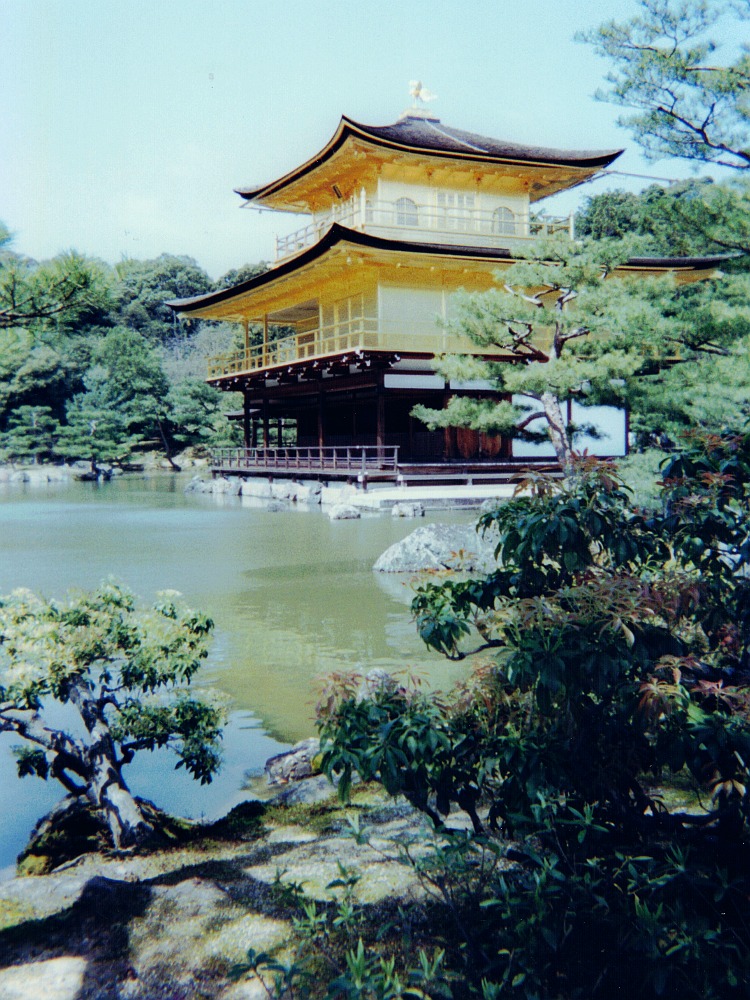
The Golden Pavilion is the city's postcard idol. It's a three-tiered structure set on the shore of an exquisitely manicured lake. The pavilion's top two storeys are clad in gold leaf that glistens spectacularly whenever the sun shines. Throw in a few cherry blossoms and you've guaranteed an absolutely breath-taking experience.


I simply loved the moss garden set into the hillside behind Ryoanji Temple, with the Kogetsudai mound coming a close second. This mound is a seamless conical mound constructed entirely of loose pebbles. I have no idea how the local monks kept in such flawless condition. Its perfection captures the essence of Japanese society - a combination of simplicity, elegance, and highly disciplined organisation.

However, having said this, Japan also has plenty of quirks. None more so than the ubiquitous presence of vending machines offering all manner of snacks, drinks and other daily necessities. You can even buy a cold Asahi beer (no ID required), or soft porno if you know where to go - I kid you not! 


You'll often find machines installed on random corners of suburban streets and along nondescript laneways. Need help finding my house?  Just look for the Coke machine outside.  Although I find it ironic that the Japanese considered it poor form to walk and eat or drink in public. To this day I still don't know where the locals go to consume their vended treats?

Finally, a little cultural highlight. The uniquely Japanese performance art of Bunraku originated in Osaka. It dates back to the 17th Century and blends complex puppetry with musical accompaniment and a chanted narrative. The lifelike puppets are beautifully handcrafted with elaborately decorated costumes and many individualized moving parts, giving them a full range of expression. These articulated puppets are so large that they require three puppeteers to operate them.


However, unlike most puppet shows, in Bunraku the puppeteers are visible throughout the performance, often dressed in black. The narrator or Tayu who chants and sings the story also voices the puppet characters, changing his speech and intonation to express different genders, ages, and social ranking.

Osaka is home to the National Bunraku Theatre. It puts on shows several times a year. My visit coincided with one such performance so I decided to treat myself to a unique cultural experience. Bunraku productions are either historical plays, such as the heroic revenge drama Chushingura, or romantic tales which dramatize the conflict between personal emotion and social obligations. Each performance can last up to three hours.

Sadly, I must confess that I lasted about an hour before declaring myself a Bunraku philistine. While the puppets were impressive, I was surprised to discover that the scenery and props were less elaborate and changed rarely during the show.  After an hour or so of chanting in a language I didn't understand, coupled with the knowledge I had at least another 90 minutes to go, I decided I'd experienced enough culture.  I quietly made my exit during one of the show's darkened scenes.

Chion-in Temple Gate

Heian Shrine

Tuesday, September 17, 2013

Fushimi Inari Taisha

I said I wasn't going to publish individual posts on our time in Kyoto. I lied.  There's one place I simply have to tell you about.  It's Fushimi Inari Taisha.  This is an incredible shrine complex on the slopes of Mount Inari, just south of Kyoto.

Inari is the god of rice.  As you know, rice is diet staple that rests at the heart of Japanese life and culture.  This means that Inari is also closely associated with wealth and prosperity.  He's considered the patron of business, merchants and manufacturers throughout the country. Fushimi Inari is his primary shrine in Japan.


As you enter the shire you're immediately greeted by an enormous stylized image of a fox.  I must confess that, at first, Mum and I thought it was cartoon dog.  However, we soon learnt that the fox is considered a messenger and guardian for Inari. Fox effigies are often displayed around Inari shrine.  you typically see them presented in one of two poses. The most common of these has the fox holding a granary key in its mouth.

The main shrine structure was built in 1499.  It actually replaced a series of earlier building dating back to 816. However, the earliest Inari shrines in the area were erected at least a century earlier. Behind the main complex stairs leads worshippers toward a series of trials that wind their way a further four kilometres to mountain's summit, 233 metres above sea level.  The main path is framed by thousands, upon thousands, of brilliant red torii gates.

Each gate is private donation from an aspiring, or possibly grateful, Japanese business. It's an extraordinary sight.  In places the path splits into two for several hundred metres.  Each route continues to be framed by the same mesmerizing river of red.

Mum and ventured up one path to the first resting place.  This small clearing houses a series of shrines, each with its own forest of paper prayers tied in neat rows along one of the ubiquitous wire-framed prayer fences you'll always find in Japan. We decided that once you've seen the first thousand gates you've really seen them all.  We retraced our steps and made our way towards Zen temples on the northern flank of the Kyoto hills.