Showing posts with label Paris. Show all posts

Monday, May 04, 2026

The City of Light


Time for another retrospective post. Visiting Paris for the first time was the fulfilment of a childhood dream. For as long as I can remember, I was mesmerised by images of the Eiffel Tower and the Arc de Triomphe. I finally got to see them with my own eyes in October 1990.

At the time, I was nearing the end of a three-month backpacking odyssey through Europe. Dean Keiller, a sheep-farming friend from Victoria, and I had leveraged a Eurail Youth Pass and travelled as far north as the Arctic Circle in Norway, and as far south as Morocco. Our final two weeks on the road were devoted to visiting Paris, the Netherlands and then making our way across the Channel to London.


Getting to Paris was another bucket list moment. On 13 October, we caught the 15:52pm TGV service bound for Paris in Avignon. As a civil engineering geek, I’d always dreamed of riding a high-speed train. The TGV had entered service just nine years earlier on a new high-speed line from Lyon to Paris, reaching a top speed of 270 km/h.

As a result, the train we caught travelled on a regular rail track until it reached Lyon, where it transitioned onto its dedicated line. You know immediately when the transition has occurred as the train’s speed increased dramatically. Dean and I were like kids in a candy store as the French countryside began to blur past the window. It was definitely worth the extra surcharge we paid on our Eurail tickets.

However, this wasn’t the only unique rail travel moment we experienced. Earlier in the day, we’d crossed the border into France after catching a train from Barcelona. Back then, Spanish trains ran on Iberian gauge tracks (1668mm width), while France used standard gauge (1435mm). As a result, when the train crossed the border near Perpignan, it had to transition onto the narrower French rails.

Carriages on the Spanish train featured an adjustable boogie that allowed their wheels to be slowly pushed together or pulled apart using a gauge-changing device. However, the train engine’s wheels were always fixed, so it was always swapped at the border. Converting the entire train took about ten minutes. These days, the high-speed train network in Spain runs on standard gauge, so its trains travel seamlessly across Europe.


After travelling continuously for almost 18 hours from Seville, we finally arrived in Paris mid-evening. Here we transferred to the local rail network and made our way to a campsite in the outer suburbs. For the next five days, we explored the City of Lights from top to bottom.

Naturally, our first full day in Paris was devoted to visiting its most iconic sights, including the Arc de Triomphe and the Eiffel Tower. We climbed both structures. The Eiffel Tower was particularly challenging. You could climb the stairway from the ground to the second level for seven francs or spend 11 francs and climb the stairs to the third level. As budget-wary backpackers, we elected to climb the stairs all the way. I’m glad we did, as it gave us a more intimate look at the tower’s structure and engineering. I loved it.


I had the same reaction to a scale model replica of the Statue of Liberty standing on an artificial island in the Seine. The original statue was designed by French sculptor Bartholdi, and its innovative iron skeleton by Gustavo Eiffel. It was built and assembled in a workshop in Paris before being shipped to New York as a gift to the American people in 1887.

I’ve pulled the image above from the web. It tells the story of what went on behind the scenes in Paris all those years ago.The replica on the Seine was one of the workshop's working models. Parisian expatriates living in the United States bought it and gave it to Paris in 1889.

Our remaining days were filled with many highlights, including a trip up the hill to Basilique du Sacré-Cœur de Montmartre, the iconic white-domed church offering uninterrupted views of the city. At the base of the hill I still recall my first glimpse of the faux windmill atop the equally iconic Moulin Rouge cabaret hall. Although we never ventured inside.


Dean and I also visited Hotel des Invalides to see Napoleon’s tomb, marvelled at the crazy pipework cladding on the Pompidou Centre, and gazed in awe at the interior of Notre Dame Cathedral. A note on the back of the photo above reminded me that I took it while sitting on Dean’s shoulders. It was the only way to get a shot with plenty of Autumn colour in the foreground.

The collonaded building shown above is La Madeleine. It’s actually a regular Catholic Church, surrounded on four sides by soaring Corinthian columns. This rather unorthodox design reflects its origins as a royal showpiece. Louis XV commissioned it as the focal point of the new Rue Royal, leading to the new Place Louis XV, the present Place de la Concorde. It’s easy to understand why the French eventually overthrew their king when you see one indulgent building after another around the city.


We spent at least half a day exploring the Louvre from one end to the other. Like all good tourists, we stopped to admire La Giaconda, better known as the Mona Lisa, and like so many before us, came away surprised at how small and unassuming the portrait really was. I also loved seeing the Venus de Milo sans her arms and the equally iconic Winged Victory of Samothrace.

Once again, much like our experience in the Uffizi Gallery in Florence, we couldn’t believe the endless stream of iconic artist names on display throughout the museum. As an aside, Dean and I visited the Louvre long before its glass pyramid entrance opened. This famous structure didn’t start greeting guests until 1993. 

On our final full day in Paris, 18 October, Dean and I ventured out of town to explore the Palace of Versailles. This former royal residence was easy to reach by train, about 18 km from the city centre. Commissioned by King Louis XIV in 1661, it became the seat of the royal court the following year and remained so until the French Revolution.

The palace is an extraordinary complex. Its statistics are mind-boggling. The palace itself sits on an estate of more than 800 hectares (8 square kilometres). The main building boasts 2,143 windows, 1,252 chimneys and 67 staircases. Within the grounds sits an equally impressive building, a French Baroque-style chateau known as the Grand Trianon. It served as a less formal retreat for the royal family.


Without doubt, the most famous room in the entire palace is the iconic Hall of Mirrors. This 400-metre-long gallery links two wings of the palace. It features 17 windows facing west towards the formal gardens and parkland, while the opposing wall has 17 equally large mirrors. These mirrors reflected the king’s wealth as mirror glass was an expensive luxury in the 17th century. It could only be made with considerable effort, which took time and money to complete. 

As you can see from the image above, which I’ve pulled from the web, the ceiling in the Hall of Mirrors is also richly decorated. One final fun fact: the infamous Treaty of Versailles, which ended the First World War, was signed here. It was the most opulent palace that Dean and I had ever seen. Decades later, I’d get to explore royal residences in London, St Petersburg and Vienna that rival Versailles. However, as my first experience of European royal decadence, it made a lifelong impression. 

On 19 October, Dean and I packed our bags and headed for the Netherlands. This was to be our final destination in continental Europe before making our way to London. However, we decided to base ourselves in Delft, rather than travel further north to Amsterdam. 

We chose this southern town for its proximity to iconic locations, including Kinderdijk and the nation’s dike system. In particular, we were keen to see the engineering marvel that is Oosterscheldekering, the enormous storm-surge barrier which had opened just three years earlier. Not sure what I’m talking about? Follow this post, which explains everything.


Friday, April 20, 2007

La Joconde


17 years after last setting foot in the Musée du Louvre, I was back again today. I've been in Paris on business since Sunday, working from 8am until late evening. This afternoon, I found myself with a few spare hours after such a hectic schedule. I decided to treat myself and a staff member to an afternoon tour of the Louvre's more famous highlights.

Forget the art, the Louvre is a destination all of its own. Originally a Royal Palace, it first opened to the public as a museum in 1793. French royalty lived in style. Each gallery, stairway and grand, sunlit hallway is an exquisite masterpiece of decoration and architecture. Many of the rooms have painted and gilded ceilings, progressively completed over the course of several hundred years.

The Louvre's most recent addition is the Pyramid, an enormous glass structure in the central courtyard that opened in 1989. Designed by Chinese architect Ioeh Ming Pei, the Pyramid serves as the main entrance for visitors.


Today we were in luck. No queues were waiting to enter. Within minutes, we found ourselves wandering the halls. Over the next few hours, we feasted on original Egyptian artefacts, Mesopotamian antiquities, Italian sculptures and Italian paintings. We found time for most of the Louvre's most popular items, including The Winged Victory of Samothrace, Venus de Milo, Canova's Psyche and Cupid, Michelangelo's The Dying Slave, and of course, La Joconde, more commonly known as Mona Lisa.


We also encountered several surprising works of art, including an ensemble of white statues standing on a stairway in Cour Puget, an enormous glass-enclosed courtyard. Each statue held a simple clock set to the correct time. Very surreal. I was equally dumb-struck by tiled walls from the Palace of Sargon II and the sheer scale of the giant bull capitals that decorated the Apadena (audience chamber) of Darius' palace at Susa.

However, the most memorable moment came as we entered the Salle des États. To our surprise, the Mona Lisa stood alone in the centre of the room. We stood in front of her for several uninterrupted minutes, marvelling at both Leonardo's masterpiece and the tranquillity surrounding us. We agreed that she was indeed smiling. Of course, it couldn't last. As we turned to view Veronese' floor-to-ceiling painting of The Wedding Feast at Cana, an unruly horde of backpackers swarmed into the room. The Louvre is a magical place.


The Louvre wasn't my only art experience this week. On Wednesday afternoon we dashed down the the dusty paths of Jardin des Tuileries to the Musée de l'Orangeries des Tuileries. Here Monet's enormous water lily panoramas are on display in two simple, naturally-lit oval rooms. It was wonderful to sit for several minutes and simply absorb the peace and serenity on offer. Paris is a magical city.

Place Vendôme's central column clad in spiralling bas-relief bronze plates

Thursday, December 14, 2006

The beauty of Paris


I've just returned from a three-day business trip to Paris. This is my third time in Paris since January. The channel tunnel makes these visits quick, comfortable and almost effortless. Take today for example. Three and a half hours after I boarded the Eurostar in France, I walked in the door at home in London. The seat beside me on the train was empty making the journey even more comfortable than usual.

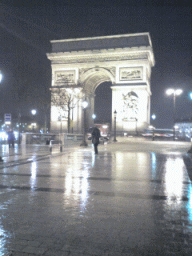
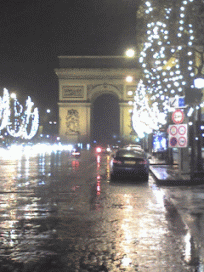
While this was another hectic trip, I did find time on Monday evening to wander around Place Charles de Gaulle, home of The Arc de Triomphe. It was pouring with rain. However, rather than spoil my walk, each rain puddle added to the spectacle, reflecting rows of dazzling Christmas lights along the Champs-Elysees boulevard.

I love The Arc de Triomphe. It's always a joy to visit. Your first view of the monument is an experience in itself. You ride the Metro escalator to street level, which is rather dull and drab. As you emerge into the street you're suddenly confronted by the monument itself. The sight is most unexpected.

The arch is more than 51 metres high and almost as wide. Its design was inspired by the Arch of Titus in Rome. Unlike its Roman cousin, The Arc de Triomphe is located in a spectacular cobble-stone streetscape, designed to match and enhance its dramatic proportions. It's details like this that make Paris a truly beautiful city.

I also love the architecture of the inner city. It's neo-classical stone buildings line both narrow streets and broad, tree-lined avenues. Each building's height is defined according to the width of the street it faces ensuring the most harmonious line of sight. I particularly like the classic Mansard roof shape (a double-sloped roof line) that makes Paris so memorable. The accompanying oval, “oeil de boeuf” windows that protrude from the sloping roof always remind me where I are.

As I wandered to work this morning I revelled in its urban vista, quietly thankful for the job I have.

UPDATE:

I returned to Paris in April 2007 for yet another business trip. Click here to read this post.

Saturday, May 20, 2006

Paris in the moonlight


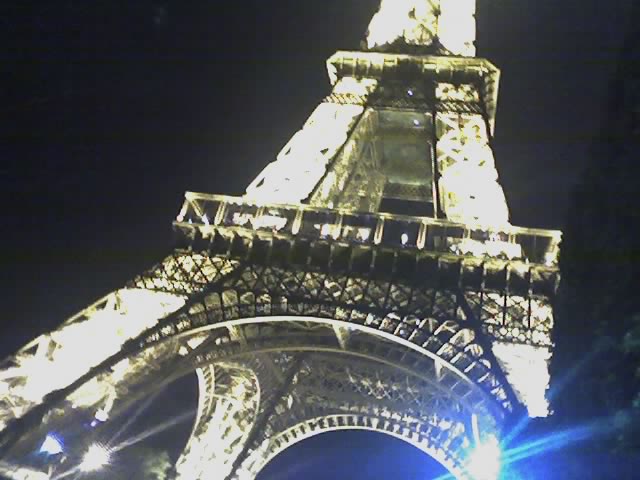
This week I was in Paris for work. I was able to grab a couple of personal moments this trip, enabling me to see a little more than just the hotel or office. On Wednesday evening, the team went for dinner by Fontaine de Mars, literally in the shadow of the Eiffel Tower. After dinner we went for a walk to the Tower itself. As you can see it was brilliantly lit, literally glowing in the night sky.


At the base of the tower were hundreds of Barcelona Football Club fans celebrating their club's win in this year's European League Football Cup. The final had been played in Paris earlier that evening. This was a game to remember. Barcelona had scored its winning goal against Arsenal in the final ten minutes after trailing for the entire game. Controversially, the referee had also sent Arsenal's goalkeeper off 18 mintues into the first half. Debate will rage over this particular decision for years to come. However, for the crowd at the tower this was all history as they lit brilliant red flares, danced and sung their club's anthem.

It was really was one of those moments when you know you're in Europe. There I was, an Australian, standing under the Effiel Tower with a French man and German woman beside me watching Spainsh football fans celebrate their win over an English football club.


The Arc de Triumphe from the back of a taxi.

I was also able to experience the passion of Arsenal's fans. My Eurostar train from London had been packed with Arsenal supporters on their way to the game. Upon arrival at Gare de Nord in Paris, we were given a wonderful taste of the impending stadium atmosphere. As the fans disembarked they began singing their club song at full volume, each verse echoing through the station. The English love their football.


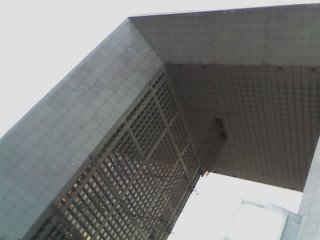
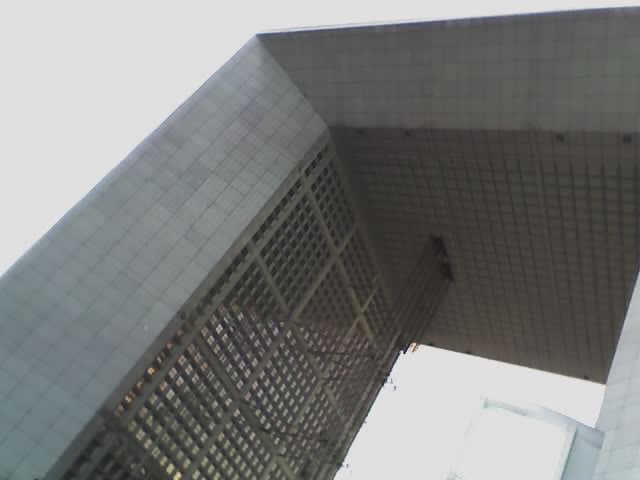
During my final evening in Paris I caught the train into the La Defense for dinner. Afterwards I took a moment to to wander around the Grande Arche plaza, soaking up the atmosphere and savouring the moment. It's not often that I get time to enjoy the signts when travelling for business so this latest trip to Paris was rather special. I particularly loved the statue located directly underneath the main arch. You can see it below. It's a guy with binoculars looking skyward.

Sunday, July 24, 2005

Paris in a day


In July 2005, I flew to London for an executive board meeting. Garry accompanied me to undertake some initial recognizance for our eventual relocation three months later. It proved to be an eventful trip. In addition, to a week in London, we also visited my brother Hamish and his family in Austria, as well as enjoying a day in Munich. 

My company gave us a limited budget for Garry’s travel costs. He took this on as a challenge, did some hardcore research online, and found an incredibly cheap business-class airfare courtesy of SWISS airline. The final route we booked took us via Singapore, Zurich, and Munich to London. The fare was so rare that my hardcore travel agent struggled to find it in her reservation system. In the end, I had to send her a copy of the fare conditions we'd sourced from the web.

The only negative about these discounted fares was the SWISS business class seats. They didn’t fully recline so our dreams of a lie-flat bed were thwarted. Despite this drawback, we slept reasonably well in our flat, but sloping, beds. Although, a group of passengers seated in the cabin's bulkhead row was rather creative. They convinced the cabin crew to elevate their footrests into a near-horizontal position by propping them up with eskies from the galley.

Source: Getty Images

A few days after we arrived in London the city was shaken by the deadly 7 July suicide bombings on the Underground. 52 people lost their lives on that fateful day. Another 700 were injured as four suicide bombers struck during rush hour. The wreck of the Number 30 double-decker bus, pictured above, has become a defining photograph of the attack. It was blown apart in Tavistock Square by the fourth, and final, suicide bomber.

I was in my board meeting at the Baglioni Hotel when the news broke. Upstairs, Garry was preparing to take the tube into town for exploratory meetings with recruiters. He was understandably shocked by how close to home it felt. His appointments were canceled soon after as public transport shut down citywide. Not an ideal introduction to life in the UK capital.


The following weekend, on a sunny Saturday, Garry and I took time out from our hectic schedule to enjoy a more appealing aspect of London life. We caught an early morning train to Paris for a quick day trip. This was my second time through the Channel Tunnel on Eurostar. My first trip was another day trip in 1998. If you ask me, it’s still mind-blowing that you can board a train in London and arrive in the City of Lights three hours later.

Our day trip started with a visit to Notre Dame. While we didn’t climb its iconic bell towers, we did stop to stand on the Zero Mile marker in the plaza out front. This is the point from which all distances are measured from Paris nationwide. From here we walked across the Seine to Place de la Concorde via the ornate Hôtel de Ville, the Louvre, and the eternally exquisite, Jardin des Tuileries.


We then embarked on a metro rail tour of central Paris featuring some of its more distant sights. This included the Arc de Triomphe, and of course, the Eiffel Tower. Looking back we covered an impressive distance in a relatively short space of time. Undoubtedly, one of the more memorable moments that day was a postcard-perfect view of the Eiffel Tower framed by Baroque-inspired buildings on Rue Buenos Ayres.


Finally, before dashing back to Gare de Nord, we completed our French excursion with a brief visit to Montmartre. It was here, on the steps of Sacre Coeur Basilica, that we joined the tourist hoards for a classic sunset view of the Parisian skyline. Then, shortly after 10:00pm, we were back at Waterloo Station in the heart of London. 

I must admit that 18 years later I can’t recall many details about the trip. For example, did we venture up the Eiffel Tower? I don't think we did. If I recall correctly the queue to climb it was insane. Did we stop for a drink while wandering along the Avenue des Champs Élysées? I'm sure we bought at least a cold drink. After all, it was a July Summer’s day.