Thursday, December 15, 2005

Cucumber Country


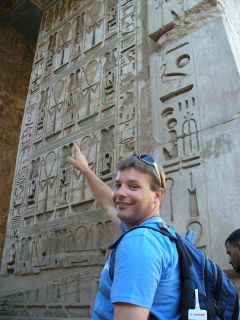
I knew very little about Luxor. As a result, almost every sight and sound was an unexpected delight. The temples are incredible, with every surface covered in Egyptian symbols and hieroglyphics. History literally comes alive before your eyes. However, this is history like you've never experienced it before. We're talking thousands upon thousands of years, all documented for eternity.

I can confidently report that Rameses II wants the world to know that he is terrific in battle, has large hands, large feet, and an impressively large "cucumber." All this and more is literally carved in stone for all to read! I can also report that cell phone reception was excellent from the back of a donkey in the Valley of the Kings. Perhaps one of the more unusual places from which to call my parents?


Our first day in Luxor started early. Our overnight train from Cairo pulled into the station shortly before dawn. We then transferred directly to The Melodie, our Nile cruise boat and home for the next five days, including two days we spent in Luxor. As we boarded the boat, the sky was glowing with dawn light, while hot balloons hung serenely in the air. It was a truly magnificent postcard introduction to an ancient river flowing through the desert.

At first glance, The Melodie wasn't much to look at. It was smaller and less spectacular than other vessels we encountered on the Nile. Take a look at the third photo below, and you'll see what I mean. It boasted only 40 cabins, compared with 80 or more on its larger competitors. However, our group of 17 (including the tour leader) had the entire boat to itself, and thus it felt rather palatial by comparison.


The boat included a top deck with an expansive sundeck. We made good use of it whenever we were on board, as our cabin wasn't large (about 15 sqm including the ensuite). Our cabin also featured air-conditioning, which, surprisingly, we never used. Luxor’s daytime temperature averaged a comfortable 23C during our stay, dropping to a chilly 5C overnight. 


Once we'd settled in for our Nile cruise, it was time to head out and explore the best of Luxor. Our first day was one of wall-to-wall sights and sounds. Shona, our guide, kicked things off with a horse-drawn carriage ride to the Karnak Temple Complex. She timed our journey to ensure we arrived as the complex opened, beating the crowd it attracts each day. Shona told us it's Egypt's second-most visited historical site, second only to the pyramids.

Karnak is a vast site filled with all manner of temples, pylons, chapels, and other buildings. Unlike most other temple sites in Egypt, it developed and evolved over an extraordinary length of time. Construction started in the Middle Kingdom and continued into Ptolemaic times. Approximately thirty pharaohs contributed to its building, enabling Karnak to reach a size, complexity, and diversity not seen elsewhere. According to the Lonely Planet guide, the complex covers more than 100 hectares. That's a lot of infrastructure to maintain!


Without a doubt, the Great Hypostyle Hall in the Precinct of Amun-Re is its primary attraction. Everything about this structure is grand. For example, it covers an area of 5,000 sqm dominated by 134 massive columns arranged in 16 rows. One hundred and twenty-two of these columns are 10 metres tall, while the remainder are 21 metres tall with a diameter of over 3 metres. See the image above. Equally impressive are the rows of ram-headed sphinxes lining the site’s main entrance, and a colourfully painted bas-relief of the ibis-headed god Thoth found inside the Great Hypostyle Hall (also shown above).


From Karnak, it was on to the Valley of the Queens. The wives of many Pharaohs were buried here, while their husbands were buried in the nearby Valley of the Kings. The Valley of the Queens was a real treat. It was only the location in Luxor where photography was permitted inside a tomb. Getting to the valley was half the fun as it's located on the opposite bank of the Nile. With the help of our guide, we caught one of the many open-sided ferry boats that continually cross the river.


We visited several smaller tombs, including the tomb of Prince Amon hir Khopshef. His tomb contained some of the most vibrant hieroglyphics we saw during our entire time in Egypt. The images above give you a hint of the technicolour array that awaited us. The dog figure is Anubis, the god of funerary rites, protector of graves, and guide to the underworld. The falcon figure is Horus, the god of kingship, healing, protection, the sun and the sky. 

I still marvel at the simple fact that this paintwork is thousands of years old. It's also hard to fathom that many of the hieroglyphics we saw in Egypt were once just as colourful. I wonder how monochromatic our world will look to others a thousand years from now?


Our next stop was a real treat. We crossed back over the Nile, grabbed lunch on board our boat, then headed for the imposing Ramesseum temple complex. Ramesses II, commonly known as Ramesses the Great, ruled Egypt from 1303 BC to 1213 BC. He's regarded as the greatest, most celebrated, and most powerful pharaoh of the New Kingdom, long considered the most powerful and influential period of ancient Egypt. He also lived longer than most of his peers. Scholars generally agree that he reached the ripe old age of 90 or 91.


To quote a recent scholar, Ramesses the Great, King of Kings, is a figure who bears comparison to Napoleon, and to every famous autocrat, from Alexander the Great to Mao Zedong. The stats alone tell a story. He lived to the age of 90, at a time when average life expectancy was less than 30. He ruled for 65 years from 1279-1213 BCE, fathered more than 100 children, and would outlive 12 potential heirs to the throne.

The King of Kings was not a modest man. In the third year of his reign, he began one of Egypt's most ambitious building projects. The population was put to work changing the face of Egypt. To quote historian Wolfhart Westendorf, Ramesses built extensively from the Nile Delta to Nubia, "covering the land with buildings in a way no monarch before him had."

However, his most enduring legacy is undoubtedly the Ramesseum temple complex he built near Quma, a few kilometres north of Luxor.  Garry and I spent several hours exploring this massive complex. It was a smorgasbord of all things classically Egyptian, including dramatic bas-relief carvings, colourful hieroglyphics and massive temple columns. It was no surprise to find Ramesse's profile appearing again and again in carvings, statues and other iconic images. 


Our final stop of the day was one I'd really been hanging out for. The tomb of Queen Hatshepsut is possibly one of Luxor's most iconic locations. For good reason, it's considered a masterpiece of ancient architecture. A broad causeway leads you towards three expansive terraces that rise from the desert floor and recede into the cliffs of Deir el-Bahari. Hatshepsut was the second female pharaoh to rule Egypt. Initially, she reigned as a regent on behalf of her stepson Thutmose III before ruling in her own right between 1473 and 1458 B.C. She's certainly secured her legacy thanks to this spectacular complex.


Shona gave us a handy tourist tip. She suggested we return to Karnak after dark, just before closing, offer the security guard a little baksheesh, and he'd take on a night tour of the complex. No doubt this breached all manner of local regulations. However, the experience of wandering through these temples without the crowd, backlit at night, was simply magic.


The following morning, we headed to the Valley of the Kings to explore more tombs, including two of Egypt's most famous pharaohs, Ramses II and Tutankhamen. This barren rocky valley is the final resting place for more than a dozen ancient rulers, each marked with a descriptive plaque. Photography isn't permitted inside any of its tombs. You'll just have to take our word that we climbed down into the bowels of the earth to experience three thousand years of history up close and personal.


After visiting the Valley of the Kings, our time in Luxor concluded with a clifftop walk at Deir el-Bahari. This vantage point gave us a superb sense of the size and scale of Hatshepsut's temple complex, and the fragile ribbon of life nurtured by the Nile as it weaves its way north. As you can see above, the views of verdant Nile farmland in the distance, with the temple below, were simply breathtaking. 


Our guide surprised us with one final experience to close off our time in Luxor.  She talked us into hiring donkeys for our return to the Nile. As our ride progressed, we discovered a strict pecking order operated within our drove of donkeys. As we trotted along, one donkey always took the lead. The others then followed in a hierarchy known only to them.  

If any donkey taking up the rear attempted to overtake those ahead, the surrounding animals immediately stepped up their pace to maintain the pecking order. Then, once order was restored, the group collectively resumed a more leisurely pace. Garry's donkey seemed particularly keen on usurping its peers, much to everyone's amusement.  This was also the moment I chose to call my parents and update them on our globe-trotting adventures.


Cruising up the Nile was wonderfully relaxing. We watched life on the river unfold before our eyes: children playing, men fishing, women washing clothes, and donkeys rolling in the mud. The Nile is an incredible oasis winding its way through endless, unrelenting desert. Human habitation and its accompanying agarian infrastructure are richly concentrated along its banks, as the land quickly becomes inhospitable only a few miles east or west. In places, the desert sand reached the riverbank itself.


Follow this link to learn more about our journey to Aswan.

Sunday, December 11, 2005

Pharaonic symbols

pyramids

Garry and I flew into Cairo on November 27. We'd literally flown directly from South America to Egypt, stopping briefly in Spain to change aircraft. It was a long and arduous flight - even in business class. Our arrival began with a minor disaster as our bags hadn't followed us from Argentina. I suspect that an incredibly tight and confusing transfer in Madrid didn't serve us well.

We'd booked a direct flight from Buenos Aires to Barcelona, with a brief transit stop in Madrid. Or at least, that's what we thought. Upon arrival in Madrid, we discovered that the transit wasn't as straightforward as you'd assume. First, our flight actually changed aircraft. Then, even more confusing, the transfer aircraft was parked at a gate in a completely different terminal. Finally, despite all these changes, the onward flight to Barcelona was listed under the same flight number. 

We ultimately had to work all this out ourselves after disembarking in Madrid, while totally jet-lagged. The Iberian cabin crew gave us absolutely no instructions before landing, and nobody said anything as we left the airbridge. I doubt we were the only passengers continuing on to Barcelona. In all my years, I've never experienced such a confusing, counterintuitive transit under a single flight number.

cairo%203
cairo%201
cairo-2xx

Needless to say, missing luggage was hardly the news we wanted to hear at 2:00am in the Cairo airport baggage hall. However, things eventually ended well. Our tour guide, Shona, did an incredible job tracking down our luggage and having it safely delivered to our cruise boat in Luxor, four days later.

Shona was simply delightful. As a lively, independent, intelligent, outdoor-oriented Yorkshire woman, she did a magnificent job bringing the Middle East to life. She had a cheeky side that made the occasional dull moment quickly pass, and regularly went beyond the call of duty, genuinely caring for the needs of others on the tour. She even came to see us in London a few months after we arrived in the UK.

Shona knows her stuff. She made our Lonely Planet guide next to useless. Of course, we never admitted this. Instead, we constantly threatened to check our guidebook before acting on her 'local knowledge' recommendations. She soon had an effective solution to this threat, simply banning guidebooks from regular briefing sessions.

Cairo is a wild city. It's noisy, dirty, chaotic, and filled with endless odours. The traffic is predictably chaotic and random. The tourist touts are everywhere and keen to empty your wallets. It would be fair to say that it wasn't our favourite city on our world tour. Fortunately, the rest of Egypt was far better and at times, exceeded all expectations. Lots of countries claim to be unique, but few really are. Egypt is.

Egypt%201
Egypt%208
Egypt%209
Egypt%205

Our first day in Cairo was spent visiting Egypt’s most iconic attractions. We started with the Pyramids and the Sphinx before visiting the equally famous Egyptian Museum, where King Tutankhamen's golden treasures are on display. We had a local guide share the highlights in each location. However, Shona also gave us a little free time to do our own thing, with plenty of inspiring recommendations to consider. More about that in a future post.

The Pyramids are everything you'd expect them to be. They're big, bold and magnificent. At times, we had to metaphorically pinch ourselves to believe we were really there. However, the spectacle came with an inevitable caveat. In every tourism brochure, the pyramids are always soaring skyward, serene and alone. Sadly, our time exploring the last remaining Wonder of the Ancient World didn't leave the same impression. 

What the brochures don't reveal is that the Giza plateau is filled with persistent touts, dodgy tourist police on the make, and locals keen to become your well-paid 'guide'. It was almost impossible to pause, reflect and absorb the historic atmosphere with these relentless distractions. However, in fairness, some kids just wanted us to take their photo for fun, as Garry discovered in the photo above.

Egypt%20%202
Egypt%203
Egypt%204
Egypt%203

Some in our group paid extra for a camel ride across the Giza plateau. The ridge from which riders set off is one of Cairo’s most iconic scenes. It's the spot where all six pyramids sit in close proximity from an observer's viewpoint. Another once-in-a-lifetime photo opportunity. Garry and I decided to give the camels a miss. We’ve ridden plenty of them over the years. Instead, we used our free time to climb into the Pyramid of Khafre and view the burial chamber hidden deep within it.

Without a doubt, it was a mind-blowing experience. The steep passageway and narrow stairs descending into the interior aren’t for the faint-hearted or those who fear confined spaces. One section involved a final 35-metre climb up a narrow passageway. Fortunately, it was lined with a steep wooden ramp studded with slats for a more secure footing. However, you still had to carefully shimmy past descending tourists as you climbed. The passageway photo above was pulled from the web.  In the heat of the moment, we never thought to take our own, but I can say, hand-on-my-heart, that I've been inside a 4500-year-old pyramid.

Egypt%206
Egypt%207
Egypt%201

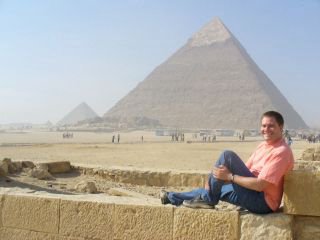
One thing certainly surprised us about the pyramids. We could walk up to the very base of these magnificent structures without restrictions, other than “don’t climb them”. As you can see from the images above, we literally stood on granite slabs at the base of the Great Pyramid of Giza, the largest and oldest pyramid on the plateau. It doesn’t get much better than that. Curiously, we couldn’t get as close to the Sphinx. It was roped off from free-ranging visitors.

The Sphinx wasn't quite what we'd expected. Tourism posters always show it standing in splendid isolation, or with an elegant pyramid hovering in the background. The reality is quite different.  The Sphinx stands at the base of a sloping 495-metre causeway leading to the Pyramid of Khafre. On either side of this ramp lie the ruins of several temples, a workers' village and an industrial complex. The overall visual impact is nothing like the serene and empty desert commonly depicted.  It's more like an abandoned worksite with its accompanying construction clutter left in place.

Egypt%200

We were equally surprised to discover how close the Pyramids are to the city of Cairo. We literally drove past the last suburb, and there they were, right in front of us. One moment you’re in a suburban street, the next you’re following a fence line with open desert and towering pyramids beyond. The first image above was taken from our tour bus on the way to our next stop, the ageing Egyptian Museum. 

egypt%20great%20hall

The Egyptian Museum is an imposing, collonaded building sitting downtown by the Nile River. I've pulled the image above from the web to illustrate this post (thank you, Spencer Davis). Apparently, a new museum on the Giza plateau is in the early stages of planning. The museum's most treasured artefact is undoubtedly Tutankhamen’s burial mask. It's truly spectacular. Photos barely do it justice. It is a genuinely stunning work of art. 

Unfortunately, cameras are forbidden in the museum, so we couldn't photograph it. A few days later, in the Valley of Kings, we were lucky enough to visit the original Tutankhamen tomb. Here we saw his comparatively humble mummy and stone sarcophagus. Never judge a book by its cover!

Speaking of sarcophagi, there are plenty on display at the museum, along with mummies in various states of unwrapping. The museum has two main floors: the ground floor and the first floor. On the ground floor is a collection of large-scale works in stone, including sarcophagi, statues, reliefs, and architectural elements. These are arranged chronologically in a clockwise fashion, from the pre-dynastic to the Greco-Roman period. Thankfully, a local guide walked us through the highlights.
  
However, jet lag and our late-night arrival finally took their toll during our guided tour. I literally fell asleep on my feet in the midst of the sarcophagus hall. Our local guide was less than amused as I stumbled across the floor, interrupting her mid-sentence. Let's just say the glance she shot me had "the look of death".  I was suitably embarrassed. 

Egypt%2011
cairo%205
Egypt%2012

Garry and I went searching for emergency clothing and toiletries after returning to our hotel. Thanks to our missing luggage, we literally had nothing more than the shirts on our backs and a spare we'd sensibly packed for the flight. To make matters worse, we were scheduled to catch an overnight train later that evening. In desperation, we wandered around our hotel’s neighbourhood seeking out a few souvenir t-shirts and a toothbrush. 

However, all we could find were restaurants and dusty stores offering random goods like frypans and buckets. We resigned ourselves to a nightly ritual of washing socks and underwear in a hand basin. That is, until we stumbled upon an isolated, brightly lit store in a nearby residential area. Much to our surprise, it sold little more than socks, hosiery, undershirts, and underwear. Crisis averted. We’d at least have clean underwear until our luggage showed up.

After our whirlwind day in Cairo, we caught a sleeper train to Luxor. These trains are a reasonably civil affair, with comfortable fold-down beds and fresh linen. Garry and I were able to get a reasonable night's sleep. The complimentary dinner was an unremarkable combination of bread, rice, and other unidentifiable starches. We reached Luxor shortly before dawn, ready for another dose of pharaonic symbols. 

Follow our next adventure here.

Egypt%202