Friday, December 16, 2005

A dam good time


Aswan was very pretty. The Nile splits into a series of picture-perfect islands at this point with a dozen traditional felucca boats sailing by at any given moment. All I knew about this city was its massive high dam holding back the Nile. Aswan proved far more note-worthy. 


I was surprised to discover that Aswan actually has two dams. The oldest of these, the Aswan Low Dam, or Old Aswan Dam as it's commonly known, was completed by the British in 1902. At the time it was the world's largest masonry dam. Today, it's the city's primary river crossing. However, an impressive new stay cable bridge recently opened upstream as a second crossing. 

The high dam sits 6km upstream from the old dam. Everything about this structure is big!. It's 3.8km long, 111 metres high, and incredibly, it's made entirely from rock and clay. The base of the dam is an astounding 980 metres wide, while the crest is a modest 40 metres. It's currently the world's largest embankment dam.


After docking in front of the Arous El Nil Hotel, we made our way to the Aswan Egyptian Nubian Museum. However, unlike the Egyptian Museum in Cairo, photos are permitted here. Above you can see the impressive Golden Coffin of a bearded priest called Wennefer and another of those prolific Ramses II effigies. This one comes from the Garf Hussein temple, 60km south of Aswan. It’s one of several archeological sites relocated to higher ground when the High Dam was built. Sadly, no surprises for guessing whom this particular temple was dedicated to.


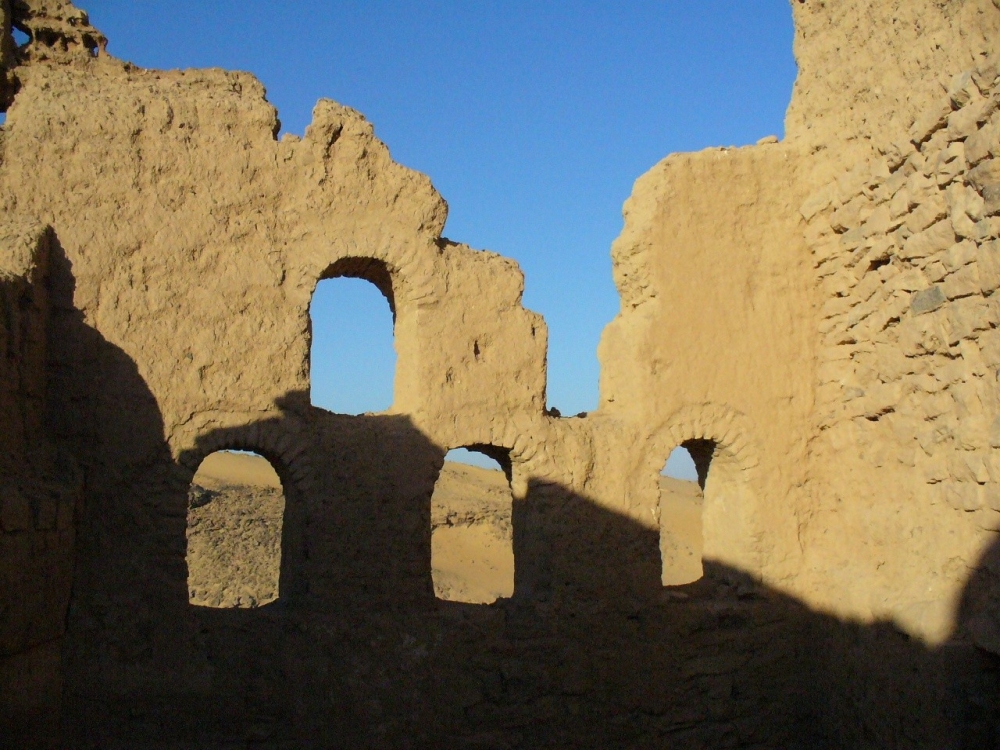
Our tour group then crossed to the West bank of the Nile, hired camels, and trekked across the desert to the abandoned monastery of St Simeon. The decaying ruins were a photographer's paradise, made all the more dramatic by late afternoon shadows. Without a doubt, it was a memorable experience with plenty of iconic desert imagery.  


Later that evening we visited the nearby Philae temple complex for a stunning sound-and-light show. The complex sits on an island in the Aswan Low Dam reservoir. It was relocated here in the 1960s when its original island was submerged by Lake Nasser. Despite the move, it retains an impressive profile from the water. Let's just say it wasn't hard to take plenty of postcard-perfect images.


On our last full day in Aswan, we awoke at 2:30am to join a convoy of 50 buses travelling to Abu Simbel, about 280km south. Tourists now travel in armed convoys as a result of a terrorist attack that occurred at Luxor in 1997. Then once there, machine gun-toting soldiers keep watch as you explore the temple’s environs. I'm happy to report that our early morning transfer passed without incident. Instead, most of us passed the time catching up on lost sleep.


Abu Simbel was phenomenal. Ramses II certainly knew how to commission a decent temple. The location is everything you imagine it to be. To think that such a structure was taken apart and moved to higher ground in the 1960s is equally amazing. The only downside?  Travelling in a convoy meant the serenity of its location on the shores of Lake Nasser was somewhat diminished by the crowd that disembarked simultaneously upon arrival.


I had to metaphorically pinch myself more than once. I couldn’t believe that I was seeing this magnificent complex with my own eyes. I recall first learning about Abu Simbel from a cover story published in National Geographic magazine in May 1969. However, at the time the only reason I had a copy of this particular magazine was an article about Apollo 8. As a space geek, I'd been given it by my mother's employer who owned an auction house. He'd been given a deceased estate to auction. It included several decades of National Geographic magazines which he let me rummage through.


From Aswan, it was back to Cairo on another sleeper train. The complimentary breakfast wasn't so memorable. There are only so many pieces of stale bread one can endure!  I'll leave you with a few parting images of our journey up the Nile. Far more memorable than the train!  As you can see, the Nile really does sustain a narrow ribbon of fertility as it makes its way through the desert.


Horus is home


As we sailed south along the Nile the sights of ancient Eygpt continued to dazzle us. We stopped at several temples including those at Edfu and Kom Ombo. Each was a unique and awe-inspiring experience that's honestly hard to convey in words.

Edfu is home to the Temple of Horus, probably Egypt’s best-preserved temple. The complex was built over a 180-year period from 237 BC to 57 BC but lay buried beneath shifting sand for centuries, thus preserving its interior. Its stone roof slabs also remain intact. As a result, this was one of the few places where you could get a feel for the environs of a fully enclosed temple.
 

We awoke after our second night on the Nile to be greeted by a fleet of boats jostling for space along the shores of Edfu. An early start saw us arrive at the Temple of Horus shortly after it opened. As a result, we had much of the site to ourselves for the first hour. Its most widely recognised symbols are two exquisitely preserved granite statues of Horus, the falcon god, standing outside the entrance to its main hall. A popular photo stop for every visitor!


The temple entrance is framed by two massive pylons that bear scenes of Ptolemy XII conquering his enemies and worshiping deities. This entrance in turn is framed by a couple of relatively modest statues of Horus. We stopped to take photos with these statues thinking they were the star attraction. We were sadly mistaken.

Once through the pylons, you enter a large open-air courtyard lined by a covered atrium. It's here that you encounter two dramatic granite statues of Horus standing guard at the entrance to the temple's two Hypostyle Halls. This second pair is truly impressive!  You can see one of them in the opening image of this post.


The twin Hypostyle Halls were equally awe-inspiring. The first illustrates the temple’s foundation with the king engaged in worship, and the second holds scenes of Horus’ journey in a sacred bark accompanied by the goddess Hathor. However, while their towering columns and ubiquitous hieroglyphics were impressive, it was the ceiling that ultimately captivated us.

The ceilings are still intact. As a result, we got an excellent insight into the construction of a stone temple. Massive columns, inscribed with hieroglyphics, support a series of stone beams that keep soot-blackened ceiling slabs aloft. As a final flourish, each column is then capped by a remarkably well-preserved floral capital.


From the second Hypostyle Hall, you move into an enclosed Transverse Hall that stretches the width of the complex, before finally reaching a small temple sanctuary at the back of the temple. A long open-air corridor also lined the outer rim of the temple complex. All in all, there was plenty to explore at Edfu and the quality of the hieroglyphics was exceptional. Some honestly looked like they'd just been carved yesterday.


From Edfu, our boat sailed south toward Kom Ombo.  This relatively small temple sits right on the edge of a sweeping river bend, affording spectacular views up and down the Nile. Kom Ombo is a unique temple, as it’s not just dedicated to one god, but two. The primary gods worshipped here are the crocodile-headed Sobek and Horus. Or more specifically, a particular aspect of Horus known as Haroeris, or Horus the Elder. Horus seems quite popular around these parts. 


Sobek was an ancient deity most commonly worshipped in Aswan and the surrounding region. Unsurprisingly, crocodiles were both feared and revered in ancient Egypt, as many lost their lives to them every year. Yet in places like Aswan, people still kept them as pets.  Kom Ombo even has a stone well that historians believe was once a crocodile sanctuary for the temple.

We stumbled across a small Crocodile Museum next to the temple. It was a well-laid-out affair entirely dedicated to Sobek worship. It contained both Sobek-related artifacts and a slightly creepy display of mummified crocodiles.


Unlike Edfu, this temple's roof is missing entirely. However, you can still make out things like the original footprint of its inner sanctuaries and the numerous intact floral columns of the Hypostyle Hall. Despite its decay, the structure was still rather dramatic. As the sun began setting, a series of lengthening shadows and golden rays simply added to the overall effect.


This location symbolized ancient Egypt for me. It was here that we watched the sun setting across the Nile in spectacular fashion. Our tour group then held an evening of Nubian dancing onboard our boat. As part of our preparation for the evening, we all went shopping for Nubian costumes in the local bazaar before returning to the boat. Local Nubians then joined us for an evening of music, whirling dancing, and plenty of laughter.