Sunday, June 09, 2013

Cool Canberra

It's been almost 25 years since my mother last visited Canberra. At the time, her visit was a last minute addition to a travel itinerary that had been thrown into disarray by the infamous1989 airline pilot's strike.  My parents were part of larger New Zealand contingent that found themselves stranded in South Australia.  Their original itinerary was meant to take them to Queensland before departing for home from Sydney. Their transport conundrum was ultimately resolved by hiring a car and driving across New South Wales to Sydney, stopping over in Broken Hill and Canberra.
 
This month, while my Auntie Pam in town, I decided to take Mum back to Canberra for another tour.  We couldn't have picked a better weekend.  It was an unusually pleasant period of winter weather with plenty of sunshine temperatures in the mid-teens. We made our way south on Saturday morning stopping for a compulsory photo at Golburn's Big Merino and a delicious late-breakfast at Grandma's Little Bakery, Fedra Olive Grove.
 
Grandma's Little Bakery has a hugely popular outlet in Inner Sydney so I was keen to road test the original cafe near Collector.  The main building sits on a low hill overlooking a young orchard of olive trees.  It's a delightful location, less than 50 minutes north of Canberra.  All three of us ordered the delicious Shakshuka; a classic Mediterranean dish of baked eggs cooked over a tomato and capsicum base.

We began our tour of Canberra with a tradition stop at Mt Anslie.  I always take visitors here first as the view down constitutional axis is an unforgettable introduction to Canberra's carefully crafted landscape. From here it was on the the Capital Exhibition Centre to learn more about the city's design and development before joining a guided tour of Parliament Hill.  .

We finished the day with a brief driving tour of the diplomatic zone before visiting the National Gallery. Our touring route naturally included a brief stop to photograph the colourful corrugated iron cows outside the New Zealand High Commission. 

The National Gallery currently has an exhibition of artwork by Turner, the British landscape artist. While we were at the gallery I also took my guests down to the Sidney Nolan gallery to see his famous silhouette depiction of Ned Kelly on horseback.  Auntie Pam later told me the Turner exhibition was a personal highlight of her Canberra weekend.

Our final day in Canberra began with a visit to the National Archives. As part of the city's centennial celebrations, original documents from the town plan design competition were on display. It was fascinating to see Walter Burley Griffins original drawing for the city.  Today's layout remains surprisingly true to his original vision.

 We then made our way to the Australian Museum for a little Australiana before making our way to the National Carillon to listen to a rousing bell recital.  The complex has a video screen at its base where you can watch the Carilloneer playing a rather daunting wooden peg keyboard. The 50 metre tall carillon tower was a gift from the British Government in celebration of Canberra's 50th anniversary.

Our next stop was Old Parliament House for lunch in its popular cafe, before making our way to the National War Memorial Museum. The sight of the infamous Japanese mini-sub was made all the more poignant given the tour of Fort Denison a few days earlier.  You'll recall that during this tour we learnt about the American "attack" on the fort that was triggered by the discovery of Japanese mini-subs in Sydney harbour.  At this point, with all of the classic sights now under our belt, it was time to head for home.

Friday, June 07, 2013

Fort Denison

Where do you take a regular international visitor for new and interesting experience of Sydney harbour?  As the years pass, this challenge grows each time my mother comes into town.  Over the years we’ve taken scenic luncheon cruises, climbed the Harbour Bridge and enjoyed lunch at Aria, on the edge of Circular Quay. However, there’s one spectacular venue, I’ve never tried.
 

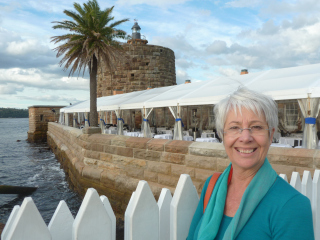
Fort Denison is an island fort situationed in the middle of Sydney Harbour.  It offers unrivaled views of the harbour from its battlements, most notably an elegant Martello Tower.   I booked lunch for Mum and my Auntie Pam, taking a chance that the weather would be suitably warm and sunny on Friday afternoon.
 
My gamble paid off.  We awoke to clearing skies and increasingly bouts of sunshine.  A short harbour ferry ride took us directly to the island.  We arrived shortly before noon, just in time to join the daily Park Ranger’s tour.  As luck would have it, there was only one other couple on the tour, making for a intimate experience.  The ranger regaled us with a series of amusing anecdotes, including the only time the fort was fired upon in war.
 
This anecdote is best told once you understand the fort’s origins.  In 1839, two American warships entered the harbour at night and dropped anchor.  The fledging colony was stunned that vessels, even those of a friendly nation, could enter the harbour undetected.  The Government reviewed the inner harbour’s defenses and decided to fortify Pinchgut Island, a rocky outcrop off midway between Garden Island and the North Shore. 
 
Fortification of the island began in 1841 but stalled when funds ran out. Construction resumed in 1855 during the Crimean War as the nation feared a Russian naval attack.  The fort was completed in late-1857.  However, it never saw action until the Second World War. 
 
In 1942, three Japanese mini-submarines ventured into the harbour.  One was sighted by an American warship berthed a nearby Garden Island.  The Americans fired on the sub.  One charge skipped across the water’s surface and slammed into Fort Denison, exploding on impact.  The irony wasn’t lost on the locals.  A century after friendly American warships prompted the fort’s construction; the same friendly nation became the first and only one to attack the fort itself.
 
Our Ranger’s Tour ended with a firing of the 1:00pm gun.  We then ventured to the fort’s restaurant for a magnificent meal, dining on succulent fresh fish and chips while basking in the afternoon sun.  The service was impeccable and the menu was sublime.  I’ll definitely be returning to Fort Denison soon.

Thursday, April 25, 2013

Marmaggedon is over!

A small miracle appeared in the mail this week.  My sister-in-law has sent me a "care package" from Auckland.  I'm now the proud owner of two jars of New Zealand's Sanitarium Marmite! More than a year since it disappeared from Supermarket shelves my favourite childhood spread is back. I made myself toast this evening just so I could have a quick salty hit.  Delicious.

ANZAC Day at Bundeena

 
After more than two decades living in Sydney I've finally made it to Bundeena.  It's a quaint riverside town on the fringe of Royal National Park. It can be reached by driving for an hour, roughly 32km, around the eastern reaches of the Hacking River.  Alternatively, you can take a 20-minute ferry from Cronulla long picturesque Gannamatta Bay and across the river. 

No prize for guessing which route my friend Michelle; her son, Zeke and I took today. The weather was warm and sunny. The ferry crossing was simply delightful.  It was the perfect day to be on the water or enjoying one of the many arcs of golden sand that line Bundeena's shoreline. We sat in a park by the ferry wharf for more than hour dining out on fish and chips, watching the world (and occasional Ibis) go by.


Sunday, March 31, 2013

Sublime Point

Garry and I have spent the last two nights staying with friends in Jamberoo, a small village south of Wollongong. The area is a fertile, green valley nestled between the coast and the 800 metre high Illawarra Escarpment. On way home we briefly stopped at the Bulli Lookout to enjoy the view.

Scientists estimate that the sandstone escarpment was created about 280 million years ago. It forms the eastern edge of the Southern Highlands plateau that stretches south toward Canberra and the Snowy Mountains. Sublime Point, where the lookout is located, sits about 415 metres above the coast.

Click on the image below for a taste of the panorama that greets visitors who venture off the Prince's Highway.


Friday, March 29, 2013

Across the Bay

The city of Melbourne sits on the northern shore of Port Phillip Bay, an enormous expanse of water, encircled by more than 264km of coastline. At its widest point the bay is almost 100km wide. However, despite this expansive surface area, the bay feels more like a lake than a harbour. Its deepest point is only 24 metres (79 ft) and its only passage to open sea is barely 3.5 kms wide.

The bay is encircled by two scenic peninsulas, both popular playgrounds for Melbourne’s frazzled urban population. Mornington Peninsular sweeps down from the northeast, while the stumpy, craggy, Bellarine Peninsula stretches out from the west. The Mornington Peninsular offers quaint coastal villages, stunning beaches and world-class golf courses, while Bellarine is home to a number of quiet, windswept nature reserves.

As a Sydney-based lad I’d never experienced the Bay’s charm until this month. A consulting engagement resulted in me spending a night at Moonah Links, a golf resort on the Mornington Peninsula’s southern flank. The resort includes two championship certified courses, including the only course designed specifically for the Australian Open tournament. From Melbourne, it takes about 90 minutes to reach the resort.

However, the morning before my consulting engagement, I’d made arrangements to spend time in Geelong. This regional city sits on the southwestern flank of Port Phillip Bay, almost an hour away from Melbourne. I was up for a 2.5 hour drive around the bay until I discovered a regular ferry service linking communities across the bay’s narrow entrance.

Every day, two large catamarans depart from opposite shores, carrying passengers and vehicles between Queenscliff and Sorrento. I caught the ferry at Queenscliff, a sleepy town on the tip of the Bellarine Peninsula. From here it’s a scenic 20 minute journey to Sorrento, a popular coastal town on the Mornington Peninsula. Not far from Sorrento is Cheviot Beach. It was here that Australian Prime Minister, Harold Holt, drowned on the morning of Sunday 17 December 1967.

The Queenscliff terminal has undergone modest redevelopment in recent years. A small, picturesque marina now offers the usual selection of shiny-new, sun-baked eating establishments on one side while open, wind-swept dunes and curving sand beaches remain untouched on the opposite side. It’s an impressive balance of modern convenience and preservation of the local environment. The entire scene can be enjoyed from a funky spiral observation tower by the marina’s entrance. On the afternoon I visited, I was fortunate to have its stunning vista all to myself.

My ferry arrived on schedule. It took less than ten minutes to load the dozen or so vehicles waiting to board. I spent the entire journey on the roof deck soaking up the view. The sun began dropping behind light cloud as our crossing began. As we sailed, its light was split into spectacular shards that danced across the headlands. A fully laden container ship completed the scene. It crossed our path and headed into the dramatic setting sun.

After such a stunning introduction, I’ll definitely be back to enjoy more of Port Phillip Bay.

Thursday, March 21, 2013

Cameo blimp

Early yesterday morning a bright blue blimp appeared over the Sydney Cricket Stadium.  It hovered over the area for 10-15 minutes then disappeared without warning.  Garry says he's spotted it several times earlier in the week. Howver, it's never reappeared leaving us unsure of its ultimate purpose.  A logo of Bayer, the multinational phamacutical company, is printed on along one side so we can only assume it was part of an advertising shoot.

Tuesday, March 19, 2013

Rest in peace

I flew back to New Zealand on March 16 to join the family as we laid my father's ashes to rest.  The family held a simple, low-key ceremony the following afternoon at Pyes Pa Memorial Park. It's a peaceful location on the outskirts of Tauranga.  The park was chosen as Dad's final resting place because his parents' ashes are also buried here.

The local council established the park in 1967.  As the years have passed, its vision of a tranquil, landscaped park has quietly unfolded.  Today the grounds are filled with mature trees and gardens, offering a peaceful park to remember those who have passed.

New Zealand is currently in the grip of its driest Summer in more than fifty years.  However, on the day we chose to gather, the heavens opened up and more than 8.4mm of rain fell.  It was somehow fitting that Dad's final act should result in another life-long memory. 

The family stopped first for lunch in Tauranga, hoping for a break in the weather.  This wasn't to be.  We ultimately gathered around Dad's plot under a raft of umbrellas.  Mum had chosen the perfect spot for his plot under the limbs of a young Magnolia tree.  In the years ahead, the tree will provide an increasingly spectacular backdrop and a handy landmark for first-time visitors.

My brother Matt read the poem "One at Rest" that my Auntie Pan had shared at Dad's funeral.  Then, one by one, family members took turns to cover the pale blue biodegradable urn containing Dad's ashes with a spadeful of soil. Our ceremony finished with each of us inscribing a colouful helium balloon with a farewell message and releasing them into the sodden sky.  As each balloon rose into the sky we shared a champange toast.  Farewell Dad.  May you live in our hearts forever.

Sunday, February 24, 2013

Surviving Marmageddon

For the last 15 months the news in New Zealand has been filled with talk about Marmageddon.  What’s that you ask?  Sanitarium Marmite, a pungent yeast spread, is a popular staple in New Zealand households. The bitter, salty, dark brown paste is the nation’s answer to Australia’s Vegemite and Promite, or the UK’s own version of Marmite.  Growing up in New Zealand, you always had Marmite spread liberally on your toast at breakfast, or hidden in your lunch box sandwiches.  

Since 1919, all of New Zealand’s Marmite has made in a single factory, located on the outskirts of Christchurch. It’s manufactured under license using a recipe adapted from that used for the UK’s Marmite spread.  Most notably, New Zealand’s version includes sugar and caramel which results in a slightly less tangy, smoother tasting product.  However, both versions use the yeast by-products of beer brewing as their core ingredient.  Much like Vegemite, you either love it, or you hate it.

I love it.  When Garry and I were living in the UK, I used to carry jars of Marmite home with me after every New Zealand visit.  My parents even bought me a large jar when they came to stay in 2007. Since returning to Australia I’ve been able to satisfy my cravings without resorting to imports as the local Supermarket sells small 250g jars of the stuff.   However, this availability proved short-lived.  Production of New Zealand Marmite was halted in November 2011 when the Christchurch factory closed for repairs.

The Christchurch factory had been damaged by the deadly February 22, 2011 earthquake and its aftershocks.  Its cooling tower had cracks and closer inspection revealed other structural issues. Sanitarium was forced to halt production.  It originally anticipated that repairs would take seven months to complete.  By March 2012, its stocks had run out, leaving consumers with the specter of bare shelves for at least three months.  The price of Marmite quickly went through the roof.  Large jars were offered online for as much as NZ$800, considerably more than the regular retail price of $4.25 for a 250g jar.

At the time I was oblivious to the shortage. I notice its disappearance from our Supermarket shelves but assumed that Coles had decided to stop stocking the product. Only weeks earlier I’d blithely and lavishly spread the last of my Marmite on toast.  I decided to resort to imports once again and my sister-in-law to bring Marmite when she came to visit.  It was then that I learnt of an emerging storage the media were dubbing "Marmageddon".

In June last year Sanitarium discovered more earthquake damage, pushing Marmite’s return to shelves out into 2013. Marmite has now been out of stock for a year.  However, the end of the drought is in sight.  This week, the company announced that Marmite would be back on shelves from March 20.  It claims to have already begun full production of 250g jars, its most popular size.  I’ll be interested to see if our local Coles will restock the product after a 12 month hiatus.  I fear they’ll decide people like me have moved on to other products.  We haven't.  I hate Vegemite and English Marmite is just awful stuff.

I’m reasonably optimistic marmite will return to local Supermarket shelves as our store recently introduced a classic New Zealand products section.  A few weeks ago we suddenly discovered a shelf groaning with L&P soft drink, cheese flavoured Rashuns and other popular New Zealand junk food.  If I’d not just returned from a month with family, drinking L&P almost daily I’m sure I’d have made an impulse purchase.  As was I relented just enough to buy a packet of coconut Krispie biscuits, a taste sensation I’ ve not had since childhood.

Saturday, February 02, 2013

Siding Springs

How about a trip down memory lane?  Over the years I’ve published numerous posts about my growing list of space tourism excursions.  You’ll recall I’ve visited Star City near Moscow, watched a Space Shuttle launch and clambered through the bowels of a Titan Missile silo.  The vast majority of these adventures have taken place overseas. Australia isn’t exactly the centre of space and aeronautic technology.
 
The nation does have a small handful of world class locations including the Canberra Deep Space Communication Complex in Tidbinbilla, the giant radio telescope at the CSIRO Parkes Observatory and the Australian Astronomical Observatory at Siding Springs.  All three sites are located within a few hours of Sydney so it’ll come as no surprise to learn that I’ve visited all three in the last 15 years.
 
I was reminded of one such visit recently after a devastating bush fire swept through the Siding Springs area on January 13.  The media published dramatic images of a wall of orange flames rising over the Anglo-Australian optical telescope’s dazzling white dome. You can see one such photo published by the Sydney Morning Herald above.

Many feared the worst.  Exactly ten years earlier bush fires completely destroyed the Mount Stromlo observatory on the outskirts of Canberra.  At the time similar images showed flames raging around the observatory’s distinctive dome.  However, this time the news was good.  The giant 4-metre optical telescope and the nearby 1.2-m UK Schmidt Telescope at Siding Springs escaped unharmed.
 
Garry and I visited Siding Springs over a long weekend in March 2005.  I’d timed our trip to coincide with a rare public open day at the observatory. We cashed in some frequent flyer points, flew to Dubbo on a Friday morning, hired a car and spent four days exploring the area.  We based ourselves in Dubbo for the first night.  While there we explored the expansive Western Springs Zoo, where a friendly giraffe gave me a terrifying tongue link.  I’d been invited to feed it carrots by the attending zoo keeper.
 
On Saturday we drove to Coonabarabran, a small town roughly 27kms away from Siding Springs.  We attended the Open Day tours on Sunday. Garry will reluctantly admit that the experience proved more interesting than expected.  Both of us were surprised to discover that Siding Springs is actually home to almost a dozen different telescopes, most of which were open to the public.  Resident astronomers spent the day taking small groups on tours through the facilities culminating in a visit to the impressive Anglo Australian telescope.
 
The giant telescope is housed in a 26 metre high dome that sits on a remote hill on the eastern edge of the Western Plains.  It was built to provide astronomers with optical observing capabilities previously limited to the Northern Hemisphere.  The telescope was commissioned in 1974, giving eager astronomers an unrivaled ability to study phenomenon only visible in the southern sky.  This includes the centre of our own Milky Way Galaxy and its nearest galactic neighbours, the Magellanic Clouds.
 
During our tour I vividly recall seeing the giant 4-metre telescope being gracefully pivoted on its equatorial mounting.  The ease with which the instrument moved was astonishing given that it weighs a staggered 260 tonnes. Our guide later explained that the telescope rarely moves in this manner.  She explained that it typically inches along, following the track of stars as they move across the night sky. It seems that the telescope’s chief engineer had decided to put on a bit of a show for the visitors. We were delighted!
 
Later that evening, Garry and I booked a night sky observation dinner in Coonabarabran. With Siding Springs nearby, many of the town’s residents are employed by the observatory.  As a result, Coonabarabran boosts a number of impressive amateur telescopes and knowledgeable astronomers.  We spent a fascinating evening at the local Warrumbungle Observatory viewing Jupiter, Saturn and the Moon’s cratered surface.

The final day of our vacation was spent back in Dubbo touring the city's infamous goal and the underworld delights of the Wellington Caves, located about 40 minutes south.  The caves proved particularly interesting.  We joined the Cathedral cave tour which takes visitors past a breath-taking 15-metre high 'Altar', a magnificent combination of boulders, flowstone and stalagmites covered in glittering crystal calcite.  However, for me, the real highlight was an opportunity to handle fossilised bones miners had extracted from neighbouring mine shafts.

Friday, February 01, 2013

We love ice cream

Perhaps one of the best things about smartphones is the ability to capture quality images of life's special moments.  This one of them. Five minutes walk from my Mum's house in New Zealand, there's a small corner store opposite the beach.  It sells the world's largest ice cream cones at the cheapest price you can image.  Here's my sister-in-law, Karin, and my niece, Nici, making the most of this Summer bargain.