Friday, January 24, 2025

Through the Atlas Mountains


To help make the most of our limited time in Morocco, we booked a two-day private guided tour through the Atlas Mountains. The tour took us across the mountains, visiting fortified Bedouin towns, stunning kasbahs and a desert oasis. By the time we returned to Marrakech, we’d driven more than 500 km. It was a wonderful contrast to the relentless hustle and bustle of Marrakech.

Addellatif, our driver and guide, picked us up from our Riad shortly after 8:00am. We’d requested an early start to get the most out of the daylight hours. This proved to be a smart move. We enjoyed a blockbuster sunrise over the Atlas Mountains while driving through some stunning foothills. Around every corner, the early rays edged their way into the valleys below, lighting the desert haze in spectacular style.


We stopped briefly for a light lunch shortly before reaching Tizi n’Tichka, a mountain pass, which at 2260 metres, marked the highest point of our journey. The final stretch of highway to the summit featured a spectacular series of curving switchbacks. Our guide stopped at a lookout where we could soak in the desolate mountainscape and marvel at the engineering skill required to build such a road.

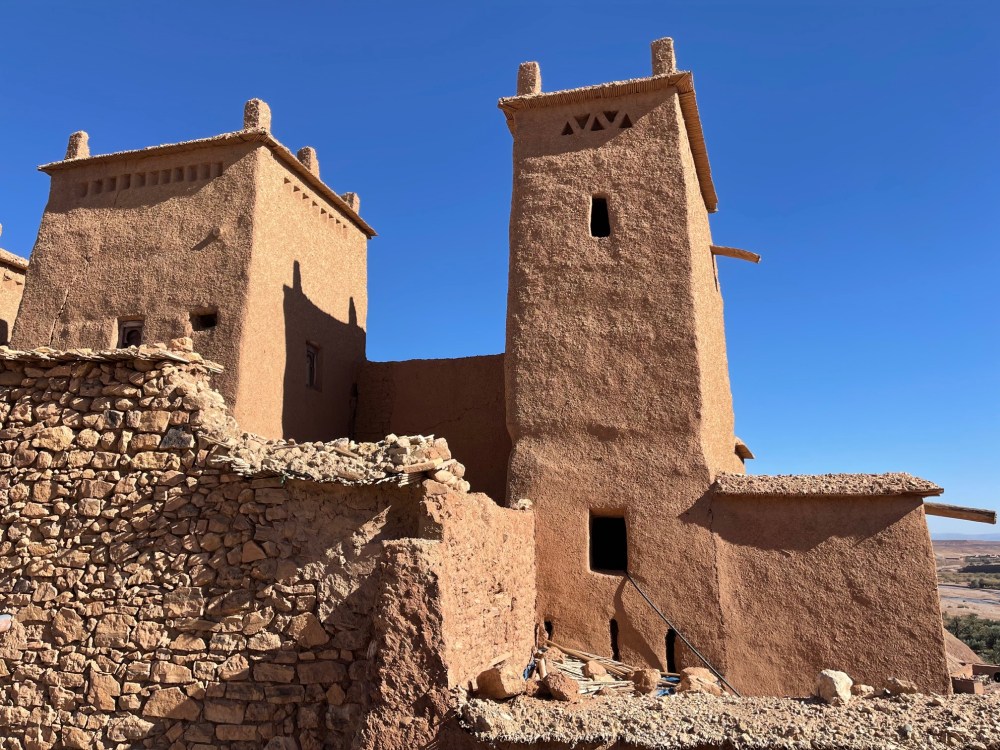
We then turned off the main highway and made our way through the picturesque Ounilla Valley. The road winds its way through dry, barren and fragmented rock canyons, each more photogenic than the last. Our guide explained how villages used subterranean groundwater along the river and river flats to sustain their existence. Adobe brick made from local red mud and straw is the primary building material.


As a result, everywhere we drove, we’d encounter flat-roofed red brick buildings nestled on the hillside, sitting above the river’s ancient flood line. This included more than one breathtaking village, denoted by jagged lines of red brick, random geometric shapes and deep shadows. At times the scene was something straight out of a classic Hollywood film. Scars from the recent earthquake were also visible, with ruined walls and buildings randomly scattered through the landscape.  However, it was often their recent replacements that stood out.


Thousands were killed by the quake in 2023 when entire adobe villages collapsed or were flattened by landslides that crushed and buried their occupants. In response to this disaster, the Government has funded rebuilding programs using more robust concrete block construction. As a result, many villages were dotted with distinctive grey buildings standing alongside their red brick neighbours. In places, entire neighbourhoods consisted of these new, rather drab, grey constructions.


Our guide took us on a detour to view one of the area’s ancient salt mines. The hills in many places are streaked by veins of white salt. We followed the path of a stream whose bed was awash with ribbons of salt until we stumbled upon the mine’s decaying ruins. By chance, we discovered one intact salt crystallisation pond once used to dry the briny water and extract its salt. Long crystal shards rimmed the pond in spectacular style.

However, our next stop was the highlight of our day. The fortified adobe village of Ait Benhaddou is one of Morocco’s most iconic sights. For more than half a century, this hillside village has been the backdrop for a myriad of Hollywood blockbusters. Known as a ksar, or fortified village, it was an important rest stop on a former caravan trading route between the Sahara and Marrakesh.


Today, the ksar itself is only sparsely inhabited by several families. Its progressive depopulation over time reflects the valley's loss of strategic importance over the last century. The caravan trade is long gone, and the modern highway follows a more westerly route. These days, most local inhabitants live in modern dwellings in a village on the other side of the river, making a living from agriculture and the tourist trade.

We hired a local guide to take us through the village and up to the granary store that caps the hill upon which the village is built. Our visit coincided with construction work for a new movie. Film crews are banned from filming in the village itself. As a result, movie studios erect temporary structures on the outskirts, using the real village as a dramatic backdrop. Incredibly, an entire fake fort was being constructed alongside the village’s actual Kasbah fort.


Our guide explained that dozens of movies, including Games of Thrones and Gladiator, were filmed here. He was once hired as an extra for Gladiator. That's him on set in the photo above. Apparently, an entire amphitheatre was built for the movie. Then, once filming was done, as required by local ordinances, the entire structure was removed. A similarly spectacular soundstage was being constructed on the same site during our visit.

Our guide explained the importance of the village granary that crowned the local hilltop.  In ancient times, the granary was considered a strategic and critical structure. It housed the entire village's annual harvest and kept it fed through the lean winter months. In essence, if you controlled the town's granary, you controlled the population.  As a result, granaries were typically built on high ground and heavily fortified to protect them from invaders. Sadly, the granary at Ait Benhaddou was destroyed in the 2023 earthquake. However, our guide told us it's scheduled for rebuilding later this year.


Honestly, Ait Benhaddou was every bit as dramatic and memorable as the best of Oman’s restored forts that we visited more than a decade ago. My photos barely do it justice. We finally finished our day with an hour-long drive to Skoura, a sprawling oasis in the Ouarzazate Province. Follow this link to learn about our adventures in the oasis.

Sunday, January 19, 2025

Medina walking tour


Our second day in Morocco was spent wandering the Marrakech medina, soaking up all its sights and sounds, while touring many of its famous landmarks. By the time we were done, we’d walked almost 16kms, and clocked up an impressive 21,546 steps.

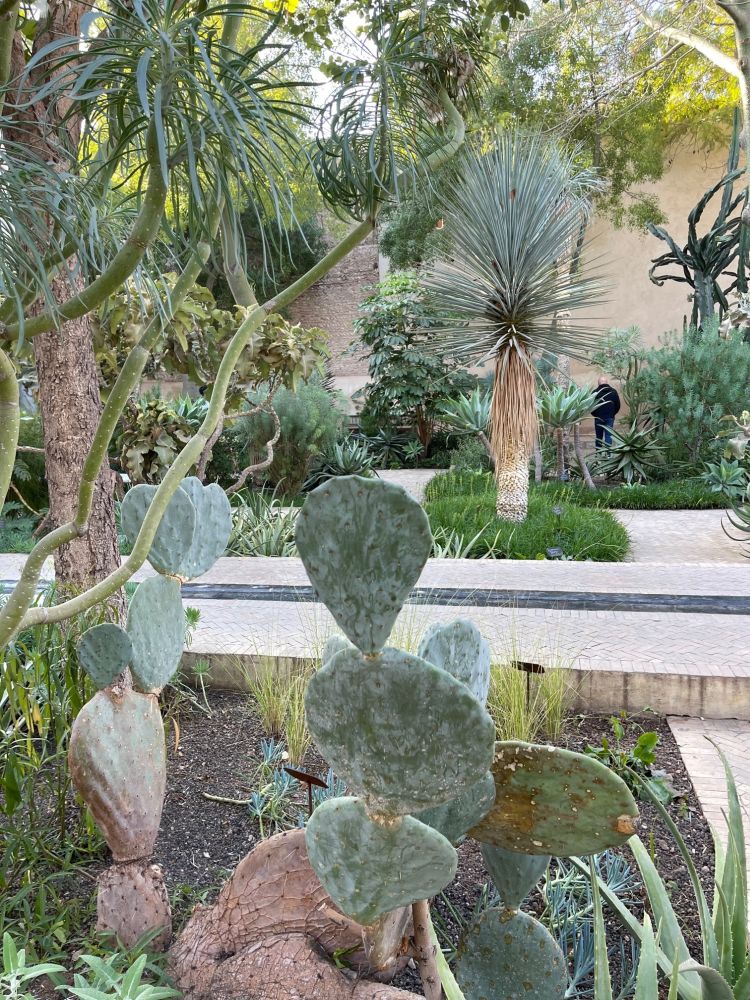
Our day began with a rooftop breakfast at our Riad hotel. Temperatures hovered around 10C until the sun finally rose shortly after 8:30am. Our first stop of the day was Le Jardin Secret (translated as the Secret Garden). These immaculately landscaped gardens are a tranquil oasis amid the souks, surrounded by high walls. They’re the last vestiges of a monumental palace complex built in the late 16th Century.


The gardens are divided into a courtyard with an exotic garden showcasing plants from around the globe (including a few from Australia) and a second courtyard containing a classic Islamic garden. Fountains dominate both gardens, fed by water from ancient underground conduits that crisscross the old city. The water originates from khettara, large reservoirs continually replenished by groundwater aquifers in the nearby Atlas Mountains.

Water is a fundamental element in all Arab-Muslim gardens. The focal point of the garden is normally a fountain, fed by gravity, while the garden itself is laid out in four quadrants symbolising paradise. The Quran describes the universe as composed of four parts divided by rivers. As a result, in an Islamic garden, you'll typically find four dividing water channels that symbolize the four rivers of paradise. In Le Jardin Secret the four quadrants meet under a pagoda that shelters a simple marble fountain consisting of a marble sphere.


We stopped for a morning coffee on an elevated terrace above the Islamic garden before making our way through the medina to Almoravid Koubba. Many of the old city’s buildings are adobe constructions. As a result, there aren’t many buildings that survive the centuries in good condition. Almoravid Koubba is said to be one of the oldest buildings in Marrakesh. Surprisingly, it remained largely hidden until excavations were made by the neighbouring Ben Youssef Mosque in 1948.


Today you can see the small building standing free in a walled pit. We decided the entry fee was rather steep, so we paused to admire it from the street level before moving on to the Ben Youssef Madrasa. This spectacular complex, built in the 16th Century was once an Islamic College. In its day it was one of the largest in Northern Africa, housing up to 900 students at its peak. However, students would have endured incredibly cramped conditions as the complex contains just 130 tiny cubicle bedrooms built on two levels around a central courtyard.

The complex was renovated and opened to the public in 1982. Its central courtyard is simply stunning. The open space is surrounded by ornately decorated marble walls, tiled pillars, and carved cedar archways. Throughout the building, tiles are laid out in geometric patterns or bear inscriptions, mostly phrases from the Quran. A rectangular pool stands in the centre for ablutions, which are required before entering the spectacular prayer room at the far end of the yard. The prayer room, clad in ornately patterned white tiles and marble, was a genuine highlight. 


We explored the madrasa for several hours, then returned to the souks to wander for another hour or two. The chaos and sights were extraordinary, frequently changing as the rhythm of the day unfolded. For example, donkey carts were visible everywhere in the early morning. They're used to haul building materials and bulk goods through the narrow streets before the markets open. Then as the pedestrian traffic builds, stalls set out their wares, then close again for midday prayer and so on.

Eventually, we stumbled across Shtatto Marrakech, a rooftop restaurant in the middle of the medina. We stopped for late lunch enjoying the winter sunshine and soaking in a chaotic landscape of roofs and minarets. It was a refreshing sanity break from all the hustle and bustle of the medina below. We vowed to return again before leaving Marrakesh.


We finished our walking tour of the medina with a side trip to Bahia Palace, a 19th-century complex that’s considered one of the city’s architectural marvels. Sadly, the palace and buildings across the city were badly damaged by a 6.8 magnitude earthquake that struck on 8 September 2023. 

The quake was the biggest to hit Morocco since 1960. It caused widespread damage in the High Atlas Mountains and Marrakesh. More than a year later, repairs are still in full swing. As we wandered through the medina, we encountered empty plots where buildings once stood, and numerous structures with cracked or broken walls. More than once, we'd turn a corner and come face to face with massive wooden struts holding frail walls in place.


The Bahia Palace is renowned for its iconic blue tile-trimmed central courtyard. You see this image online all the time.  Sadly, large sections of the surrounding riwaqat were shrouded in scaffolding during our visit, so we missed out on our Instagram experience. However, its side rooms and restored ceilings were almost as dazzling. You can see some of these above. 

After a long day of walking, we returned to our Riad to freshen up, then ventured back into Jemma el-Fnaa for dinner. We decided to take our lives into our own hands and dined at one of the many food stalls that come to life after dark. Garry was keen to give them a go after seeing stall after stall filled with meat cuts, kebabs and smoking earth ovens.


I was a little nervous about eating in the market. We were scheduled to drive through the Atlas Mountains early the next morning, so we couldn't afford to get food poisoning. Each stall also displays its raw meat on a sloping, open-air platform. Not exactly the most hygienic set-up. However, I’m pleased to say we survived the meal without incident, and it ultimately tasted as good as it looked. Much to our delight, dinner finished with an impromptu musical performance delivered by the kitchen staff.

You can read about our two-day private tour of the Atlas Mountains here.