Wednesday, September 11, 2013

Matsumoto

Japan's most famous Samurai castle sits on a small hill overlooking the town of Himeji.  It's soaring white and black turrets are the stuff of postcards, making it a memorable day trip from Osaka. I first visited this castle in 1993, returning again with Garry in 2006.  Naturally, I was keen for Mum to see an authentic Japanese castle as well. They're such a unique design, unlike any castle you'll see in Europe or the Middle East.

Himeji castle is known locally as Shirasagi, which translates as the White Egret.  It's also one of very few Japanese castles preserved in its original wooden form. Sadly, most castles you see these days are ferro-concrete reproductions. More than a dozen were built during a feudal revival fad that swept the nation in the fifties and sixties. 

Himeji castle is currently undergoing a comprehensive five-year restoration.  The work, which began in 2010, is rapidly approaching its peak. This means that the entire structure is currently enveloped by an enormous scaffold structure. This wasn't quite the postcard I had in mind for my mother.  However, a little research uncovered an equally iconic substitute; the photogenic triple towers of Motsumoto Castle in central Honshu. Like Himeji, this castle retains its original wooden form and can be reached easily by train.

Mum and I scheduled a half-day excursion in Matsumoto while travelling to Osaka.  This meant catching an early train from Kawaguchiko station, making a brief transfer at Otsuki before finally arriving at Matsumoto two hours later.  Purely by chance we caught the local railway company's Thomas the Tank Engine train from Kawaguchiko.  It's a two-carriage train painted from top to bottom in cartoon colours and Thomas-related images.  It's classic Japanese kitsch at its best.

Matsumoto Castle didn't disappoint.  Our humble, amateur photos were the equal of those in travel guides and brochures.  The current structure was built around 1595 and incorporates three defensive towers. It's nickname, Karasu-jo, or Crow Castle reflects the wonderfully photogenic dark tones of its exterior. 

Japanese castles are built using three unique configurations; one for mountains, one for local hilltops and one for flat, open plains.  Himeji is a hilltop design, while Matsumoto sits on an open plain.  Like all castles built on flat ground, Matsumoto castle is protected by concentric rings of moats, each wider than the last. 

We later learnt that the width of the inner-most moat reflects the distance at which warriors firing primitive muskets became inaccurate.  Apparently, Matasumoto is one of few castles built late enough in the feudal era to incorporate this sort of defensive feature.  The castle also features a cleverly hidden sixth floor.  From the building's exterior, attackers can only see five levels thus fooling anyone storming its interior.

As Mum and I entered the castle grounds, we were approached by one of the city's Goodwill Guides.  These are local volunteers who take visitors on a guided tour of the castle. Our guide took us on a fascinating hour-long tour.  We weaved through its creaking wooden interior and climbed floor after floor of steep wooden stairs.  The steepest of these stairways rises at an incline of 61 degrees with each step an uncomfortable 40cms high. Its design was clearly meant to make invading warriors as vulnerable as possible.

The castle interior is a fascinating blend of shapes and angles.  As you round one corner, large cedar beams and well-worn floorboards fill the view; then the next corner exotic roof tiles can be glimpsed from a myriad of small windows. Mum and I loved the curving shachihoko gargoyles which perch on the corner of each roof gable.

These mythical creatures consist of a tiger's head and a carp's body.  They protect the castle from the constant threat of fire.  As you can imagine, a wooden building slowly desiccating over centuries is something of tinderbox.

With our tour finished, we stopped for lunch.  We sat on bench in the shade by the carp-filled moat with the castle as our backdrop. We then wandered along the reconstructed streets of Matsumoto's old town district before returning to the station.  The old town was rather disappointing. Our guide book had promised a trip through the streets of yesteryear.  In reality, it all felt rather modern and austere.

Matsumoto is certainly a popular destination. We discovered this to our detriment earlier in the day.  When we arrived at the station, we'd searched in vain for an empty coin-operated luggage locker.  It seemed that every locker large enough to hold our suitcases was occupied.  We searched three separate zones on two levels before finally discovering a row of empty lockers just outside. Panic over. Disaster averted.

We finished our day travelling by train through the scenic Kiso valley to Nagoya where we transferred for Osaka.  Despite its remote location, the valley is filled with endless villages and terraced rice fields. Mum loved the opportunity to see some classic wooden buildings and witness the bustle of village life in the countryside.

Unfortunately, our arrival at Osaka station was a lesson in pure frustration.  We searched in vain for taxi rank to take us to our hotel.  We followed every sign we saw.  None lead us to the taxi rank. We finally found a cab by pure chance outside a small hotel connected to the station. We looked again the following day  but never did find the taxi rank.  It was such an odd experience given how organized everything normally is in Japan. On this occasion, local knowledge was clearly required.

Tuesday, September 10, 2013

Soaking it up in Fujigoko

I organised a special treat for my mother's birthday while we were in Japan. I was keen for her to experience a traditional Japanese ryokan hotel and soak in a sweltering onsen hot tub. I decided that the spectacular Fuji Five Lakes district would be the perfect place to experience these cultural moments.  I also thought a little birthday indulgence was in order.

I booked us into Kozantei Ubuya, an exclusive award-winning ryokan on shores of Lake Kawaguchi.  The hotel gets rave reviews online.  It offers unrivaled views of Mount Fuji, enjoyed from the comfort of a private hot tub on the balcony of your room.  I arranged an upgrade that saw us enjoy a spacious suite complete with its own special "mountain viewing" room.  The viewing room allows guests to settle into comfortable leather chairs and take in the district's scenic vista.

However, viewing Mount Fuji can be a hit and miss affair.  As Japan's highest mountain, the 3776 metre peak, is frequently shrouded in cloud. As it happened, luck was on our side.  We awoke on our first morning to heavy cloud shielding the mountain.  However, shortly after breakfast, the cloud began lifting.  Within a couple of hours we were treated to stunning views of the mountain's soaring cone. It was truly spectacular.

Mum decided we should take the local ropeway up nearby Mount Tenjo and soak in the view while it lasted.  She made the right call.  We reached the ropeway's scenic outlook just as the final clouds were lifting from all but the very tip of Fuji's summit.  I couldn't believe our good fortune.  The view was incredible. To the west lakes stretched out before us, to the east, the gently sloping flank of Fuji rose to its full height.  I was surprised just how far the mountain's arcing flank spread across the surrounding landscape. 
 
Mount Tenjo is also the location of popular Japanese fairytale by Osamu Dazai called Kachi Kachi Yama.  It's the tale of a cheeky raccoon who steals freshly sown grain from the field of old man and his wife.  The elderly couple set a trap and catch the thieving animal.  The raccoon promises to mend his ways but soon returns to his old habits.

The elderly couple are ultimately avenged by friendly rabbit who sets the raccoon alight before drowning him in a nearby river.  Apparently, story books describe the rabbit's antics in gruesome detail. I'm sure it must frighten the most hardly child.  It was therefore somewhat ironic to find cute cartoon effigies of the raccoon and rabbit adorning every corner of the ropeway's grounds, including the roof of its gondolas.

With a Fuji viewing under our belt, we headed for the local sightseeing boat. It took into the middle of Lake Kawaguchi for another unrivalled view of Fuji.  We then spent the rest of the day visiting the lake's foreshore tourist venues.  Mum was keen to explore the local craft market.  However, we soon discovered something had clearly been lost in translation. It wasn't a bustling plaza filled with artesian handicrafts.  Instead, it consisted of several nondescript buildings where visitors were invited to decorate their own souvenir mug or plate.
 
Our next venue proved equally disappointing.  We decided to visit the nearby Music Forest. Tripadvisor contributors had voted it the third most popular tourist attraction in the area behind the lake itself and the view of Mount Fuji.  This attraction sits on the foreshore of Lake Kawaguchi and consists of building loosely themed around a faux Italian alpine lake experience.

Sadly, nothing looks particularly authentic.  It's main attractions include several small museums housing a collection of music boxes, jukeboxes and a spectacular organ that takes up the entire wall of an ornate, Baroque themed hall. The Japanese have some rather novel ideas about what makes a noteworthy tourist attraction.

We finished the day with a stunning five-star meal at our hotel.  I'd pre-ordered a special shabu shabu main course. This ultimately played a small part in banquet of endless elegant, bite-sized Japanese dishes.  It was delicious.  The hotel even presented Mum with a lovely birthday gift and a card signed by all the staff.  We finished our evening with a soak in our balcony hot tub before finally falling into bed. Happy Birthday Mum.


Monday, September 09, 2013

Tokyo in a day

The Tokyo region is home to an estimated 20 million people.  It's bustling urban jungle that spreads around the shores of Tokyo Bay and across the broad Kanto Plain. The view from any elevated location reveals an endless expanse of concrete, buildings and murky haze. Over the years I've developed a comprehensive one-day tour that gives first time visitors a vivid snapshot of the city.

My tour always begins with a view of Tokyo from the Southern observation deck of the Tokyo Metropolitan Government Office tower in Shinjuku. The local government provides access to the 45th floor free of charge.  At 202 metres (663ft) it provides a breath-taking view of the city and its environs. I then take visitors to the opposite side of Shinjuku where the dazzling neon lights of Kabukicho come alive after dark in spectacular fashion.  Mum and I did each sight on separate days as our hotel was within a comfortable walking distance of both locations.

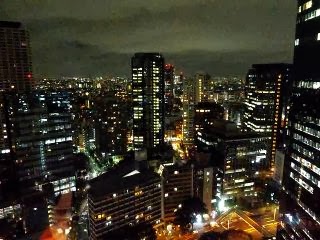
However, the view from our hotel room was almost as spectacular as the Metropolitan Government Office Building.  We cashed in a fistful of loyalty points and booked ourselves into the Hilton Hotel in Shinjuku.  We were given a room on a high floor with a stunning view over central Tokyo.  I was thrilled that my camera successfully captured the cosmopolitan razzle-dazzle in all its glory.

On our final day in Tokyo we spent out time taking a leisurely loop around sights of the inner city, broadly tracing the famous Yamanote train line circuit. Our tour began with a short ride to Shibuya to see the famous statue of Hachiko.  In the 1920s, a teacher who lived near the station kept a small Akita dog. His faithful companion would come to the station every day to await his master's return.

The man died in 1925 but his dog continued to return each day until its own death 11 years later. Today, a statue of Hachiko the dog sits outside the station immortalizing his loyalty.  The locals use it as a meeting place to gather before heading off to shop or share a meal. We used the statue as the perfect opportunity to take our own classic Japanese photo; one with everyone giving the photographer a cheesy peace symbol.

From here we boarded the train again and made our way to Ginza, Japan's homeland of luxury brand shopping. It's also a convenient hop-off point for visiting the Imperial Palace, the home of Japan's Emperor. Everyone flocks to the edge of the palace's inner moat to catch a brief glimpse of the palace and it's famous entrance bridge, Niju-bashi.  The current palace was constructed in 1968 after allied bombing destroyed its predecessor in the final months of World War II.

I then took Mum for a stroll through the heart of Marunouchi, the central city's exclusive business district, that eventually led us to the majestic Edwardian facade of Tokyo Railway Station.  In recent years. the building elegant central dome has been carefully restored to form a light and airy entrance lobby.

Our next stop was Senso-ji, a colouful temple complex in the heart of Tokyo.  Getting to the site can be quite an ordeal.  Visitors must first weave their way through narrow lanes filled with shops and stalls selling all manner of souvenirs, trinkets and craft ware.  The temple itself is protected by a towering red gate known as Kaminari-mon, or Thunder Gate.  To the left of the gate stands a classic five-story pagoda which is usually closed to the public.

Mum and I visited Senso-ji on Saturday afternoon.  This was clearly the temple's busiest period as the streets and temple grounds were simply heaving with people.  The most memorable moment of our visit came as we stood outside the main hall.  We were mesmerized by the constant sound of clattering coins as each visitor stopped to pray and leave an offering. The temple must rake in hundreds of thousands of dollars every month.

We finished our day tour of Tokyo by returning to Shinjuku to wander the massive food hall of Isetan Department Store.  It's considered one of Tokyo's iconic stores, selling luxury goods from across the globe. Incredibly, its roof consists of an expansive grass lawn surrounded by beautifully maintained gardens and mature trees.  It's hard to believe this green oasis exists in the heart of city.


Sunday, September 08, 2013

A sacred mountain stroll

The quiet mountain town of Nikko is a popular day trip from Tokyo. Its a spiritual place filled with sacred temples and shires. Most of its sights are nestled on a heavily wooded hillside rising from the edge of town. It’s also the site of a mausoleum for Tokugawa Ieyasu, the warlord who united Japan under a shogunate regime that lasted until the current imperial order was restored in 1867.

The areas two most famous venues are Tosho-gu shrine and Rinno-ji temple. Visitors coming from town must cross the Diaya River. Today this involves nothing more than a road bridge. However, in ancient times, most visitors had to ford the river. The Shogun however could cross using Shin-kyo an elegant red wooden arch bridge. The bridge still stands.  It was recently restored and is now open to anyone keen to pay an entrance fee.

Unfortunately Rinno-ji temple is currently undergoing restoration. The entire structure is wrapped in scaffolding and enclosed by an enormous temporary shed. This left us with plenty of time to explore the neighbouring Tosho-go shrine. The main entrance to the complex is marked by a five-story pagoda that dates back to 1650.  However, the current structure was built in 1818.

Remarkably the building’s stability is maintained during earthquakes by special dampening structure.  A long timber pillar is suspended internally from its upper floors. The inertia of swaying weight absorbs the worst of a earthquake's movement thus saving the building from collapse.

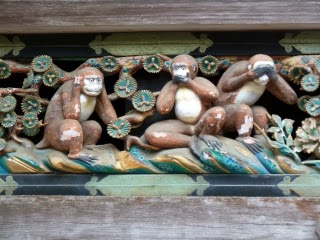
A stairway draws visitors up the hill and through the main gate, which is protected on either side by Deva Kings. I’ve seen a number of these guardians over the years. Nikko’s pair are among the most impressive. Inside the grounds visitors are greeted by a number of famous buildings including the Shinkyusha, or sacred stable. The eaves of the building include a relief carving of the famous “hear no evil, see no evil, speak no evil” trio of monkeys.

Perhaps the shrine’s most famous sights are the Yomei-mon, an intricately decorated gate. Its surface is adorned by elaborate carvings, many of them gilded or covered in red lacquer. The details are extraordinary. The overall design feels surprisingly Chinese, unlike the recently restored, and equally beautiful hall that sits behind it. Restoration work continues on another equally elaborate gate nearby.

The same internal courtyard included Honji-do, a hall with a huge dragon painted on its ceiling. However, the hall’s most astonishing quality is not the artwork, but rather its unusual acoustics. A resident monk happily demonstrates its reverberation by clapping two wooden blocks. The lingering echoes really are breath-taking.

 However, the least satisfying sight was Ieyasu’s tomb. To reach it we climbed what seemed like hundreds of stairs winding their way through the hillside’s towering cedars. The tomb proved to be a rather unimpressive, simple affair. We’d been given a map that had referred to it as the ‘sleeping cat’. However, there was nothing on the site that vaguely resembled anything remotely feline. I later learnt that the sleeping cat was in fact a small statue we’d missed at the base of the first stairway.